Growing Investor Anxiety Signals
US CDS Premium Hits Highest Since 2008
Stock Market Impact Expected After Limit Increase
As U.S. President Joe Biden and the Republican Party continue their standoff over the debt ceiling negotiations, there are growing concerns that the "X-day," the point at which the U.S. Treasury's cash reserves are depleted, is being pushed forward. Originally expected between July and September, the X-day could come as early as early June due to depleted balances and sluggish tax revenues, increasing market anxiety.
On the 23rd (local time), Bloomberg and other outlets analyzed that the X-day, when the U.S. Treasury's available cash runs out, is being brought forward due to lower-than-expected tax inflows in April. According to U.S. investment bank Goldman Sachs, April tax revenues in the U.S. fell by about 29% compared to the same month last year.
Currently, the U.S. Treasury's available cash stands at around $250 billion (approximately 334 trillion KRW). Until last year, the Treasury balance was maintained at $500 billion but dropped to the $80 billion range before the April tax inflows. As the depletion rate of the balance accelerated beyond expectations, the anticipated X-day was moved up from July-September to June. Danske Bank forecasted that considering the debt level, the X-day could come "significantly earlier," around early June.
The shortage of tax revenue is fueling fears about the X-day, increasing panic among market investors. The credit default swap (CDS) premium on U.S. Treasury bonds has surged to an all-time high, reflecting this anxiety. According to Bloomberg data, the 1-year CDS premium on U.S. Treasury bonds rose sharply to 106 basis points (1bp = 0.01%) from 15bp at the beginning of the year. This is the highest level since 2008.
Bloomberg noted that the sharp rise in CDS premiums on government-issued bonds indicates growing market unease, stating, "As debt ceiling negotiations face difficulties and the X-day tightens, concerns over U.S. short-term bonds are also increasing."
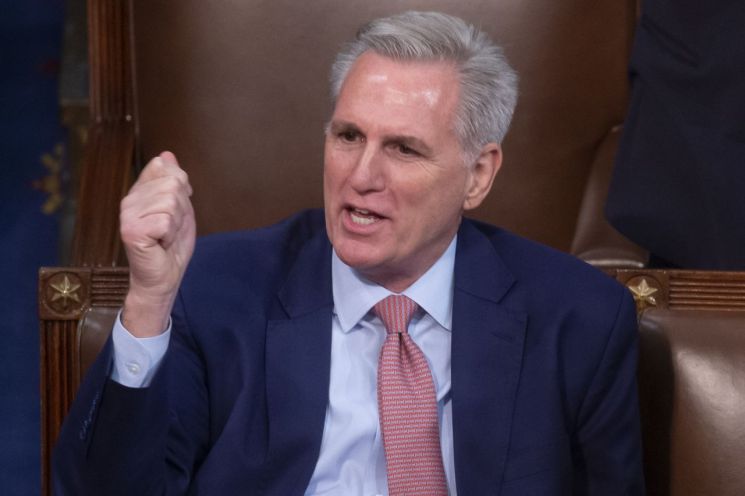
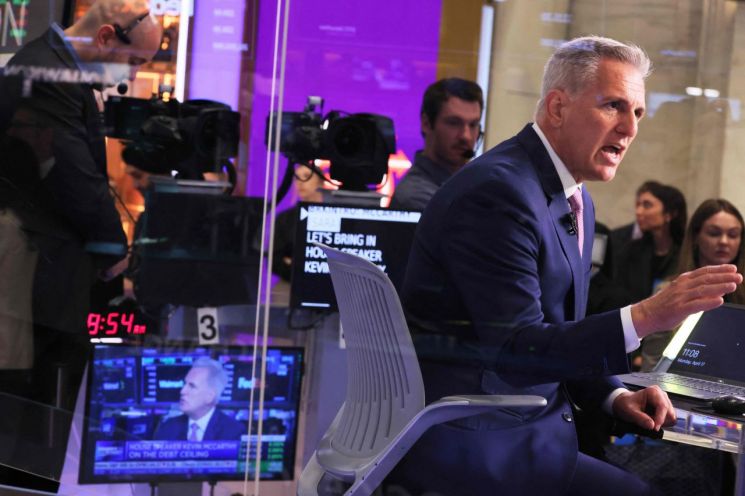
The stock market remains relatively still. Kevin McCarthy, the Republican Speaker of the House who is continuing the standoff with the Biden administration over raising the debt ceiling, visited the New York Stock Exchange (NYSE) on the 17th to publicly reiterate his conditions for raising the debt ceiling, but the market showed little reaction.
Regarding this market response, The New York Times (NYT) interpreted that the default crisis is a familiar negative event that everyone has experienced before, and that partisan battles over taxes and government spending are ultimately expected to be resolved at the last minute.
However, if the debt ceiling is not raised within the Treasury's emergency measures period, there are predictions that the financial market could face repercussions similar to the 2011 U.S. credit rating downgrade incident. In 2011, during the Obama administration, no agreement was reached between parties until the last moment, raising default risks and resulting in a downgrade of the national credit rating.
At that time, the S&P 500, the representative index of the New York stock market, maintained an upward trend until the end of July when the crisis peaked. Bloomberg analyzed that the stock market began to plunge only after the parties reached an agreement to raise the debt ceiling.
The debt ceiling is a limit set by Congress on the amount of money the U.S. government can borrow, currently at $31.381 trillion. The U.S. government previously requested Congress to raise the debt ceiling, but the Republican Party rejected it, linking it to government spending cuts. Ultimately, when the debt ceiling was reached on the 19th, the Treasury implemented special measures such as deferring new contributions to the Civil Service Retirement and Disability Fund (CSRDF).
U.S. Treasury Secretary Janet Yellen stated in January that avoiding default without raising the debt ceiling would only be possible until early June, and some predict that cash reserves could run out in the third to fourth quarter of this year.
Jin Ross, a senior researcher at the U.S. think tank Center for American Progress, warned, "If the debt ceiling is not raised, it will cause catastrophic consequences throughout the U.S. economy," adding, "The unemployment rate will more than double, interest rates will rise, and no American household will be spared from disaster."
© The Asia Business Daily(www.asiae.co.kr). All rights reserved.


















