Keimyung University has decided to focus on nurturing talent to successfully lead the future mobility industry in connection with Daegu City's five major new industries.
On the 21st, Keimyung University signed an MOU for "Local Settlement-Type Talent Development for Daegu Future Mobility Industry" at the Seongseo Campus, together with Daegu City, related organizations, and 70 local companies.
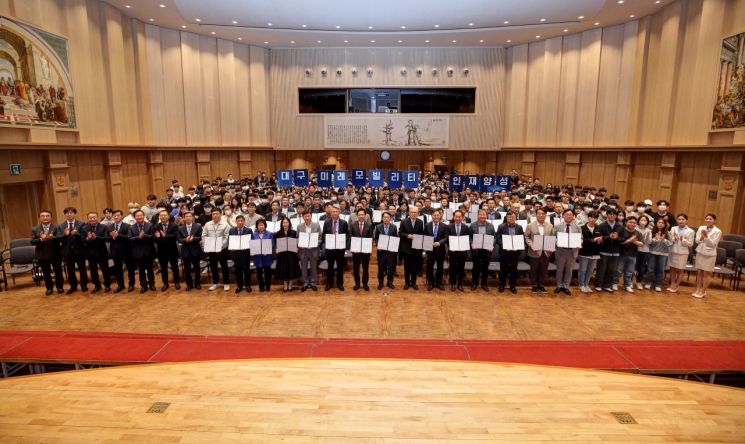 Keimyung University has signed a business agreement with 70 companies in the Daegu area to foster talent for future mobility.
The event was attended by related organization heads and mobility-related business leaders from about 70 companies in the region, including Hong Seok-jun, a member of the People Power Party (Daegu Dalseo), Lee Jae-ha, chairman of the Chamber of Commerce, Kim Ki-hyuk, president of the Transportation Corporation, Do Geon-woo, director of Technopark, Song Gyu-ho, director of the Machinery Parts Research Institute, Oh Se-il, head of the Digital Industry Promotion Agency, Lim Tae-ho, head of the Intelligent Automobile Parts Promotion Agency, Bae Cheol-yong, director of the Daegu-Gyeongbuk Regional Headquarters of the Korea Automotive Technology Institute, as well as SL’s CEO Choi Byung-sik and Kyungchang Industry’s vice chairman Kang Ki-bong, all joining forces to foster Daegu’s future mobility industry.
This agreement was signed to establish a cooperative system among Daegu City, universities, and companies for the sustainable development of the local future mobility industry sector and to integrate regional resources through local settlement-type talent development that grows together with the region.
Recently, the global automobile market has rapidly shifted to the eco-friendly automobile industry due to the Fourth Industrial Revolution and strengthened environmental regulations, with the United States and European countries policy-wise reducing internal combustion engine development.
Along with this, Daegu City is promoting an innovative transition to the future mobility industry by utilizing the infrastructure of local automobile parts companies and related enterprises.
In this environment, Keimyung University has pursued an agreement to establish a sustainable industry-academia-research cooperation talent development system for nurturing innovative talent in the future mobility industry together with local governments and companies. Based on this, it is expected that new job creation in the future mobility industry will encourage local talents to settle and contribute to regional development.
To contribute to the development of the local future mobility industry, Keimyung University will newly open educational programs. With the vision of being the "Cradle of Smart Talent Development for Daegu Future Mobility Industry," the university has set the top priority of education as "regional growth" and nurturing "settlement talent" that grows together with the region through powerful industry-academia-research linked future mobility curricula.
For "regional growth," the university aims to nurture 300 specialized talents by operating IEV-based future mobility courses, electric propulsion system specialization courses, innovation specialization courses, educational environment innovation, and support for digital transformation education in industries. For "settlement talent," the core tasks include operating education programs based on the technology demands of Daegu companies, "Daegu-ro" education to promote employment in local companies, and support for excellent international students to settle in the region, all targeting employment and entrepreneurship in local companies.
Based on this, an education curriculum operation committee composed of participating companies and faculty members from participating departments will be formed, and curricula will be developed and operated based on demand surveys and analysis. Additionally, an open campus will be operated, allowing participation from students and faculty of other universities.
Shin Il-hee, president of Keimyung University, said, "The future mobility industry is not limited to automobiles; it is an expanded concept combining technology and culture where all industries converge. If local governments, organizations, companies, and universities join forces, its development potential is expected to be limitless. Keimyung University will fulfill its role in nurturing talents needed by the region and those who want to work locally, and will devote all its capabilities to becoming a university that grows and develops together with the region."
© The Asia Business Daily(www.asiae.co.kr). All rights reserved.
![Clutching a Stolen Dior Bag, Saying "I Hate Being Poor but Real"... The Grotesque Con of a "Human Knockoff" [Slate]](https://cwcontent.asiae.co.kr/asiaresize/183/2026021902243444107_1771435474.jpg)
















