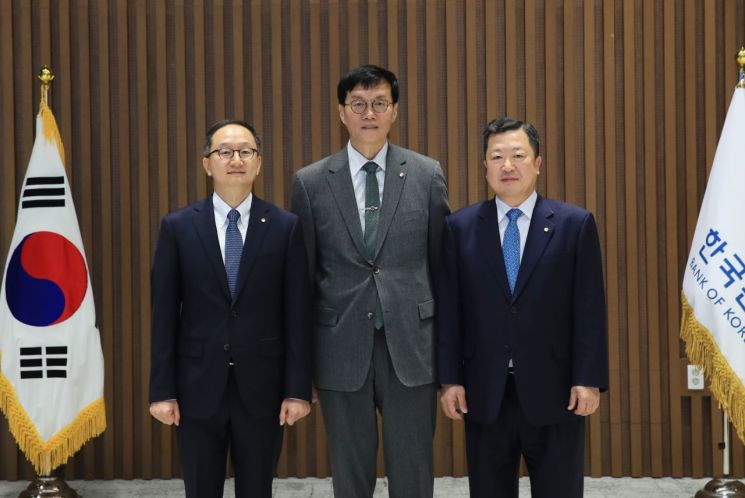
 Lee Chang-yong, Governor of the Bank of Korea (center), is taking a commemorative photo with Jang Yong-seong and Park Chun-seop, newly appointed members of the Monetary Policy Committee, at the inauguration ceremony on the morning of the 21st. (Photo by Bank of Korea)
Park Chun-seop, the newly appointed member of the Monetary Policy Committee, addressed the market's perception that he would exhibit a "dovish" stance (favoring monetary easing) because of his background as a government official, stating, "It does not matter where I come from or who recommended me," and added, "It is a matter of choice depending on the economic and financial conditions."
On the afternoon of the 21st, Park visited the Bank of Korea press room and said, "While it may be said in hindsight that a member was dovish, it is not appropriate to say so in advance."
Park, who took office as a Monetary Policy Committee member that morning, previously served as spokesperson, economic budget reviewer, chief budget reviewer, and director of the Budget Office at the Ministry of Strategy and Finance. His nomination as a committee member was also recommended by the Financial Services Commission, a government agency. Therefore, many in the market analyzed that he would likely show a dovish tendency aligned with government policy.
Park said, "Whether monetary policy or fiscal policy, the ultimate goal is economic stability and growth. I will judge by harmonizing these," adding, "Although my background is in fiscal affairs, going forward, as a Monetary Policy Committee member, I will prioritize monetary policy."
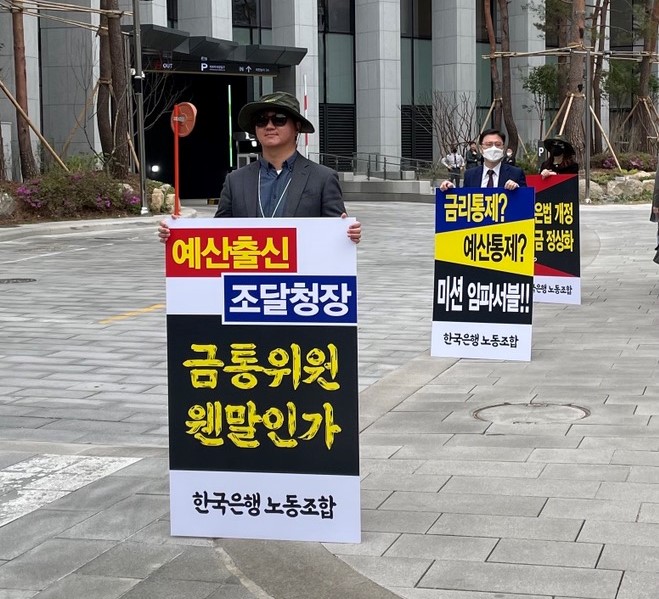 Employees belonging to the Korea Bank Labor Union held a protest with critical placards against newly appointed Monetary Policy Committee member Park Chun-seop in front of the main gate of the Bank of Korea headquarters on Namdaemun-ro, Jung-gu, Seoul, on the morning of the 21st. (Photo by Korea Bank Labor Union)
Regarding the protest by the Bank of Korea labor union on his way to work that morning, holding placards declaring him "unsuitable as a Monetary Policy Committee member" due to issues related to the construction of the Bank of Korea's integrated annex building that occurred when he was head of the Public Procurement Service, Park said, "The past is gone."
He stated, "I also regret and feel heavy-hearted because such incidents happened in the past," and added, "I hope that meeting with the union soon will help resolve the issue." He further said, "Now, I represent the Bank of Korea's position," and asked, "I would appreciate it if you could consider the past as over."
Previously, the Public Procurement Service selected Gyeryong Construction as the successful bidder for the reconstruction of the Bank of Korea annex building on Namdaemun-ro, Jung-gu, Seoul, in December 2017. However, due to allegations of bid-rigging, the construction was delayed for about three years, causing losses to the Bank of Korea. The Bank of Korea is currently pursuing damages litigation, stating that the bidding process by the Public Procurement Service was not transparent at the time.

Monetary Policy Committee member Jang Yong-seong explained the current economic situation to reporters, saying, "Exports are difficult, the financial environment is unfavorable, and although geopolitical risks have improved, they could worsen at any time."
Regarding his paper last year warning of the risk of stagflation?a situation where high inflation coincides with economic stagnation?in South Korea, Jang said, "In the U.S., since the 1990s, there have been stagflation situations with high inflation and poor economic conditions. While South Korea is not at that level, similar signs have appeared, so the paper was written to urge caution."
He added, "If inflation and the economy are in conflict, you might not catch both rabbits but can catch one. However, if the relationship is reversed, you might fail to catch either, so we need to prepare."
Jang said, "Since I came from academia, I am not as familiar with market conditions as other members, so I will learn going forward," and added, "The Governor emphasizes research functions, and I think I can support that area well."
© The Asia Business Daily(www.asiae.co.kr). All rights reserved.
![Clutching a Stolen Dior Bag, Saying "I Hate Being Poor but Real"... The Grotesque Con of a "Human Knockoff" [Slate]](https://cwcontent.asiae.co.kr/asiaresize/183/2026021902243444107_1771435474.jpg)


















