Code of Conduct for Public Officials Does Not Apply to Political Appointees
Fines Possible Based on Police Investigation
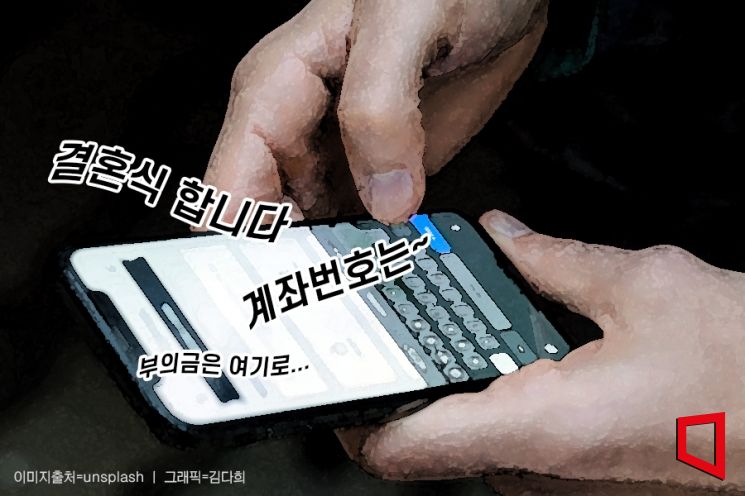
Can a local government head who sends congratulatory or condolence messages containing bank account numbers to many local residents, especially those related to their duties, be disciplined? Although this clearly violates the Code of Conduct for Public Officials, it is expected to be difficult to impose disciplinary action at the government level because the Code of Conduct does not apply to political appointees. However, if found guilty of violating the Improper Solicitation and Graft Act, they may face fines or other penalties.
On the 20th, the Anti-Corruption and Civil Rights Commission announced that Lee Sang-ho, mayor of Taebaek, Gangwon Province, and Kim Seong, county head of Jangheung, Jeollanam-do, violated the Code of Conduct for Public Officials.
On March 19, Kim sent mobile wedding invitations to about 1,000 residents and paper card invitations to about 300 acquaintances ahead of his son's wedding. The paper invitations reportedly included Kim’s bank account number, while the mobile invitations contained the bank account numbers of the groom, bride, and both families’ heads.
Earlier, in December last year, Mayor Lee sent condolence text messages containing his bank account number to many people regarding his mother’s funeral. The messages, delivered via KakaoTalk, were reportedly sent even to citizens who had no personal relationship with the mayor.
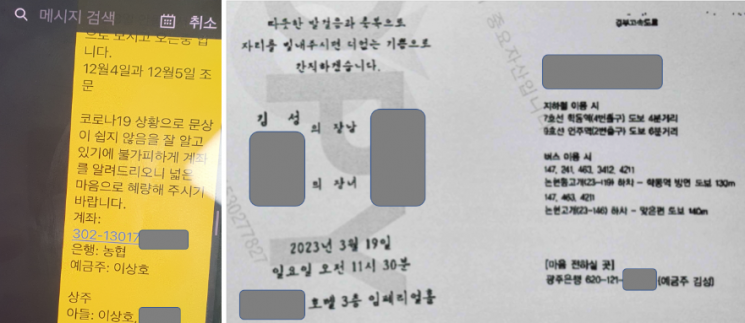 Obituary message for the mother of Lee Sang-ho, Mayor of Taebaek (left), and the wedding invitation of Kim Seong, County Governor of Jangheung's son. [Image provided by the Anti-Corruption and Civil Rights Commission]
Receiving congratulatory or condolence messages with bank account numbers from a local government head who holds significant influence in the community can cause considerable psychological pressure. Notably, among those who received such messages were individuals related to the local government’s duties, such as those receiving subsidies or entering into private contracts. According to the Anti-Corruption and Civil Rights Commission’s investigation, Mayor Lee informed about 200 duty-related persons, and Kim about 100, of the events.
This constitutes a violation of the Code of Conduct for Public Officials. According to Article 17 of the Code, public officials must not notify duty-related persons who are not relatives or members of affiliated religious or social groups about congratulatory or condolence events. Even if notification is allowed, under the Improper Solicitation and Graft Act, congratulatory or condolence money is limited to 50,000 KRW, and including wreaths and floral arrangements, the total must not exceed 100,000 KRW. This is to prevent improper or illicit acceptance of money disguised as congratulatory or condolence gifts from duty-related persons.
However, disciplining these individuals appears difficult because political appointees are not included in the scope of application defined in Article 3 of the Code of Conduct.
Nonetheless, if the police investigation confirms the charges, they may face punishment. The police, having received complaints from civic groups and local residents, have booked Mayor Lee and Kim on charges of violating the Improper Solicitation and Graft Act, and if the allegations are confirmed, fines or other penalties are expected.
According to the Anti-Corruption and Civil Rights Commission, Kim returned about 24 million KRW in congratulatory money received from a total of 175 people, including 105 duty-related persons, but Mayor Lee did not submit financial transaction details to the Commission. The Commission stated, "Considering that investigative authorities are currently investigating the same matter, we will review follow-up measures based on the investigation results."
© The Asia Business Daily(www.asiae.co.kr). All rights reserved.


















