40% Less Plastic Usage Compared to LCD TVs
Extensive Use of Recycled Plastic in Product Body
LG Electronics' efforts to practice ESG management have been recognized overseas as well.
LG Electronics announced on the 20th that all models of the 2023 LG OLED Evo have obtained environmental product certifications for three consecutive years from the UK Carbon Trust and Swiss SGS, both nonprofit certification organizations in Europe.
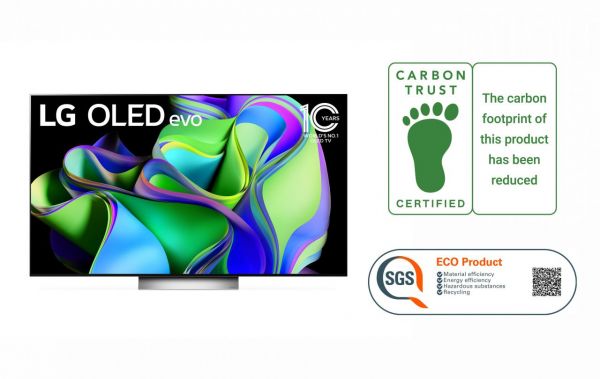 The 2023 LG OLED Evo has consecutively received environmental product certifications from global non-profit certification organizations. The Carbon Trust Carbon Reduction Mark and SGS certification mark obtained by the LG OLED Evo (model name: 65C3).
 [Photo by LG Electronics]
Both organizations dispatched inspection teams to rigorously examine the entire process from product manufacturing, delivery, usage, to disposal.
During the inspection process, LG Electronics' efforts to reduce plastic usage received particularly high praise. The LG OLED Evo applies composite fiber materials and metal instead of plastic, making it lighter while enhancing durability. The amount of plastic used in the LG OLED Evo is only about 40% of that used in an LCD TV of the same size. The plastic reduction effect expected throughout this year is approximately 20,000 tons. In the case of the 65-inch OLED Evo, which uses composite fiber materials lighter than plastic, it is about 20% lighter than an LCD TV of the same size, thereby reducing the amount of carbon dioxide generated during product transportation. Since metal materials have higher durability than plastic, they also reduce resource waste caused by breakage.
Additionally, LG Electronics used recycled plastic containing more than 30% waste plastic in parts such as the bracket covers on the back of all 2023 OLED TVs, QNED TVs, and NanoCell TVs. Through this, an annual recycling effect of 3,200 tons of waste plastic is expected from TV products alone.
Furthermore, LG Electronics uses packaging materials that do not use color ink for all TV products, including OLED TVs. The remote control packaging uses biodegradable bio-materials that decompose when buried in the ground, demonstrating continuous efforts for the environment in various ways.
LG Electronics' OLED TV, first commercialized worldwide in 2013, has a simple display structure with fewer parts compared to LCD TVs that require a backlight component emitting light from behind the screen, resulting in excellent resource efficiency and reduced plastic usage. In particular, the 2023 LG OLED TV improved energy efficiency by about 40% compared to the initial model, considering the environment not only in production but also during usage.
LG Electronics has been included in the Dow Jones Sustainability Index (DJSI) World index, which selects the top 10% of companies in ESG management, for 11 consecutive years, and has received a comprehensive A grade for two consecutive years in the "2022 ESG Evaluation and Rating Announcement" by the Korea Corporate Governance Service (KCGS), recognizing its ESG management achievements both domestically and internationally.
Baek Seonpil, Executive Vice President of LG Electronics HE Product Planning, said, "The LG OLED Evo is a TV that considers not only an overwhelming viewing experience but also its environmental impact," adding, "As a leader in the OLED TV market, we will continue to practice ESG activities."
© The Asia Business Daily(www.asiae.co.kr). All rights reserved.

















