EU Council, Parliament Triple Agreement
Attracting 100 Billion Euro Public and Private Investment
US and China Semiconductor Competition Expected to Intensify
Following the United States and China, the European Union (EU) has agreed on a semiconductor law worth 43 billion euros (approximately 62 trillion won) to foster the semiconductor industry within the region. The EU expects this legislation to increase its semiconductor market share from the current 9% to 20%.
On the 18th (local time), Thierry Breton, the EU Commissioner for Internal Market, announced at a press conference held at the European Parliament in Strasbourg, France, that the trilogue negotiations on the semiconductor law had been finalized. The trilogue is the most crucial procedure where the EU Commission, the Council representing the 27 member states, and the European Parliament come together to finalize the details of new legislation. The semiconductor law will be implemented after going through approval processes and voting in both the European Parliament and the Council.
Through this law, the EU Commission agreed to expand support across the entire semiconductor supply chain, including advanced semiconductor factories, legacy process production sectors, research and development (R&D), and design sectors. Support under the semiconductor law requires a combination of national-level investments and private investments. The funding will be sourced from the EU budget.
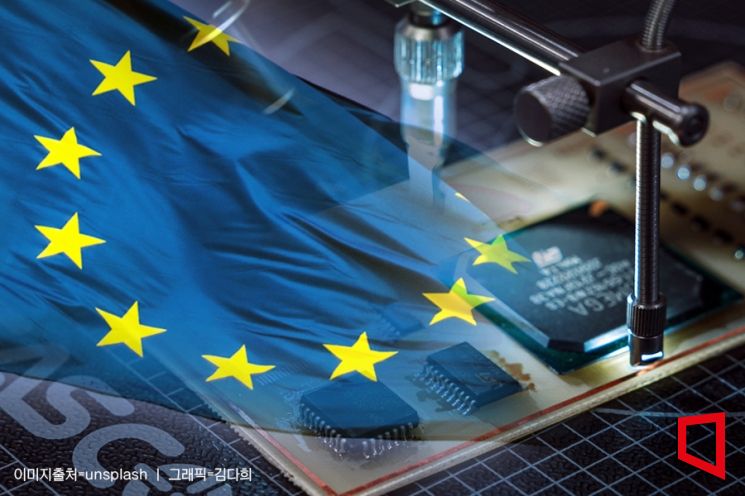
The EU prepared this legislation to reduce its high dependence on semiconductors from the United States and Asia, especially after the global supply chain disruptions caused by COVID-19 impacted automobile production. The EU is home to ASML, the world's leading semiconductor equipment company, based in the Netherlands.
While ASML is considered to hold a monopolistic position in advanced semiconductor production, the actual semiconductor production volume within the EU accounts for only 10% of the global total. An EU official told major foreign media, "Since the semiconductor law plan was announced last year, the EU has already attracted public and private investments worth 100 billion euros (144.519 trillion won)."
With the passage of the EU semiconductor law, competition among countries in the semiconductor sector is expected to intensify further. In the United States, the CHIPS Act was enacted in August last year, providing subsidies of 10 billion dollars or up to 40% tax credits for semiconductor factories established in the U.S. Despite U.S. export control pressures, China is fully supporting its domestic semiconductor companies through the National Integrated Circuit Industry Investment Fund. Chinese foundry company SMIC (Zhongxin Guoji) and system-on-chip designer UNISOC (Ziguang Zhanrui) are examples of companies that have grown with the support of the national fund.
Some observers believe that despite the law's passage, the EU may face limitations in narrowing the gap with competing countries. The funds secured by the EU are considered insufficient to significantly enhance semiconductor competitiveness, and it is argued that simply increasing market share through support policies alone is challenging. Bloomberg reported, "Politicians and experts believe that the 43 billion euros raised by the EU are insufficient to raise the market share to 20%."
Eva Maydell, the lead representative of the European Parliament, also stated, "(The semiconductor law) will help raise the market share to 20%, but we definitely need to consider other factors that make the EU market attractive."
Concerns were also raised about the EU's capacity to secure funds if it decides to use subsidies as a card to secure market competitiveness. Paul Triolo, an analyst at the Center for Strategic and International Studies, a U.S. foreign policy think tank, explained, "Like the U.S., a key point the EU needs to focus on is how much it will cost to relocate the semiconductor supply chain that supports the industry to the EU."
© The Asia Business Daily(www.asiae.co.kr). All rights reserved.
![Clutching a Stolen Dior Bag, Saying "I Hate Being Poor but Real"... The Grotesque Con of a "Human Knockoff" [Slate]](https://cwcontent.asiae.co.kr/asiaresize/183/2026021902243444107_1771435474.jpg)

















