Expansion of Industries Subject to Carbon Emission Trading System
Price Expected to Rise Up to 140,000 KRW per Ton
Companies exporting major product groups such as steel and aluminum to the European Union (EU) will be subject to a 'carbon border tax' starting in 2026. As a preliminary measure for this, a mandatory carbon emissions reporting system will be introduced from this October, which is expected to affect domestic export companies as well.
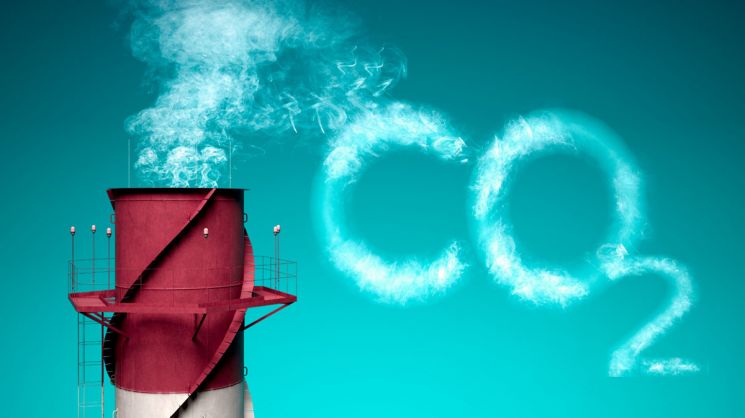
On the 18th (local time), the European Parliament announced in a press release that the Carbon Border Adjustment Mechanism (CBAM) bill was passed with 487 votes in favor, 81 against, and 75 abstentions. This vote was the final parliamentary procedure based on the tripartite agreement reached last December among the EU Commission (EC), the EU Council, and the European Parliament for the introduction of CBAM. Once the Council, representing the 27 EU member states, gives final approval, the implementation will be confirmed.
CBAM is a system that imposes a kind of tax on the estimated carbon emissions generated during the production process of six product categories?steel, aluminum, fertilizers, electricity, cement, and hydrogen?when exported to the EU. The tariff level is set based on the EU Emissions Trading System (ETS), which involves buying and selling emission allowances for amounts exceeding the allocated carbon emissions.
However, the EU has designated the period from October 1, when the bill takes effect, until the end of December 2025 as a transition (preparation) period, during which only the obligation to report carbon emissions will be imposed instead of tariffs. The carbon border tax will be gradually imposed from 2026 to 2034.
On the same day, the parliament also approved an expanded reform plan for the ETS, which was pursued in parallel with CBAM. The core of this expansion plan is to raise the carbon emissions reduction target for industries subject to ETS from 43% to 62% compared to 2005 levels. As the target is raised, the price of emission allowances, currently around 80 to 85 euros per ton, is expected to rise to about 100 euros (approximately 140,000 KRW) per ton. This price is about seven times higher than the domestic price, which is in the 20,000 KRW range per ton.
Additionally, the maritime transport sector will be included in the ETS, and from 2027, ETS II will be established to require the purchase of emission allowances for excess carbon emissions in the building and road transport sectors, effectively strengthening carbon emission regulations across almost all industrial areas.
The EU plans to phase out the free allocation of ETS allowances, which has been exceptionally applied to carbon-intensive EU companies to protect domestic industries, from 2026 to 2034. Regarding this, the EU stated that since carbon taxes on non-EU companies will be fully imposed under CBAM during the same period, this measure aims to eliminate discriminatory factors between domestic and foreign companies.
© The Asia Business Daily(www.asiae.co.kr). All rights reserved.
![Clutching a Stolen Dior Bag, Saying "I Hate Being Poor but Real"... The Grotesque Con of a "Human Knockoff" [Slate]](https://cwcontent.asiae.co.kr/asiaresize/183/2026021902243444107_1771435474.jpg)
















