Fair Trade Commission's Study on Applying the Fair Trade Act to Self-Employed Persons with Worker-Equivalent Status
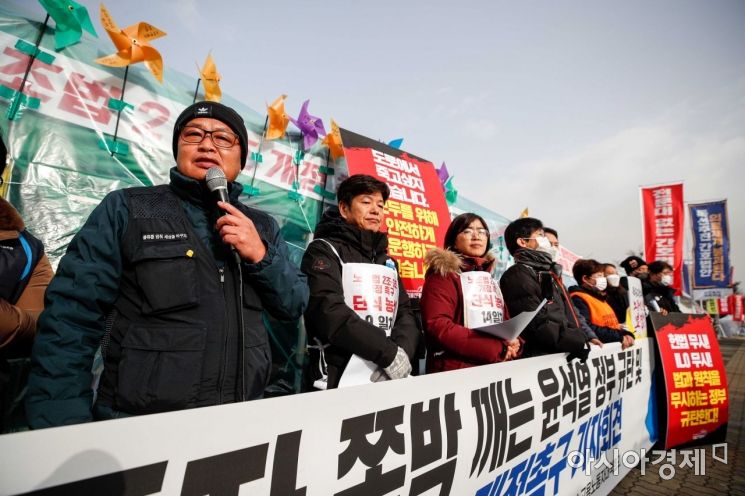 Park Jae-seok, Secretary General of the Cargo Solidarity Union, is speaking at the "Press Conference Urging the Amendment of Articles 2 and 3 of the Trade Union Act" held in front of the National Assembly in Yeouido, Seoul, on the 13th. Photo by Kang Jin-hyung aymsdream@
Following the Cargo Solidarity incident, the Fair Trade Commission (FTC), which has been accelerating sanctions on prohibited acts by business associations, has launched a study to establish standards for applying the Fair Trade Act to workers in special types of employment (special employment workers, or teukso-goyongjik) and others. This move is interpreted as an effort to minimize recurring social controversies surrounding the application of the Fair Trade Act to organizations such as Cargo Solidarity and construction unions.
According to the FTC on the 19th, the Market Surveillance Policy Division of the FTC has commissioned a research project titled "Study on Issues Related to the Fair Trade Act for Workers and Self-Employed Persons in Equivalent Positions to Workers." An FTC official explained, “The FTC has recently taken measures applying the prohibition on business association acts to groups like Cargo Solidarity and construction unions. Recently, Representative Park Yong-jin of the Democratic Party of Korea proposed an amendment to the Fair Trade Act in February to exclude workers under the Labor Union Act from the scope of the Fair Trade Act. In this context, the purpose is to systematically organize the standards and scope of applying the Fair Trade Act to groups like Cargo Solidarity and reflect them as a reference for institutional improvement.”
The current Fair Trade Act only includes a general provision recognizing exemptions for “lawful acts under other laws,” but does not have separate exemption provisions specifically for the labor sector. Therefore, the FTC explains that there is a need to concretize the standards for applying the Fair Trade Act to organizations with characteristics similar to Cargo Solidarity. The FTC has judged that groups like Cargo Solidarity can be regarded as “business associations” and that the Fair Trade Act can be applied to them, but through this study, it aims to establish detailed standards for the application of the Fair Trade Act.
To this end, the FTC will refer to how competition laws are applied to self-employed persons in positions equivalent to workers in major countries such as the United States and Europe. In the U.S., the Clayton Act prohibits applying competition law to labor unions, but the Norris-LaGuardia Act also stipulates cases where it is difficult to exempt unions from competition law. For example, even pure labor organizations without business characteristics can be subject to competition law for anti-competitive acts that are not means of negotiating for wage or working condition improvements. The European Union (EU) also established standards for applying competition law to such organizations in its “Guidelines on the Application of Competition Law to Working Conditions of Self-Employed Persons” issued in September last year. The guidelines specify applicable standards depending on the type of conduct.
An FTC official said, “Although overseas cases differ, none uniformly exclude the application of competition law simply because the entity corresponds to a worker under labor union law. We will refer to specific details on when competition law can be applied or exempted for certain types of conduct.” However, the official clarified that setting criteria for determining the business or labor nature of specific organizations is unrelated to this study. He added, “The criteria for judging whether certain organizations are workers or not fall under the jurisdiction of the Ministry of Employment and Labor.”
© The Asia Business Daily(www.asiae.co.kr). All rights reserved.

















