US Average Deposit Interest Rate Exceeds 10 Times
Expanding Territory Through Finance
'Bankdemic' Financial Sector Undergoing Major Changes
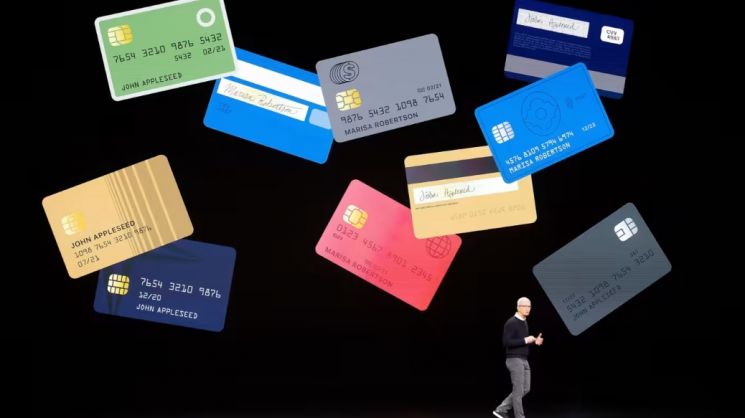
Apple has launched a savings deposit product offering a high annual interest rate of 4.15%. Leveraging its extensive user base and strong brand power, Apple is gradually expanding its ecosystem across the financial sector by introducing deposits alongside Apple Pay and Apple Card. Attention is focused on whether Apple can cause a seismic shift in the financial industry, using the recent Bankdemic (bank + pandemic) crisis as a stepping stone.
IT Giant Aiming for Apple Bank... Launches 4.15% Annual Interest Deposit
On the 17th (local time), Apple announced the launch of the Apple Card Savings Account, offering a 4.15% annual return, in partnership with Goldman Sachs. This comes six months after Apple announced plans to introduce a savings account last October.
Apple Card users in the U.S. can open this account through the iPhone Wallet application. There are no fees or minimum deposit requirements, and deposits are insured up to $250,000. After opening the account, users can receive up to 3% cashback (Daily Cash) on payments made with the Apple Card.
The 4.15% interest rate promised by Apple is quite high even in the U.S. According to the Federal Deposit Insurance Corporation (FDIC), the average deposit interest rate, including demand deposits, is 0.37%. Apple’s savings deposit interest rate is more than ten times higher. Compared to other banks’ savings deposit rates, Apple offers higher interest. It surpasses the deposit rates of Ally Bank, the largest internet-only bank in the U.S. (3.75%), and Goldman Sachs’ Marcus account (3.9%).
Jennifer Bailey, Vice President of Apple Pay and Wallet, stated, "Users can manage and save the Daily Cash earned from card usage all in one place," adding, "The savings account will enhance the value of the Apple Card’s maximum benefit of cashback service and provide users with an easy way to save daily."
Apple Expands Territory into Finance... Service Revenue Increases
This account launch is significant in terms of expanding Apple’s financial ecosystem. Since launching the digital wallet Wallet in 2012, Apple has continuously expanded its financial services. In addition to Apple Pay, it offers Apple Cash (peer-to-peer payment service) and Apple Card (credit card). After distributing hardware such as iPhone, iPad, and MacBook, Apple has dominated the mobile ecosystem with software called the App Store and is now extending into financial services.
Last month, Apple also introduced "Apple Pay Later" in the U.S., a short-term loan-type installment financing service. It allows users to pay up to $1,000 upfront and repay the purchase amount in four installments over up to six weeks. This service is based on a system that evaluates users’ creditworthiness internally and is expected to officially launch after a pilot operation within a few months. With the recent launch of the savings account, Apple is now considered to have become an "Apple Bank" offering both deposit and loan services.
Apple’s expansion into financial services is analyzed as a measure to strengthen the "lock-in effect," keeping users continuously tied to the Apple ecosystem. Strengthening the lock-in effect is likely to drive growth in Apple’s software division. The proportion of financial services in Apple’s total revenue has expanded from less than 10% in 2015 to over 20% currently. Supported by growth in the financial sector, Apple’s service revenue increased by 14% year-over-year to $78 billion from October 2021 to September 2022. The Wall Street Journal (WSJ) analyzed, "Apple has turned the iPhone into a digital wallet," adding, "These efforts help keep consumers connected to the software ecosystem behind the device."
Will 'Bankdemic' Cause a Seismic Shift in the Financial Sector?
Apple’s high-interest savings account was launched while the financial sector has not fully recovered from the turmoil of the Bankdemic, and it is expected to have a significant impact on the industry. Following the collapse of Silicon Valley Bank (SVB) last month, trust in banks has eroded, prompting investors to quickly exit banks and move toward stable money market funds (MMFs).
In particular, Apple’s move to offer high interest rates to expand its user base is seen as a strategic play to cause a seismic shift in the financial market. Ming Ma, a finance professor at Columbia University, said, "The most special thing is that Apple is the entity," adding, "Everyone knows Apple, and many people are already using Apple Card." He further noted, "The attractive interest rates combined with Apple’s brand recognition could be especially appealing to customers who have concerns about the stability of the banking industry."
However, it is not yet decided whether Apple’s newly introduced savings deposit service will be launched domestically in Korea. Since Apple Pay, introduced in 2014, only landed in Korea last month after nine years, it is expected that even if the service is launched domestically in the future, it will take a long time.
© The Asia Business Daily(www.asiae.co.kr). All rights reserved.
![Clutching a Stolen Dior Bag, Saying "I Hate Being Poor but Real"... The Grotesque Con of a "Human Knockoff" [Slate]](https://cwcontent.asiae.co.kr/asiaresize/183/2026021902243444107_1771435474.jpg)
















