Semiconductor Exports Fell 33.8% in March
Export Decline Continues Since August Last Year
South Korea's Semiconductor Industry Structure Increases Export Risks
"Overcoming Vulnerable Areas Including Systems Is Essential"
As the semiconductor sector, which had been driving exports, stumbles, domestic export figures are sharply declining. While the worst-ever downturn in the semiconductor market is the main cause, there is also an assessment that this reveals a weak link in the domestic semiconductor industry. Experts advise that not only semiconductor manufacturing but also the materials and equipment industries need to be developed. Strengthening competitiveness in system semiconductors, including foundry (semiconductor contract manufacturing), is also essential.
According to Korea Customs Service statistics on the 18th, semiconductor exports in March amounted to $8.8 billion, down 33.8% from the same month last year. Although the rate of decline has narrowed compared to January (-43.4%) and February (-41.5%) this year, it is still on a downward trend. Negative growth has continued since August last year (-7.0%). The share of semiconductors in total exports shrank from 18.9% last year to 13.6% in the first quarter. This is the first time since 2016 that the semiconductor export share has fallen below 15%.
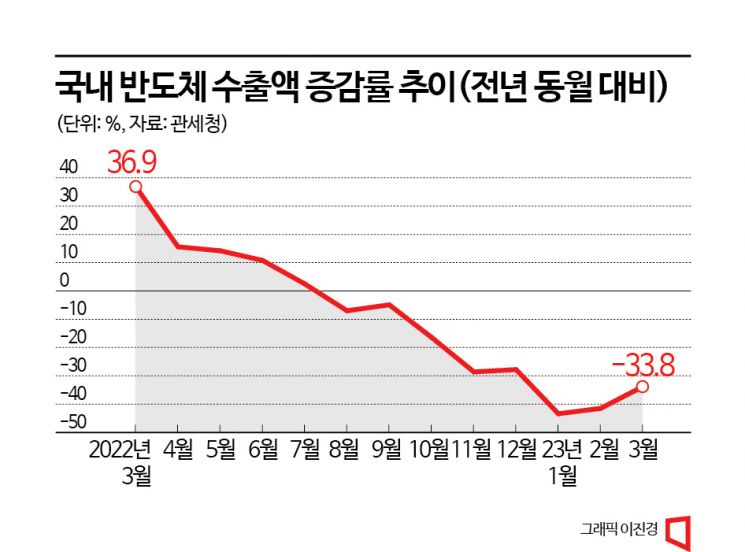
With semiconductor exports plunging, domestic exports are also struggling. In March, domestic exports fell 13.6% year-on-year to $55.1 billion, while imports decreased by 6.4% to $59.7 billion. This marks 13 consecutive months of trade deficits (exports minus imports). The Korea International Trade Association previously revealed that when examining the contribution rates to export declines by item for January and February, the semiconductor sector accounted for the highest proportion at 70.3%.
Inside and outside the semiconductor industry, it is believed that the downturn that began in earnest last year has led to these results. Not only memory semiconductors, which are highly sensitive to economic conditions, but also system semiconductors, which had relatively smaller fluctuations, have seen export declines, revealing the worst market conditions ever. In fact, memory exports have been in negative growth since July last year, and system semiconductor exports since January. In particular, falling prices of memory products such as DRAM and NAND are dragging down export values.
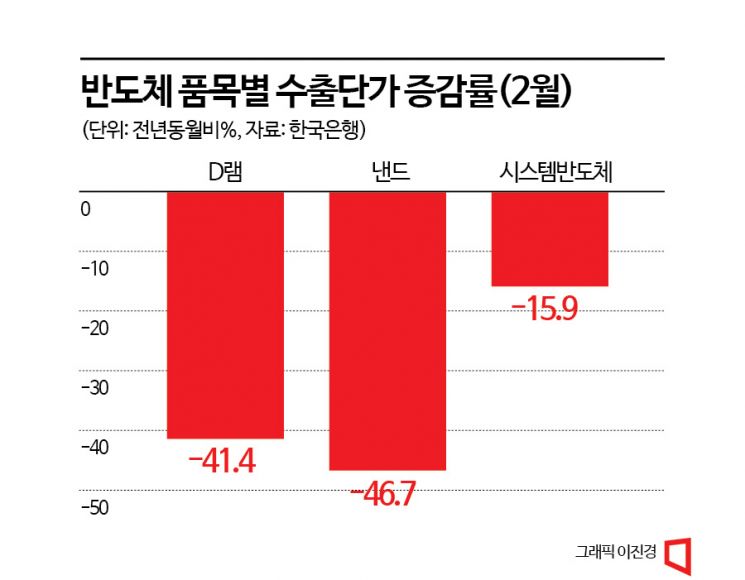
There is also analysis that the structure of the domestic semiconductor industry has increased export vulnerability. Experts explain that due to the high dependence on specific sectors in the domestic industry, exports inevitably fluctuate significantly depending on economic conditions. Rather than just hoping for a market recovery, improving the limitations confined to semiconductor manufacturing, especially memory, is key to enhancing Korea's semiconductor competitiveness and stabilizing exports.
Professor Eom Jae-cheol of the Semiconductor Electronics Department at Youngjin College said, "We have focused on exports in semiconductor devices and memory manufacturing," adding, "If we had strengthened the equipment, materials industries, and system semiconductors in advance, the impact would have been relatively less severe." He continued, "Although these industries are also inevitably affected by the poor market conditions, having a foothold in various sectors would have allowed for less sensitivity to economic fluctuations."
Lee Chang-han, Vice Chairman of the Korea Semiconductor Industry Association, also said, "Ultimately, we have no choice but to focus on system semiconductors and foundry," adding, "Although the foundry market is also weak, it is fundamentally more resilient to economic cycles than memory demand." He further noted, "Overcoming the limitations of the domestic industry is not something that can be achieved in the short term, so we must steadily work on it over the long term." This implies that there are no shortcuts to accomplishing these tasks.
© The Asia Business Daily(www.asiae.co.kr). All rights reserved.
![Clutching a Stolen Dior Bag, Saying "I Hate Being Poor but Real"... The Grotesque Con of a "Human Knockoff" [Slate]](https://cwcontent.asiae.co.kr/asiaresize/183/2026021902243444107_1771435474.jpg)

















