Ryu Seong-geol, People Power Party Lawmaker's Office Hosts 'Nuclear Armament' Debate
Jung Seong-jang "North Korea Denuclearization Possibility Slim... Response Measures Needed"
Seo Gyun-ryeol "Sufficient Technology... Time to Develop Potential Like Japan"
As North Korea continues to unveil new strategic weapons, escalating nuclear and missile threats, a National Assembly forum was held to discuss South Korea's independent 'nuclear armament' necessity. Experts expressed views that South Korea should develop a 'self-owned nuclear possession scenario' to bring North Korea into nuclear disarmament negotiations and, based on South Korea's outstanding technological capabilities, establish a 'nuclear development potential' similar to Japan's near-nuclear weapon status.
Jung Sung-jang, head of the Unification Strategy Research Office at the Sejong Institute, presented on the topic "Is South Korea's independent nuclear possession necessary?" at a National Assembly forum hosted by Rep. Ryu Seong-gil of the People Power Party on the 17th. Rep. Tae Young-ho also attended the forum, and the chair was Professor Lee Chang-wi of Seoul National University of Science and Technology's Law School. The discussion following the presentation included Professor Seo Kyun-ryeol of Seoul National University’s Department of Nuclear Engineering, Director Joo Eun-sik of the Korea Institute for Strategic Studies, Chairman Choi Ji-young of the Northeast Asia Diplomacy and Security Forum, and Research Fellow Lee Sang-gyu of the Korea Defense Research Institute’s North Korean Military Research Office.
Escalating North Korean Nuclear Threat... "Respond with Independent Nuclear Armament"
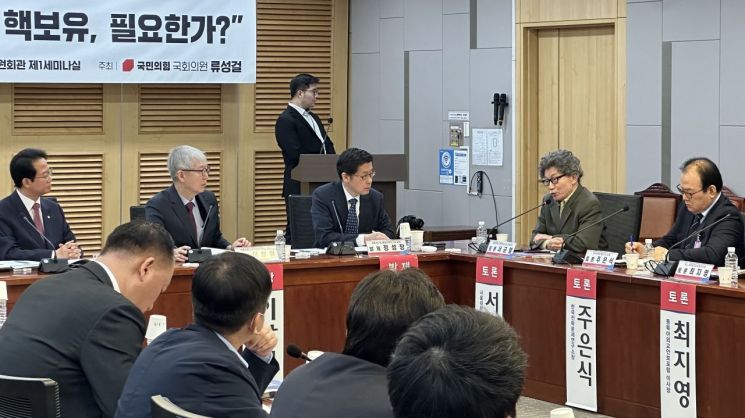 On the 17th, at a National Assembly forum hosted by Ryu Seong-geol of the People Power Party, experts continued discussions on the topic "Is South Korea's Own Nuclear Armament Necessary?" Photo by Jang Hee-jun
In his presentation, Jung Sung-jang stated, "There are many prejudices and concerns in our society regarding nuclear self-reliance," and diagnosed that "the mainstream position leading South Korea's nuclear self-reliance now differs from the past in that it adopts a phased, gradual, and long-term approach."
He presented two main grounds for the necessity of 'independent nuclear possession': complacency about the belief that North Korea will not use nuclear weapons and the outlook that North Korea's denuclearization is practically impossible. In particular, Jung analyzed, "The possibility of North Korea's denuclearization has become even more remote given that Ukraine, once the world's third-largest nuclear weapons possessor, was invaded by Russia after abandoning its nuclear arsenal."
Jung argued that independent nuclear armament is necessary to dispel doubts about the effectiveness of U.S. extended deterrence if North Korea actually carries out a nuclear attack. He predicted, "Based on North Korea's nuclear material stockpile, it is expected to possess more than 100 nuclear weapons within 10 years, possibly up to 200." Indeed, Chairman Kim Jong-un recently ordered an 'exponential' increase in nuclear weapons.
'Four-Stage Nuclear Possession Scenario' Aimed at North Korean Denuclearization
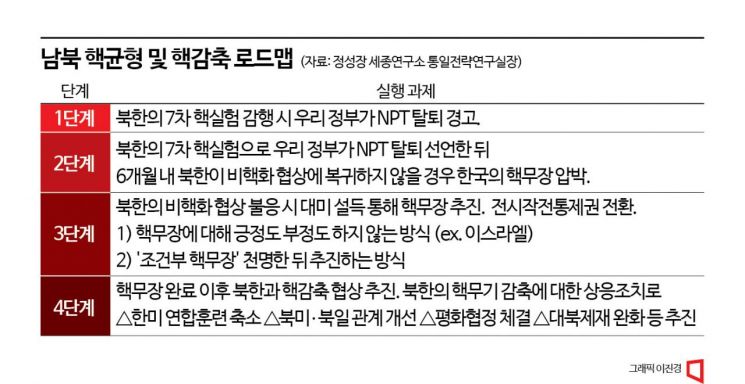
Jung proposed a 'four-stage approach' as a mid-to-long-term plan for nuclear balance and reduction between South and North Korea. This is a self-owned nuclear possession scenario aimed at bringing North Korea into nuclear disarmament negotiations.
The first stage is for South Korea to warn of withdrawal from the Nuclear Non-Proliferation Treaty (NPT) if North Korea conducts a seventh nuclear test. In the second stage, South Korea would actually withdraw from the NPT (or suspend its implementation) to pressure North Korea to return to negotiations. Although the possibility of the U.S. accepting South Korea's NPT withdrawal is low, using the suspension card could avoid direct sanctions from the international community.
The third stage involves pursuing direct nuclear armament through persuasion of the U.S. Specifically, this could be done by quietly pursuing nuclear armament internally without an official stance, like Israel, or by declaring 'conditional nuclear armament' and then proceeding. The final fourth stage involves mutual nuclear reduction negotiations with North Korea, offering measures such as ▲ reduction of South Korea-U.S. joint military exercises ▲ easing of sanctions on North Korea in exchange for North Korea's nuclear weapons reduction.
The biggest obstacle if our government pursues nuclear armament is the United States, which is both a key party to the North Korean nuclear issue and a strong proponent of maintaining the NPT regime. However, Jung emphasized repeatedly that, recalling that South Korea's independent nuclear armament was discussed during the Trump administration, the U.S. can change its policy stance depending on the administration's orientation.
He also predicted that if sanctions against South Korea's nuclear armament are pushed, the U.S. would protect South Korea, just as China and Russia have frequently used their veto power at the UN Security Council to support North Korea. In fact, U.S. experts on the Korean Peninsula who have opposed South Korea's nuclear armament have expressed similar views. Robert Einhorn, former Special Advisor for Nonproliferation and Arms Control at the U.S. State Department, mentioned at the Korea-U.S. Nuclear Strategy Forum last December that "if the U.S. wants, it could block Security Council sanctions against South Korea's nuclear possession." Bruce Klingner, senior researcher at the Heritage Foundation, also predicted in a February interview that "if China pushes for sanctions against South Korea at the UN Security Council, the U.S. will exercise its veto."
"Sufficient Nuclear Technology... Should Prepare as a Nuclear Latent State Like Japan"
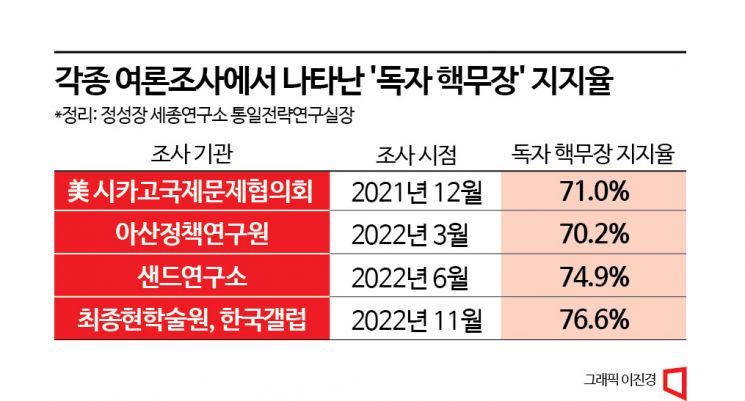
During the discussion, there was also an analysis that South Korea already possesses the technology and potential to have nuclear weapons. Even if immediate nuclear armament is difficult, it was suggested that South Korea should have 'nuclear development potential' like Japan to respond to North Korean nuclear threats.
Professor Seo Kyun-ryeol of Seoul National University’s Department of Nuclear Engineering, former vice president of the Korean Nuclear Society, stated in the discussion, "Our country already possesses a considerable level of technology for nuclear development, including high explosives, detonators, and guidance devices," and argued, "In the case of plutonium bombs, virtual experiments using supercomputers and artificial intelligence (AI) can replace nuclear tests, and uranium bombs do not require nuclear testing at all."
He estimated that with South Korea's laser enrichment technology, one nuclear weapon could be manufactured within three months. It is estimated that the 20,000 tons of domestic spent nuclear fuel as of this year contains more than 100 tons of plutonium, and even after purification processes, enough material could be secured to produce between 8,000 and 16,000 nuclear weapons. In terms of quantity, this surpasses the levels of the U.S. and Russia.
Professor Seo pointed out that domestic public opinion supporting independent nuclear armament has significantly increased, stating, "Given that North Korea has effectively become a nuclear-armed state, the argument that South Korea, Japan, and Taiwan should not arm themselves with nuclear weapons is illogical." He emphasized, "Japan has already extracted 50 tons of plutonium capable of producing 6,000 nuclear warheads, the largest amount among non-nuclear states, and if a nuclear arms race breaks out in Northeast Asia, Japan could skip the plutonium extraction and uranium enrichment processes."
Professor Seo's suggestion is that although it may be difficult to develop nuclear weapons immediately, South Korea should establish 'nuclear development potential' like Japan and pursue nuclear possession according to changing circumstances. In fact, during the 1994 Yongbyon nuclear crisis, Japan's Chief Cabinet Secretary Hiroshi Kumagai publicly stated, "Technically, nuclear weapons development is possible within three months." In South Korea's case, this implies that nuclear possession would be actively pursued if North Korea carries out an actual nuclear attack or if a U.S. administration favorable to South Korea's independent nuclear armament comes to power.
© The Asia Business Daily(www.asiae.co.kr). All rights reserved.



















