Kishida Shot During Election Campaign
Safety Issues Raised Ahead of G7
A terrorist incident targeting the incumbent Prime Minister occurred in Japan, shaking the country's reputation as a safe nation. Although security measures for VIP protection were further strengthened following the shooting attack on former Prime Minister Shinzo Abe, a similar incident occurred just nine months later, revealing vulnerabilities. Especially with the upcoming Group of Seven (G7) summit scheduled next month in Fukushima, Japan, concerns about the safety of world leaders are growing.
Prime Minister Kishida was attacked on the 15th while giving a support speech for a by-election at Saikazaki Fishing Port in Wakayama City, Wakayama Prefecture. At that time, a silver explosive device flew about 1 meter in front of Prime Minister Kishida just before his speech, and the explosive he threw detonated approximately 50 seconds after he dodged it.
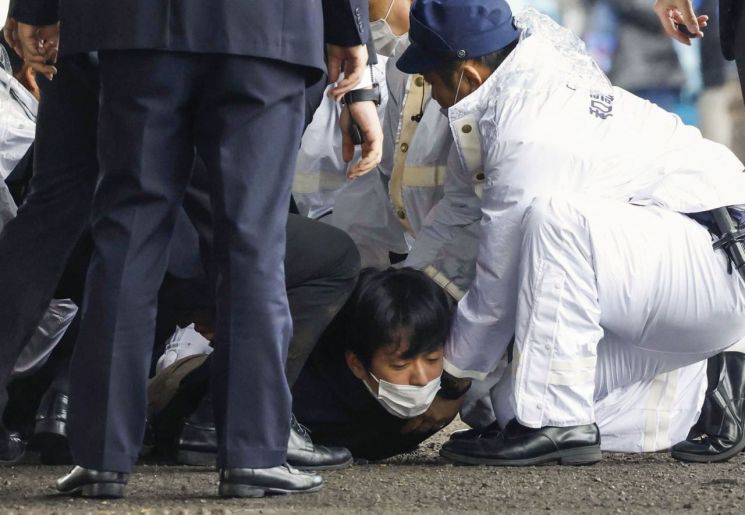 At around 11:30 a.m. on the 15th, a man who threw an object that caused an explosion sound just before Japanese Prime Minister Fumio Kishida began his speech after completing an on-site inspection in Wakayama Prefecture, Japan, is being arrested. Photo by Yonhap News Agency
The suspect is 24-year-old male Kimura Ryuji. He lives with his parents in a residential area in Kawanishi City, Hyogo Prefecture, and is reportedly unemployed. Kawanishi City is about 100 km away from Saikazaki Fishing Port, where the incident occurred.
He did not respond to questions during police interrogation regarding whether he admitted to the charges. However, Kimura is said to have had a strong interest in politics. The Yomiuri Shimbun reported, citing a Liberal Democratic Party (LDP) official in Kawanishi City, that the suspect showed political interest by attending an LDP-affiliated municipal report meeting held in Kawanishi City on September 24 last year.
This is the first political terror attack targeting a prime minister in Japan in nine months. Previously, in July last year, former Prime Minister Shinzo Abe was shot and killed on the street during a campaign. The shooter, Yamagami Tetsuya (42), was motivated by resentment after his mother, a member of the Unification Church, poured the family fortune into donations to the religious group, leading to financial hardship.
The reason former Prime Minister Abe was targeted was due to animosity toward his maternal grandfather, former Prime Minister Kishi Nobusuke. Since Kishi was believed to have ties with the Unification Church and Abe was also considered connected, Abe became the target of the attack.
With two political terror attacks targeting prime ministers occurring within less than a year, the safety issues surrounding the G7 summit have come under scrutiny. The G7 is a consultative group consisting of the United States, the United Kingdom, France, Germany, Italy, Canada, Japan, and the European Union (EU). This year, the summit will be held from May 19 to 21 in Fukushima, Japan, the host country.
Notably, President Yoon Suk-yeol will also attend the summit as an observer leader. Following the Korea-Japan summit last month, Prime Minister Kishida invited President Yoon to the event.
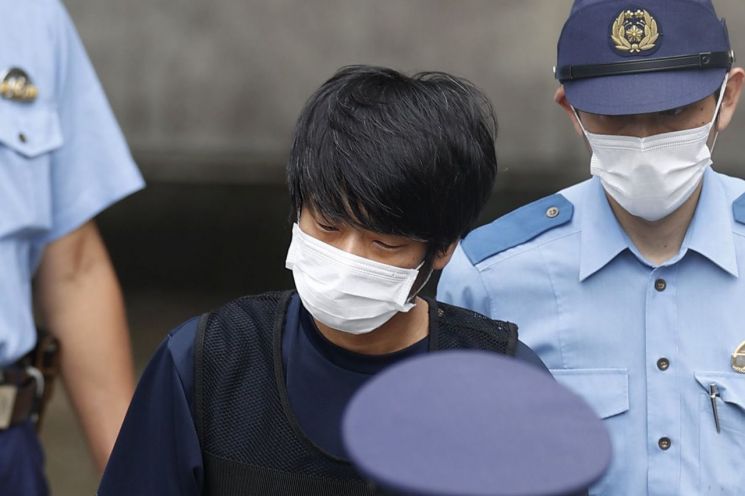 Tetsuya Yamagami (41), who shot and killed former Japanese Prime Minister Shinzo Abe during a campaign speech, is being transferred from the Nara Prefectural Western Police Station to the prosecution in July last year. He stated that he committed the crime because he believed that former Prime Minister Abe was connected to a certain religious group he resented. Photo by Yonhap News
Professor Lee Young-chae of Keisen Jogakuen University said on the CBS radio program "Kim Hyun-jung's News Show" on the 17th, "After the failure of security for former Prime Minister Abe, there were many issues with VIP protection in Japan. The Tokyo Metropolitan Police Department changed all manuals, reviewed the procedures, arranged VIP placements, and conducted training, but a major gap has been revealed again." He added, "There are concerns about whether the upcoming G7 Hiroshima summit in May can be held safely, whether foreign leaders' security can be properly ensured, and whether Japan's security system for open spaces is fundamentally flawed."
Not only Japan but also international media are criticizing the VIP protection measures. The Yomiuri Shimbun pointed out, "The fact that there are still gaps in VIP protection has been highlighted," and noted, "With the G7 summit, where many dignitaries will gather, approaching, reviewing the security system has become an urgent task." Bloomberg News also remarked, "This incident raises questions about the security arrangements for the G7 summit."
© The Asia Business Daily(www.asiae.co.kr). All rights reserved.


















