KAIST Develops Highly Sensitive Wearable Blood Pressure Sensor
Meets Medical Device Certification Standards
Domestic researchers have newly developed a high-precision blood pressure measurement sensor for wearable devices at the level of medical device certification, drawing attention to its potential impact on the smartwatch market. Existing wearable devices such as Samsung Electronics' Galaxy Watch and Apple Watch also have blood pressure measurement functions. However, their accuracy is not high enough to receive medical device certification. If this sensor is adopted in the Galaxy Watch, it is expected to provide an opportunity to catch up with the Apple Watch, which lags behind in global market share.
The Korea Advanced Institute of Science and Technology (KAIST) announced on the 17th that a research team led by Professor Geonjae Lee of the Department of Materials Science and Engineering, in collaboration with the Korea Research Institute of Standards and Science and the Catholic University Medical School, has developed a wearable flexible piezoelectric sensor for precise blood pressure measurement.
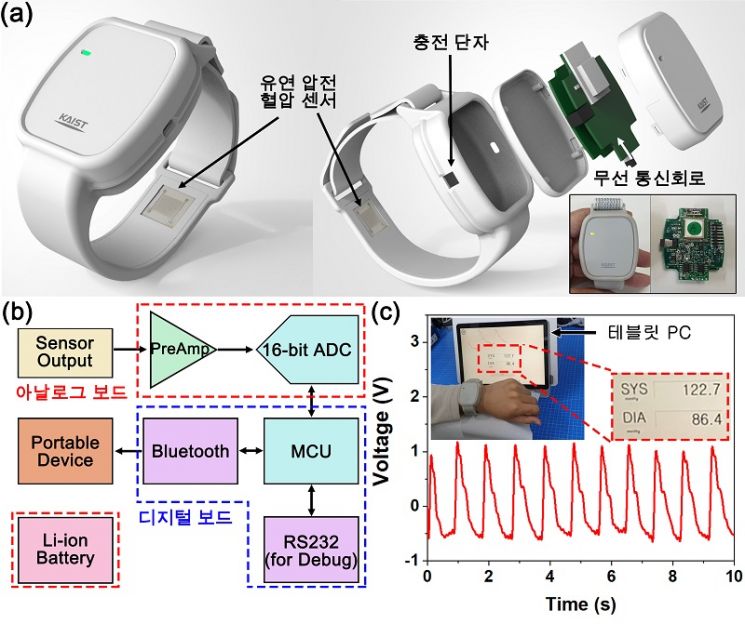 Flexible piezoelectric blood pressure sensor embedded in a wearable watch. Image source: Provided by KAIST
Blood pressure is a key indicator for assessing overall health and the potential risk of stroke and heart attack. Wearable medical products that can conveniently and continuously monitor blood pressure are receiving significant attention. Recently, wearable blood pressure measurement products using LEDs have been released, but due to the limitations of optical sensor accuracy, it is difficult to meet the standards required for medical device certification.
The research team fabricated the blood pressure sensor by transferring an ultra-high-sensitivity inorganic piezoelectric thin film, with a thickness of several micrometers (one hundredth the thickness of a human hair), from a rigid substrate after high-temperature heat treatment onto a flexible substrate. They succeeded in accurately measuring blood pressure by closely adhering the sensor to the skin and detecting the subtle pulse waveform of blood vessels.
In clinical trials conducted at the Catholic Hospital, the sensor met the high standards of the international certification criteria for automatic electronic sphygmomanometers, with an error of ±5 mmHg or less and a standard deviation of 8 mmHg or less for both systolic and diastolic blood pressure. Additionally, by integrating the blood pressure sensor into a wearable watch, continuous blood pressure monitoring became possible.
Professor Geonjae Lee stated, “The sensor developed this time not only has excellent reliability and durability but also can measure accurate and continuous blood pressure, so it is expected to play a key role in the healthcare market for hypertension patients,” adding, “We plan to accelerate technology commercialization through startups after further developing a patch-type blood pressure sensor for sleep monitoring.”
The research results were published on the 24th of last month in the online issue of the international academic journal Advanced Materials and were also selected as a cover paper.
© The Asia Business Daily(www.asiae.co.kr). All rights reserved.
![Clutching a Stolen Dior Bag, Saying "I Hate Being Poor but Real"... The Grotesque Con of a "Human Knockoff" [Slate]](https://cwcontent.asiae.co.kr/asiaresize/183/2026021902243444107_1771435474.jpg)
















