Advanced Measures for National Contract System
Economic Regulation Innovation TF Announcement This Month
Relaxation of Adjustment Requirements for Construction Material Contract Deposits
The government will raise the minimum bid rate for safety equipment in high-risk occupations such as firefighting, military, and police from the current 60% to 80%. Additionally, it will ease the requirements for adjusting contract amounts for construction materials during price increases to reduce excessive management burdens on construction companies. The government plans to announce related revisions to the national contract system through the Economic Regulation Innovation Task Force (TF) later this month.
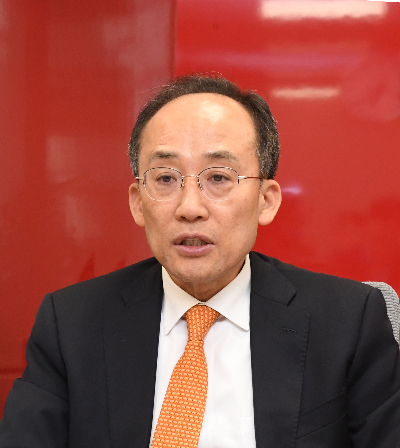
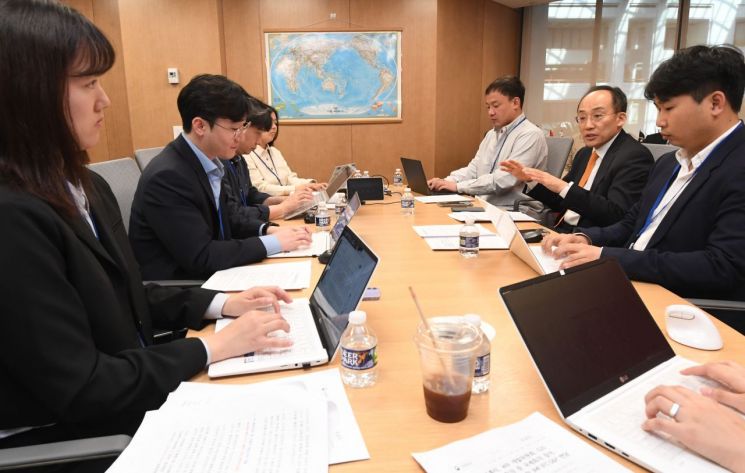
On the 13th (local time), Deputy Prime Minister and Minister of Economy and Finance Choo Kyung-ho, after attending the G20 Finance Ministers meeting in Washington D.C., tentatively disclosed the 'National Contract System Advancement Plan' aimed at easing corporate burdens during a joint press briefing held at the International Monetary Fund (IMF) headquarters.
Deputy Prime Minister Choo stated, "The public procurement system is an important economic policy tool alongside budget, taxation, and finance. It is necessary to support economic revitalization by improving regulations and unreasonable market practices that companies experience during the procurement process." The public procurement market size expanded by about 34% over the past four years, from 137 trillion won in 2017 to 184 trillion won in 2021. However, the national contract system's stringent requirements and numerous related regulations have been pointed out as obstacles to corporate economic activities.
Specifically, the government plans to first raise the minimum bid rate for safety equipment in high-risk occupations such as firefighting, military, and police from the current 60% to 80%. The minimum bid rate refers to the ratio that allows contracts to be awarded in order of the lowest bids below the estimated price during competitive bidding. High-risk occupations require securing high-quality safety equipment, but concerns about low-quality and low-price bids have consistently been raised due to the same minimum bid rate applied as for general goods. Deputy Prime Minister Choo explained, "We will significantly raise the minimum bid rate for safety equipment in these occupations to improve quality while also enhancing the business conditions of bidding companies."
The requirements for adjusting contract amounts for construction materials during price increases will also be eased. This comes amid criticism that despite recent rises in raw material prices for construction, the conditions for increasing contract amounts for related materials are very strict, resulting in low utilization of the system. For example, in the case of rebar, contract amounts can only be adjusted if they exceed 1% of construction costs and the price increase rate is 15% or more. The government plans to lower the specific material ratio within construction costs (materials, labor, expenses) from the current 1% to 0.5% to facilitate smoother contract amount adjustments during price increases. However, this applies only to specific materials like rebar and is not linked to delivery prices or inflation.
Furthermore, the government is discussing allowing companies that commit minor violations related to public corporation and quasi-governmental agency construction projects to participate in bidding even if fines are imposed. Currently, for national and local governments, minor violations do not restrict bidding participation when fines are imposed, but public corporations and quasi-governmental agencies lack a fine system, resulting in bidding restrictions. This means that the fairness of sanctions varies depending on the contracting agency, even for the same violations. Going forward, a fine system will be introduced for contracts issued by public corporations and quasi-governmental agencies, allowing bidding participation to not be restricted depending on the level of violation.
The government also plans to advance the timing of disclosure of bidding-related information by contracting agencies so that companies have sufficient time to review. Currently, contracting agencies are allowed to disclose bidding information up to the day before the bid. If disclosure is delayed, companies face difficulties due to insufficient preparation time. The government intends to improve the current timing of document provision from "the bid announcement date to the bid registration deadline" to "providing all information on the bid announcement date" to secure document review time. Deputy Prime Minister Choo said, "One of the Ministry of Economy and Finance's roles is to consider ways to reduce private sector burdens and support competitiveness," adding, "We will strive to improve the system as we have identified many issues through industry expert meetings and field surveys over the past year."
© The Asia Business Daily(www.asiae.co.kr). All rights reserved.
![Clutching a Stolen Dior Bag, Saying "I Hate Being Poor but Real"... The Grotesque Con of a "Human Knockoff" [Slate]](https://cwcontent.asiae.co.kr/asiaresize/183/2026021902243444107_1771435474.jpg)

















