Average Meal Cost Rises from 7,000 Won to 9,000 Won
30.7% of Office Workers "Avoiding Desserts"
Rising Prices Boost Popularity of Cafeterias
The easing of COVID-19 restrictions and soaring lunch prices are changing the lunchtime culture of office workers.
On the 17th, Embrain Trend Monitor, a market research specialist company, conducted a 'Survey on Office Workers' Perceptions of Lunch Meals' targeting 1,000 office workers aged 19 to 59 nationwide. The results showed that the influence of COVID-19 is decreasing and lunch price increases are changing how office workers have their lunch.
'Cafeterias' Still Popular... Delivery and Takeout Decrease, 'Eating Alone' Increases
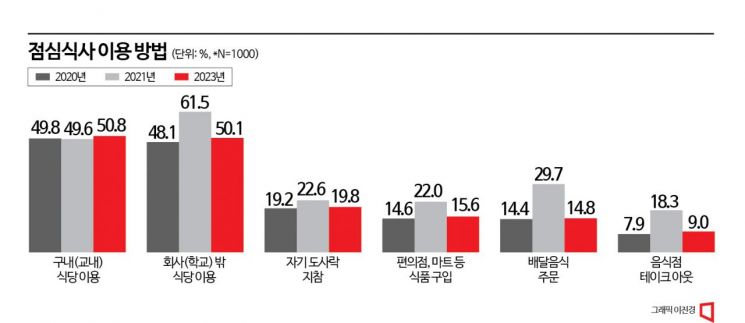
Office workers still mostly use cafeterias (50.8%, multiple responses allowed) or dine at restaurants outside the company (50.1%) for lunch.
However, compared to the period when COVID-19 restrictions were tightened, the number of office workers ordering delivery food or taking out food for lunch has decreased.
The percentage of office workers who ordered delivery food for lunch dropped from 29.7% in 2021 to 14.8% in 2023, and those who took out food decreased from 18.3% to 9.0% during the same period. Embrain interpreted this as a return to the pre-pandemic lunch culture similar to 2020.
However, some office workers still appear to be cautious about COVID-19 infection. When selecting lunch menus, 64.9% responded that they need to be careful about shared dishes such as jjigae (stew).
The number of office workers who eat 'honbap' (eating alone) also slightly increased. In 2021, 35.3% of office workers said they ate alone, but this rose to 42.6% in 2023. This trend was especially noticeable among those in their 20s and 30s.
Average Meal Cost Rises 28.5%... 3 out of 10 Skip Meals
Recent increases in dining-out prices have led to more office workers feeling burdened by lunch costs. While the average meal cost was 7,000 won in 2020, it rose to 9,000 won in 2023.
Accordingly, office workers reported sometimes substituting lunch with convenience foods (43.5%) or skipping lunch altogether (32.6%).
Some also refrained from having dessert after lunch. While 37.2% of office workers said they eat dessert after lunch, 30.7% responded that they do not.
These findings suggest that rising dining-out prices are also affecting the lunch culture of office workers.
© The Asia Business Daily(www.asiae.co.kr). All rights reserved.
![Clutching a Stolen Dior Bag, Saying "I Hate Being Poor but Real"... The Grotesque Con of a "Human Knockoff" [Slate]](https://cwcontent.asiae.co.kr/asiaresize/183/2026021902243444107_1771435474.jpg)

















