Unifying the Term 'North Korea Denuclearization'... Specifying North Korea's Responsibility
"Security Anxiety Due to North Korea Provocations"... 'Dialogue and Cooperation' Contrasted with Moon
Behind the Hardline Policy Toward North Korea... Notable Disconnect in Each Statistic
The first unification white paper published by the Yoon Suk-yeol administration clearly stated that the instability of the Korean Peninsula situation and the breakdown of inter-Korean exchange and cooperation are due to North Korea's nuclear threats and military provocations. Notably, the term 'denuclearization of the Korean Peninsula' was unified to 'denuclearization of North Korea,' explicitly designating North Korea as the subject and responsible party for denuclearization.
Lee Hyo-jung, deputy spokesperson of the Ministry of Unification, said at a regular briefing held at the Government Seoul Office on the 14th, "We are publishing the 2023 Unification White Paper, the first white paper of the Yoon Suk-yeol administration, summarizing the main contents of the unification and inter-Korean policies pursued over the past year," adding, "It provides detailed explanations of the Yoon Suk-yeol administration's unification and inter-Korean policies, including the bold initiative, emphasizing changed policies such as North Korea denuclearization, normalization of inter-Korean relations, promotion of North Korean human rights, and preparation for the future of unification."
The Yoon Administration's First Unification White Paper... Firmly Establishes 'North Korea Denuclearization'
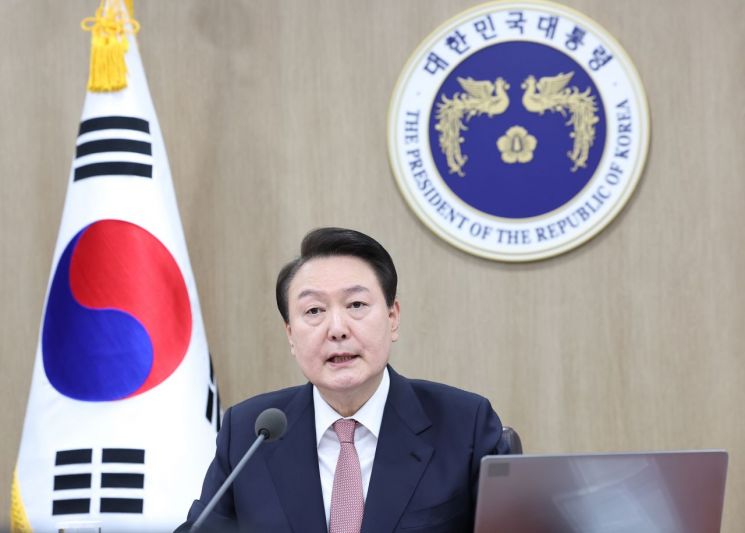
On the same day, the Ministry of Unification published the '2023 Unification White Paper,' approximately 290 pages long. Minister of Unification Kwon Young-se defined the North Korean nuclear issue as the 'fundamental cause of the deterioration of the Korean Peninsula situation' in his foreword. From the first chapter, the white paper states, "North Korea maintained a hardline stance toward us and the United States and, despite chronic economic difficulties, continued nuclear and missile threats and provocations, exacerbating security instability on the Korean Peninsula."
This statement is interpreted as clearly assigning responsibility for the deterioration of the Korean Peninsula situation and the stagnation of inter-Korean relations to North Korea's nuclear development and military provocations. In particular, this year's white paper uses expressions such as ▲zero tolerance for any armed provocations ▲firm response regarding North Korea's provocations, clearly indicating a tough stance. In contrast, the last unification white paper under the Moon Jae-in administration, the '2022 Unification White Paper,' mentioned that "North Korea heightened tensions by test-firing various missiles," but did not describe these actions as 'provocations,' highlighting a notable difference.
Above all, this year's white paper officially replaced the term 'denuclearization of the Korean Peninsula,' used until last year, with 'denuclearization of North Korea.' The denuclearization of the Korean Peninsula originated from the 1992 inter-Korean joint declaration, and the Moon Jae-in administration officially used this term. Changing it to 'denuclearization of North Korea' is interpreted as more firmly establishing that North Korea is the subject that must give up its nuclear weapons.
Attention is also drawn to the change in the traditional order of the term 'North Korea-US relations' to 'US-North Korea relations.' Previously, the Ministry of Unification explicitly used this order in promotional materials for the bold initiative, a denuclearization roadmap, at the end of last year. Deputy spokesperson Lee explained, "After completing the unification white paper, during the expert review process, there was an opinion that it would be better to unify the terminology," adding, "We reflected this opinion and consistently expressed it accordingly."
Additionally, this year's white paper is evaluated as placing considerable emphasis on North Korean human rights issues. While last year's white paper placed the North Korean human rights issue at the end of Chapter 3, 'Humanitarian Cooperation,' this time it is dealt with in detail throughout Chapter 2. This reflects the Yoon Suk-yeol administration's stance of recognizing North Korean human rights issues as important matters, as much as North Korea denuclearization.
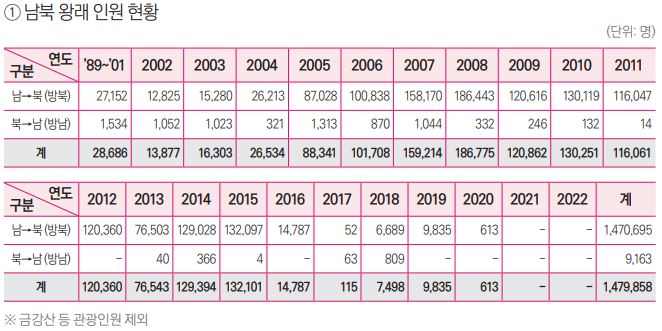
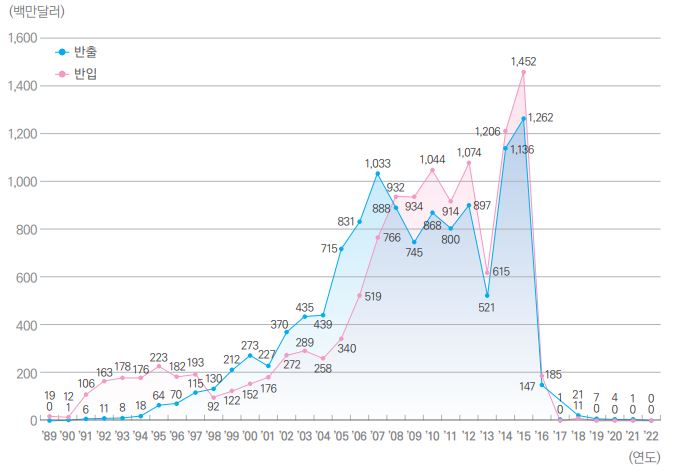
This unification white paper is evaluated as actively reflecting the Yoon Suk-yeol administration's stance to firmly respond to North Korea's provocations. However, the main current status revealed in the white paper also clearly shows the prolonged stalemate in inter-Korean relations. In particular, during the past year when COVID-19 spread rapidly, the number of inter-Korean visits and trade volume were found to be nonexistent.
According to key statistics on inter-Korean relations contained in the 2023 Unification White Paper, the number of inter-Korean visits last year was zero for both South-to-North and North-to-South visits. This means that for two consecutive years, following 2021, the path for human exchange between the two Koreas has been completely cut off. Before the suspension of the Kaesong Industrial Complex in 2016, the number of inter-Korean visits was active, exceeding 100,000 annually.
This breakdown in exchanges is also confirmed in the status of transportation means. Inter-Korean vehicle crossings via the Gyeongui Line and Donghae Line land routes totaled 312 in 2020 but none operated in 2021 and 2022. Ship and aircraft crossings have been nonexistent for four years since 2019. Trade volume statistics also vividly reveal the reality of inter-Korean disconnection. In 2021, exports were recorded at 1 million USD, but last year, both imports and exports converged to zero. However, last year, there were 2 export transactions and 1 export item recorded.
Humanitarian aid to North Korea also sharply declined. Last year, government-level funding support to private organizations amounted to 600 million KRW, and free support from private organizations was 2 billion KRW, totaling 2.6 billion KRW. Compared to 27.7 billion KRW in 2019, 14.9 billion KRW in 2020, and 3.1 billion KRW in 2021, the amount has decreased year by year.
Family reunions have not taken place for four years since 2019, with 2018 being the last year they occurred. Last year, inter-Korean family-related exchanges were limited to three private-level letter exchanges; there were no exchanges at the governmental or private levels. Inter-Korean talks have also not been held for four years since 2019, with 36 meetings in 2018 being the last, and accordingly, no agreements have been adopted for four years.
Meanwhile, the number of North Korean defectors entering South Korea last year totaled 67, maintaining the 60s range for the second consecutive year following 63 in 2021. The number of defectors entering had maintained around 1,000 annually until 2019 but sharply declined after 2020 (229). The total number of defectors is 33,882, with women accounting for 72%.
© The Asia Business Daily(www.asiae.co.kr). All rights reserved.
![Clutching a Stolen Dior Bag, Saying "I Hate Being Poor but Real"... The Grotesque Con of a "Human Knockoff" [Slate]](https://cwcontent.asiae.co.kr/asiaresize/183/2026021902243444107_1771435474.jpg)


















