On the 14th, the ruling party's Legislation and Judiciary Committee member filed a dispute over authority
"Less than 60 days have passed without reason"
The ruling party People Power Party has pulled out the 'Constitutional Court' card in response to the continuous direct referral of bills by the major opposition party. Attention is focused on whether the ruling Democratic Party's legislative dominance will be halted by the Constitutional Court's ruling.
On the 14th at 10:30 a.m., People Power Party lawmakers Yoo Sang-beom, Jang Dong-hyuk, and Jeon Ju-hye, members of the National Assembly's Legislation and Judiciary Committee, will visit the Constitutional Court's civil affairs office to submit a petition for adjudication on the authority dispute regarding the direct referral of the Broadcasting Act amendment bill to the plenary session, and will also apply for a provisional injunction to suspend its effect. The petitioners are six members of the People Power Party from the Legislation and Judiciary Committee, and the respondents are Jeong Cheong-rae, chairman of the National Assembly's Science, Technology, Information and Communications Committee from the Democratic Party, and Kim Jin-pyo, the Speaker of the National Assembly.
The background for filing the adjudication with the Constitutional Court is the claim that the direct referral of the Broadcasting Act violated Article 86, Paragraph 3 of the National Assembly Act. Article 86, Paragraph 3 of the National Assembly Act states that the basis for direct referral is "when the Legislation and Judiciary Committee has not completed the review within 60 days from the date of referral without reason."
The issue lies in the interpretation of "without reason." People Power Party lawmakers on the Legislation and Judiciary Committee argue that the Broadcasting Act, which was directly referred, was referred to the Committee's second subcommittee and is currently under discussion, thus more than 60 days have passed with "reason." They contend that the direct referral does not meet the requirement of "without reason" as stipulated by the National Assembly Act.
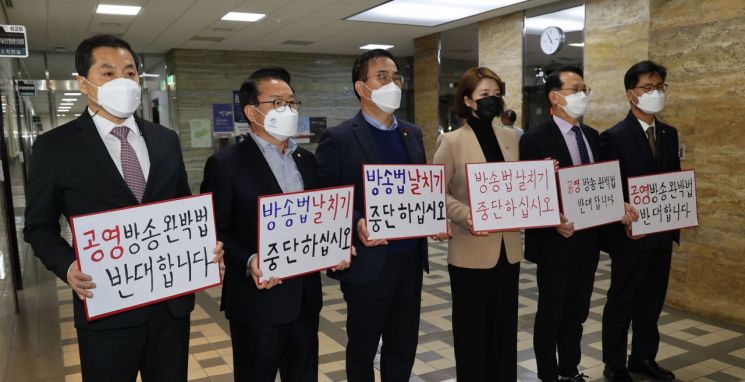
Since the resolution of the direct referral of the Broadcasting Act on the 21st of last month, People Power Party members of the Legislation and Judiciary Committee have raised this issue. At that time, Jeong Jeom-sik, the ruling party's Legislation and Judiciary Committee secretary, said, "It infringes on the Legislation and Judiciary Committee's subcommittee system and its authority to review the wording itself," and added, "All members of the Legislation and Judiciary Committee should unite and strongly protest." Kim Do-eup, chairman of the Legislation and Judiciary Committee from the People Power Party, also emphasized regarding the direct referral request, "It is clearly illegal and unlawful. It violates Article 86, Paragraph 3 of the National Assembly Act."
Unlike the Grain Management Act and the Nursing Act, which were directly referred to the plenary session earlier, the ruling party filed the adjudication regarding the Broadcasting Act due to the issue of "60 days without reason." A People Power Party Legislation and Judiciary Committee official explained, "Those bills (unlike the Broadcasting Act) had already passed 60 days before being referred to the committee's subcommittee for discussion." The Nursing Act was referred to the Legislation and Judiciary Committee on May 17 last year, and discussion only began in the plenary session in January this year, more than half a year later. The Grain Management Act was referred to the Legislation and Judiciary Committee on October 20 last year, but was only presented at the meeting on January 16 this year, three months later.
Until now, the People Power Party has checked the Democratic Party's legislative dominance by blocking the submission of contentious bills to the Legislation and Judiciary Committee. However, as the Democratic Party pulled out the direct referral card according to Article 86, Paragraph 3 of the National Assembly Act, recently the direction has shifted to holding contentious bills in the Legislation and Judiciary Committee. As a result, in cases like the Grain Management Act and the Nursing Act, direct referral was discussed after the 60-day period had long passed, whereas for the Broadcasting Act and others, they were submitted to the Legislation and Judiciary Committee relatively soon after passing the standing committee.
Depending on the Constitutional Court's ruling, there is a possibility that the direct referral of contentious bills such as the Labor Union Act (commonly known as the Yellow Envelope Act), which the Democratic Party is promoting, could be halted. The Yellow Envelope Act passed the standing committee on February 21 and can be directly referred starting from the 22nd, and the Freight Truck Transportation Business Act, which deals with the safe freight rate system, was referred to the Legislation and Judiciary Committee on December 9 last year and has now been pending for 60 days. A People Power Party Legislation and Judiciary Committee official said, "This adjudication petition is intended to block such bills," and added, "We will decide how to proceed based on the Constitutional Court's conclusion regarding the Broadcasting Act."
The Broadcasting Act amendment bill proposes increasing the number of public broadcasting directors from about 10 to 21 and requires recommendations from the National Assembly, academic societies, and media organizations. The ruling party opposes the bill, arguing that if passed, it could create a biased composition of public broadcasting management. On the other hand, the opposition party insists on plenary session approval, saying, "It will select neutral and fair personnel."
© The Asia Business Daily(www.asiae.co.kr). All rights reserved.

















