COVID-19 Financial Support - Key to Smooth Landing of Real Estate Market
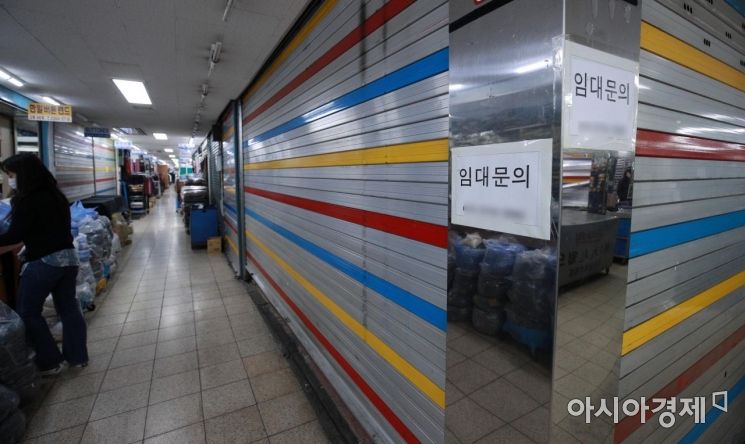 On the 19th, a rental notice was posted at a store within the fashion town shopping area in Dongdaemun-gu, Seoul, which is experiencing a recession due to the prolonged impact of COVID-19. Due to the effects of COVID-19, Dongdaemun shopping malls, symbolized by fashion accessories, are also becoming vacant. According to the Shopping Mall Information Research Institute, the vacancy rate of medium to large shopping malls in the Dongdaemun commercial district was 10.8% in the second quarter of last year. The vacancy rate in the Dongdaemun commercial district has been continuously rising since the second quarter. Photo by Kim Hyun-min kimhyun81@
The non-performing loan (NPL) market is showing signs of a boom. This is due to the global tightening trend following the COVID-19 pandemic, which has increased the possibility of an economic recession worldwide. It is a so-called ‘paradox of recession.’ Industry experts believe that the impact of the extension and interest deferral programs for small and medium-sized enterprises (SMEs) and self-employed individuals, as well as whether the real estate market achieves a soft landing, will serve as key indicators for the market.
According to the related industry on the 14th, the volume of NPL sales by domestic banks in the first quarter of this year was approximately 710 billion KRW based on the outstanding principal balance (OPB). This is about 1.7 times higher than the same period last year (approximately 420 billion KRW). NPLs refer to loans on which principal and interest payments have been overdue for more than three months and have not been recovered normally. Financial institutions such as banks manage their NPLs through various methods including sales, write-offs, securitization, collateral disposal, and normalization. Distressed asset investment companies like Korea Asset Management Corporation (KAMCO) acquire these NPLs to restructure and resell them.
The domestic NPL market reached an annual scale of 5 trillion KRW until 2017 but shrank to around 2 trillion KRW during the COVID-19 period due to large-scale government financial support. However, since last year, with tightening led by the U.S. Federal Reserve (Fed), the market has been gradually heating up. The industry expects the market size to rise above the usual level this year.
The NPL market, which had been quiet for a while, is showing signs of a boom, and players are gradually increasing. In addition to KAMCO and Daishin F&I, which have led the existing market, Hana F&I has recently entered the corporate restructuring market and significantly increased its investments, and Woori Financial Group also joined by establishing Woori F&I at the end of 2021. Furthermore, NPL funds are being formed mainly by asset management companies and institutional investors.
The industry expects that once the COVID-19 SME and small business extension and interest deferral programs, extended until September this year, end, the NPL market could expand rapidly. This is based on the judgment that distressed loans related to marginal companies that have survived by relying on such financial support measures over the past three years may flood the market.
The increase in distressed companies also supports this view. According to the ‘2022 Regular Credit Risk Assessment Results’ announced by the Financial Supervisory Service at the end of last year, creditor banks selected 185 companies as distressed companies (C and D grades) through the regular credit risk assessment last year. This is a 15.6% (25 companies) increase compared to the previous year.
Distressed companies peaked at 210 in 2019, then showed a downward stabilization trend during the COVID-19 pandemic with 157 in 2020 and 160 in 2021, but increased by 25 companies last year alone, approaching the 2018 level (190 companies). It is also noteworthy that the increase is centered on D-grade companies, which mean ‘companies with low possibility of business normalization.’
Jungdong Kim, Senior Researcher at Korea Ratings, said, “For banks and other financial institutions, if government support stops, they will have no choice but to declare an event of default (EOD) on businesses whose repayments have been deferred to manage the ratio of non-performing loans, and if the supply cannot be absorbed, they will sell the NPLs. Even now, while support is ongoing, I understand that there are quite a few business assets such as factories on the market.”
Whether the real estate market achieves a soft landing is also crucial. If various development projects such as commercial real estate collapse, a large number of NPLs could flood the market. A financial sector official explained, “As the high-interest rate phase continues, there is a possibility that bridge loan defaults, which fail to transition to the main project financing (PF), will spread over time. The creditor groups will also take steps to manage non-performing loans by disposing of distressed assets.”
While the NPL industry anticipates market expansion, it also expresses concerns about a sharp economic downturn. An industry insider said, “In the first quarter of this year, all four major domestic commercial banks (KB Kookmin, Shinhan, Hana, and Woori) have been selling NPLs, so the atmosphere is quite different from last year when the market was sluggish. However, if the recession deepens and an excessive volume of NPLs floods the market, it will be difficult for the market to absorb them, so the recession cannot be seen as an unqualified positive factor.”
© The Asia Business Daily(www.asiae.co.kr). All rights reserved.
![Clutching a Stolen Dior Bag, Saying "I Hate Being Poor but Real"... The Grotesque Con of a "Human Knockoff" [Slate]](https://cwcontent.asiae.co.kr/asiaresize/183/2026021902243444107_1771435474.jpg)
















