Issues and Response Directions for US Semiconductor Act Subsidy Application Requirements Report
Hankyung Yeon "US Semiconductor Act's 4 Major Toxic Clauses Must Be Eased"
The excessive subsidy application requirements of the CHIPS and Science Act (hereinafter referred to as the Semiconductor Act) announced by the U.S. Department of Commerce are analyzed to have a serious impact on domestic companies.
On the 14th, the Korea Economic Research Institute pointed out four representative problematic clauses among the subsidy application requirements in its report titled "Problems and Response Directions of U.S. Semiconductor Act Subsidy Application Requirements": ▲allowing access to semiconductor facilities, ▲sharing of excess profits, ▲submission of detailed accounting data, and ▲restrictions on expanding factories in China. The U.S. Department of Commerce plans to provide $39 billion (about 50 trillion KRW) to semiconductor companies applying for subsidies and $13.2 billion (about 17 trillion KRW) for research and development (R&D).
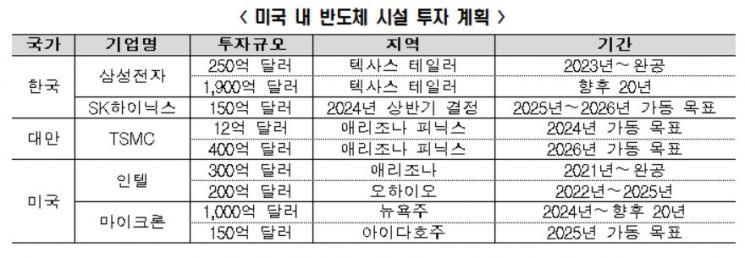
The report viewed the facility access requirement among the subsidy application conditions as allowing national security agencies to access semiconductor production facilities, which raises a high possibility of leakage of technology and trade secrets. It also evaluated the requirement that semiconductor companies receiving subsidies exceeding $150 million must share up to 75% of excess profits with the U.S. government as "restricting the company's inherent goal of profit pursuit." Furthermore, it pointed out that since this condition lowers the economic feasibility of investments and may adversely affect corporate profitability, it is difficult for companies to accept, and there are concerns about the leakage of technology and trade secrets when providing data such as expected cash flow and profitability of the project.
Regarding the detailed accounting data submission requirement, which demands not only financial data but also information on major products, production volume, top 10 customers, production equipment, and raw materials, the report flatly rejected it, stating, "For semiconductor subsidy benefits, trade secrets such as semiconductor production-related data, raw material names, and customer information cannot be disclosed." Concerning the guardrail clause restricting the expansion of factories in China, it analyzed, "It is a regulation that prohibits expanding investments or semiconductor manufacturing capabilities in countries of concern for 10 years," and warned that "restrictions on expanding semiconductor production facilities in China may lead to deterioration in productivity and profitability of existing Chinese factories owned by domestic companies."
The Korea Economic Research Institute holds the position that if domestic semiconductor companies cannot receive benefits such as tax credits due to excessive subsidy application requirements when investing in U.S. production facilities, these requirements are unreasonable for Korea, a U.S. ally. It argues that subsidy requirements under the Semiconductor Act should be established based on reciprocity and fairness to promote mutual benefits between the two countries.
The Korean government needs to request easing of the U.S. Semiconductor Act requirements as an economic security issue at the Korea-U.S. summit and should establish reasonable subordinate regulations through continuous working-level consultations during the coordination of detailed rules related to excess profit recovery and guardrail clauses. For example, it means negotiating so that favorable conditions for domestic companies are reflected by utilizing definitions, exceptions, and caveats included in subsidy requirements such as "agreed figures," "may vary by project," and "except under certain conditions."
It also argued that improving the domestic investment environment, such as providing tax benefits to attract investment in domestic production facilities, is necessary. Major countries worldwide are expanding corporate tax cuts, R&D and facility investment tax reductions, and subsidies to induce investment in their own countries. Accordingly, if investments by domestic large corporations flow overseas, domestic investment could be adversely affected.
Recently, Korea passed a law in the National Assembly to raise the R&D and facility investment tax credit rates, establishing a support base at the level of competing countries, but the corporate tax cut was only 1%, falling short of the OECD average of 22%. In the case of facility investment tax credits, only a temporary 10% additional tax credit benefit on excess investment is provided this year.
Lee Gyuseok, a senior researcher at the Korea Economic Research Institute, said, "The U.S. is expanding support for semiconductor production companies to foster the semiconductor industry, but cooperation between Korea and the U.S. under the 'Chip 4 Alliance' is insufficient," adding, "It is necessary to expand cooperation so that the alliance relationship between Korea and the U.S. leads to semiconductor investment and mutual benefits."
© The Asia Business Daily(www.asiae.co.kr). All rights reserved.
![Clutching a Stolen Dior Bag, Saying "I Hate Being Poor but Real"... The Grotesque Con of a "Human Knockoff" [Slate]](https://cwcontent.asiae.co.kr/asiaresize/183/2026021902243444107_1771435474.jpg)











