Controversy Over the Appointment of Choi Min-hee as Broadcasting Commission Candidate
The battle between the ruling and opposition parties over the position of a standing commissioner at the Korea Communications Commission (KCC) is intense. Both sides are shamelessly changing their statements. They say, "That was then, but not now." There has been a heated debate over the appointment of Choi Min-hee, the KCC standing commissioner candidate recommended by the Democratic Party of Korea as the opposition's quota. The ruling party, People Power Party, argued that it violates the KCC Establishment Act. According to the KCC Establishment Act, the president nominates two people: the chairman and one commissioner. The remaining three commissioners are recommended by the ruling party (one person) and the opposition party (two people). The intention is to maintain a 3:2 balance of power. The controversy arises because the ruling and opposition parties switched after the last presidential election. The commissioner recommended by the opposition party during their tenure steps down, and the person recommended by the Democratic Party takes that position. In conclusion, the People Power Party argues that if former lawmaker Choi is appointed, the composition would be one commissioner recommended by the ruling party and four by the opposition, which goes against the law's intent. The Democratic Party insists that since the predecessor was recommended by the opposition, the successor should also be from the opposition.
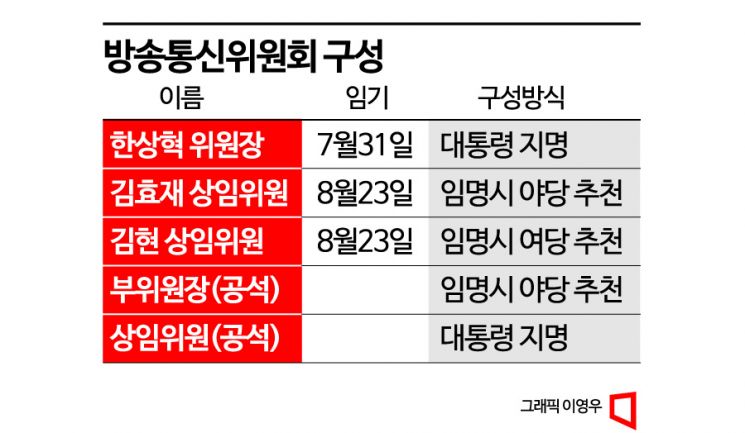
Following the Predecessor's Recommending Party?
In fact, this is a predictable confrontation. Similar incidents have occurred every time the government changes. The positions of the two parties have varied each time. They have changed their logic to favor their own party. In 2014, when the Democratic Party was the "opposition," they recommended former commissioner Kim Jae-hong. Even after becoming the "ruling party" in 2017, the Democratic Party again recommended former commissioner Heo Wook as Kim's successor. Former commissioner Ahn Hyung-hwan, who was recommended by the "opposition" (People Power Party), was the successor to former commissioner Kim Seok-jin, who was recommended by the then "ruling party," the Liberty Korea Party. There are also opposite cases. Former commissioner Pyo Cheol-soo, who took office in 2017 as the "opposition" (People Party) recommendation during the Moon Jae-in administration, was the successor to former commissioner Ko Sam-seok, who was recommended as the "opposition" (Democratic Party) quota during the Park Geun-hye administration in 2014. Rather than a uniform rule, the parties have acted flexibly depending on the situation, like "earrings on the ear or nose rings on the nose."
If candidate Choi becomes a standing commissioner, the personnel composition will immediately tilt toward the Democratic Party. However, this composition will not last long. President Yoon is expected to nominate a successor to former commissioner Kim Chang-ryong, who retired on the 5th. Also, the terms of Chairman Han Sang-hyuk (presidential nominee), Kim Hyo-jae (opposition recommendation), and Commissioner Kim Hyun (ruling party recommendation) will end in July and August. After that, the KCC commissioners are likely to be balanced again at 3:2 between the ruling and opposition parties.
What About the KCC Vacancy?
Since the launch of the Yoon Seok-yeol administration, the KCC has been in a state of "temporary closure" for 3 to 4 months due to a full-scale "KCC purge" involving power and investigative agencies as well as the political sphere. Internally, people say, "We don't know what to do." Since last September, there have been audits by the Board of Audit and Inspection, three raids, the arrest of department heads, inspections by the Office for Government Policy Coordination, and a detention warrant request for the chairman. Allegations that the KCC intervened to lower the scores of judges during TV Chosun's license renewal in 2020 have shaken the commission.
The media industry expects the appointment process for KCC standing commissioners to be slow. This is because the appointment authority lies with the president. The presidential office has indicated that if the National Assembly officially requests the withdrawal of former lawmaker Choi's appointment as a KCC commissioner, they may consider it. The process to appoint a successor to former commissioner Kim Chang-ryong has not yet started.
A media industry official said, "There are talks that the appointment of standing commissioners will remain sluggish until Chairman Han Sang-hyuk's position is decided," adding, "If the organization is not quickly reorganized, the atmosphere at the KCC will worsen further."
© The Asia Business Daily(www.asiae.co.kr). All rights reserved.
![Clutching a Stolen Dior Bag, Saying "I Hate Being Poor but Real"... The Grotesque Con of a "Human Knockoff" [Slate]](https://cwcontent.asiae.co.kr/asiaresize/183/2026021902243444107_1771435474.jpg)
















