[Upcoming Hydrogen Economy]
Debate Between Energy Companies and Renewable Firms Over IRA Benefits 'Clean Hydrogen' Definition
Is Nuclear-Powered 'Pink Hydrogen' Environmentally Friendly?
"The U.S. Department of the Treasury plans to spend $100 billion (approximately 130 trillion KRW) on hydrogen projects that emit carbon under loose regulations." (Public letter sent in March 2023 by 18 U.S. environmental policy organizations to the federal government)
In the United States, there is heated debate among energy companies over the eligibility criteria for clean hydrogen tax credits. In Europe (EU), member states are divided on whether hydrogen produced from nuclear power should be recognized as green hydrogen.
The core of the debate is a hegemonic competition to claim the benefits arising from hydrogen, which has emerged as the next-generation energy source for achieving carbon neutrality. As South Korea is in a position where hydrogen, like fossil fuels, must be imported, it should closely monitor these debates and reflect the outcomes in its policy formulation.
The U.S. Department of Energy provides a tax credit of $3 per kilogram of clean hydrogen produced by companies starting this year under the Inflation Reduction Act (IRA). The problem is that the definition of clean hydrogen remains unclear.
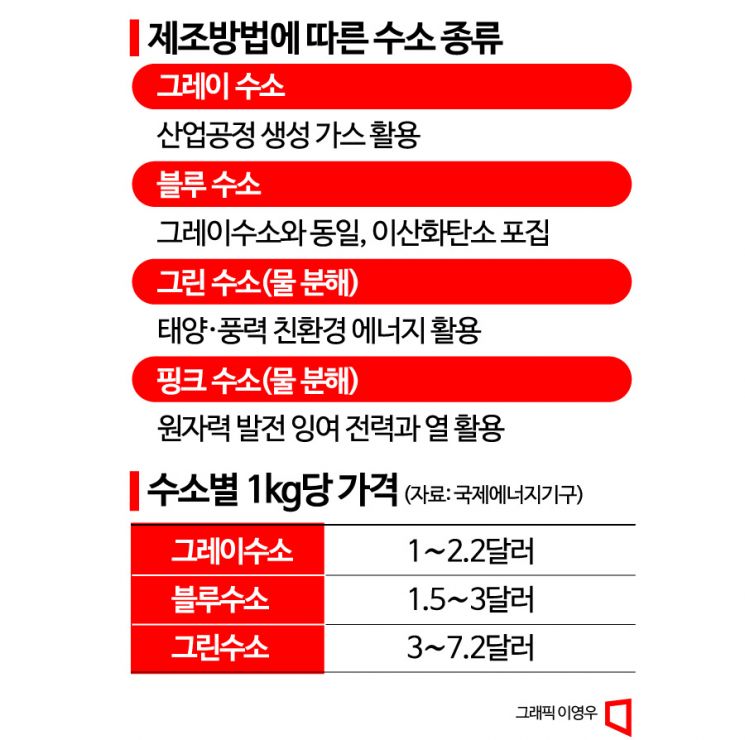
Hydrogen as a fuel is often described as having a spectrum and hierarchy. The most ideal hydrogen is green hydrogen. It is produced by generating electricity from solar, wind, hydro, etc., and then using that electricity to split water. In other words, it is environmentally friendly as it emits no carbon during production and can be continuously reproduced without wasting resources. However, its production cost is high. The production cost of green hydrogen in the U.S. is about $5 per kilogram.
Next is blue hydrogen. Blue hydrogen is produced by splitting fossil fuel natural gas. The carbon dioxide generated during production is captured and stored separately, making it more environmentally friendly than fossil fuels but still more burdensome to the environment than green hydrogen. However, its production cost is low at $1.5 per kilogram in the U.S. If natural gas is used to produce hydrogen without capturing carbon dioxide, it is called gray hydrogen.
Producing 1 kg of gray hydrogen emits 10 kg of carbon dioxide. No matter how cheap the production cost is, it is environmentally harmful and cannot be considered a future energy source. Then there is pink hydrogen, produced using nuclear power. Nuclear power generates electricity without emitting carbon dioxide and can produce electricity at a lower cost. The problem is that nuclear power generation produces waste. There is controversy over whether blue and pink hydrogen should be recognized as clean hydrogen.
If green hydrogen producers receive tax credits but blue hydrogen producers do not, the price gap narrows significantly. In other words, how the tax credit recipients are determined will have a considerable impact on hydrogen industry investment and development. The problem is that energy companies have differing opinions on the scope of clean hydrogen. To produce hydrogen, water electrolysis is used. The key issue is whether the electricity used is 'carbon neutral.'
Electricity generated from solar, hydro, and wind power is theoretically carbon neutral without dispute. However, it is not easy to strictly separate electricity sources. Currently, the power grid mixes electricity generated from solar power and fossil fuels.
Many energy companies plan to produce green hydrogen by purchasing renewable energy certificates (RECs) while receiving electricity from the current power grid. A representative company is the oil major BP. BP intends to prove that the electricity they use is 'carbon neutral' by purchasing RECs annually.
On the other hand, renewable energy companies and environmental groups argue that hydrogen must be produced using 100% renewable energy. Since the current power grid includes electricity generated from fossil fuels, they demand proof that only renewable energy is used on an hourly basis. Vestas, the world's largest wind turbine manufacturer, is a leading company advocating for 100% renewable energy use. However, critics argue that establishing a system to prove renewable energy use on an hourly basis will take considerable time and delay clean hydrogen production.
This debate is an extension of discussions on 'RE100' and 'CF100.' In the U.S., there is ongoing discussion that if RE100, which requires using only renewable energy, is not realistically feasible, it should be replaced by CF100, which allows the use of nuclear power or fuel cells as alternatives. In Europe, France and Germany have been engaged in a standoff over whether to recognize pink hydrogen produced using nuclear power as clean hydrogen.
France, where nuclear power accounts for 70% of total electricity generation, along with Hungary, Poland, and the Czech Republic, argued that pink hydrogen should be allowed as clean hydrogen. In contrast, Germany, where renewable energy accounts for nearly half of electricity generation, countered, "Hydrogen produced from nuclear power is not green hydrogen."
Last July, the two countries also clashed over whether to include nuclear investments in the EU's green taxonomy during its decision-making process. The result was a decisive victory for France. Nuclear power was included in the taxonomy. On the 30th of last month, after overnight discussions, the European Union (EU) Council recognized hydrogen produced from nuclear power as clean hydrogen.
Professor Jinsoo Kim of Hanyang University said, "In South Korea's case, nuclear power is essential to achieve carbon neutrality," adding, "If hydrogen is produced using nuclear power, it can meet low production costs, so this issue should be actively reviewed."

© The Asia Business Daily(www.asiae.co.kr). All rights reserved.



















