7% Global GDP Decline Due to Trade Fragmentation
Heads of the two major international economic organizations, the International Monetary Fund (IMF) and the World Bank (WB), recently pointed out that geopolitical conflicts are placing a significant burden on the economy and trade.
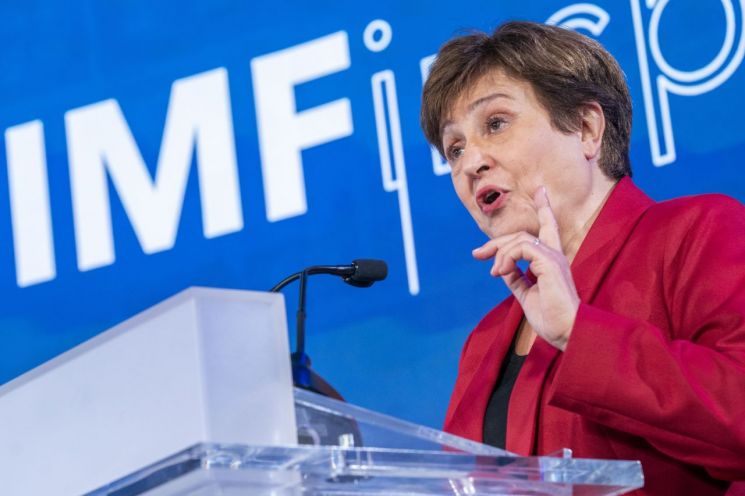
Kristalina Georgieva, IMF Managing Director, stated on the 10th (local time) during a dialogue at the IMF-World Bank Spring Meetings held in Washington DC that the divisions caused by geopolitical conflicts are among the biggest challenges the global economy must address.
She said, "The links that bind the world together have weakened over the past few years, and as divisions deepen, they negatively impact the integrated economy that has generated tremendous momentum for growth and prosperity over the past 30 years." Referring to IMF research indicating that fragmentation of trade could reduce global GDP by up to 7%, she emphasized, "Division of labor through trade must be effectively empowered to increase productivity."
Need for Liquidity Support for SMEs and Developing Countries
The heads of both organizations agreed on the necessity of providing liquidity to small and medium-sized enterprises (SMEs) and developing countries to ensure stability in the financial sector. Georgieva stressed that while central banks around the world have no choice but to keep interest rates high to stabilize prices, financial sector stability is also important, and liquidity must be supplied to SMEs, developing countries, and emerging markets.
David Malpass, WB President, agreed with Georgieva’s assessment, stating, "The degree to which trade is segmented into regional or protectionist blocks is concerning." He added, "As the world moves toward halting and reversing globalization, productivity may decline, posing risks to global growth."
He argued that although central banks are raising interest rates to curb demand, in the long term, expanding supply should be the solution, and short-term financing for SMEs should be increased. He particularly emphasized that developing countries, which have experienced capital outflows due to interest rate hikes, are facing severe difficulties from debt burdens, climate change, rising food prices, and slowing growth.
In this regard, Georgieva announced plans to hold a roundtable involving governments, private sector creditors, and creditor countries to address the sovereign debt issues of developing countries.
Global Economic Growth Rate Revised Up to 2.0%
The Spring Meetings, which run until the 16th, bring together finance ministers and experts from around the world to discuss major global economic issues such as the war in Ukraine. The IMF, which had forecast a 2.9% global economic growth rate for this year in January, will release an updated outlook on the 11th.
Meanwhile, Malpass raised the global economic growth forecast from 1.7% in January to 2.0% during a press briefing on the same day. He explained that the upward revision is due to China lifting its COVID-19 lockdowns and advanced economies performing better than expected. However, he warned that recent developments such as stress in the banking sector and rising oil prices could weaken economic growth.
© The Asia Business Daily(www.asiae.co.kr). All rights reserved.
![Clutching a Stolen Dior Bag, Saying "I Hate Being Poor but Real"... The Grotesque Con of a "Human Knockoff" [Slate]](https://cwcontent.asiae.co.kr/asiaresize/183/2026021902243444107_1771435474.jpg)
















