On the road heading out of Gunsan city center toward Saemangeum Bieung Park and Bieung Port. Minerals stacked like Lego blocks in a wide yard and buildings lined up on both sides surrounding the area reveal a grand scale. This is the exterior view of the ‘Gunsan Raw Material Stockpile Base’ seen from the main gate adjacent to the city outskirts road.
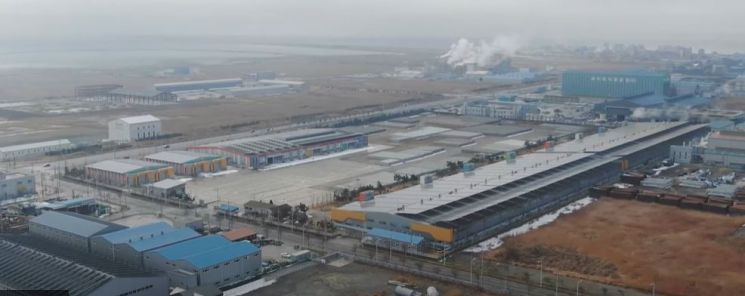
On the 6th, we visited the Gunsan Raw Material Stockpile Base located on Muyeok-ro in Gunsan, Jeonbuk. The raw material stockpile base plays a role in stabilizing prices by having the government directly purchase and stockpile raw materials and releasing them to companies when supply and demand are not smooth.
Currently, across the country, there are three large stockpile bases located near ports in Incheon, Busan, and Gunsan, and six small stockpile bases located inland in Daegu, Daejeon, Gyeongnam, Gwangju, Chungbuk, and Gangwon, which are established and operated.
As of the end of February, these stockpile bases have stored a total of 248,000 tons of metal resources, including 225,000 tons of six types of non-ferrous metals such as aluminum, copper, lead, zinc, tin, and nickel, and 23,000 tons of rare metals including rare earth elements.
Among them, the Gunsan stockpile base boasts the largest scale among the large stockpile bases. Accounting for 47% of the entire Public Procurement Service’s stockpile facilities, it moved from Sorong-dong, Gunsan, where it was established in 1979, to Muyeok-ro, Gunsan in 2008, taking its current form.
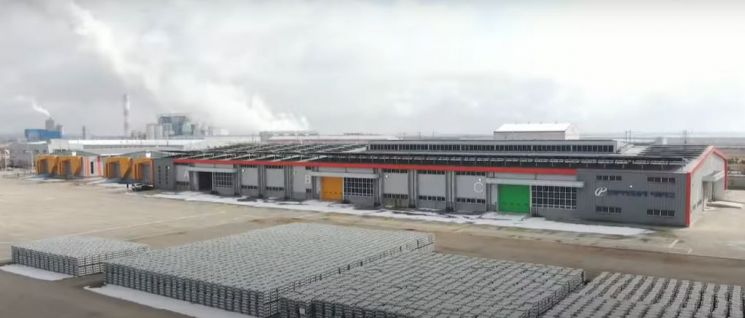 Non-ferrous metals such as lead stacked in the warehouse building and the yard in front of the building at the Gunsan stockpile base. Provided by the Public Procurement Service
The main facilities consist of five warehouses (38,435㎡) and a yard (93,795㎡), with a facility area equivalent to 18 soccer fields.
The Gunsan stockpile base mainly stores non-ferrous metals, and as of the end of February, the amount of six types of non-ferrous metals stored here was totaled at 66,000 tons. This accounts for about 27% of the entire Public Procurement Service’s non-ferrous metal stockpile inventory. This is why this place can be called a ‘metal treasure warehouse.’
In particular, the Public Procurement Service is also promoting the construction of two new stockpile warehouses (14,929㎡) within the Gunsan stockpile base, aiming for completion in 2025. This means that the scale of non-ferrous metals to be stockpiled at the Gunsan base may increase further.
The fundamental purpose of the stockpile project is to facilitate the supply and demand of raw materials and economic security items. In addition, by regularly releasing some of the stockpiled raw materials to domestic demand companies and continuously purchasing and stockpiling insufficient raw materials domestically and internationally to maintain a certain inventory level, it is possible to maintain the quality of raw materials through inventory circulation.
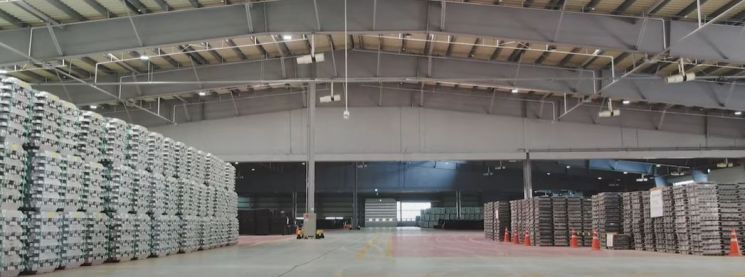 Non-ferrous metals are stacked layer by layer inside the Gunsan stockpile base. Provided by the Public Procurement Service
Above all, the Public Procurement Service’s raw material release prices are set based on international raw material prices, playing a vanguard role in suppressing sharp domestic raw material price hikes during supply crises and helping small and medium-sized enterprises with insufficient purchasing power to secure raw materials stably.
During the COVID-19 pandemic, when the supply of masks did not meet demand, the Public Procurement Service directly supported supply stabilization, which is in the same context.
The recent response to the urea solution crisis was no different. Among supply chain vulnerable items that are usually not visible, the government manages core materials critical to domestic industry and economy as economic security items, and the Public Procurement Service and stockpile bases are responsible for stockpiling materials that have a high possibility of dual supply chain crisis or are closely related to citizens’ lives.
In line with this, the Public Procurement Service designated activated carbon for water purification and vehicle urea as new stockpile items last year and started stockpiling them, and this year it has confirmed the inclusion of calcium chloride and fluorite in the stockpile items.
Furthermore, the Public Procurement Service plans to strategically utilize the stockpile project by supporting export excellent companies with priority allocation of discounted releases, expanded allocation limits, and preferential credit and loan releases to respond to the global raw material crisis.
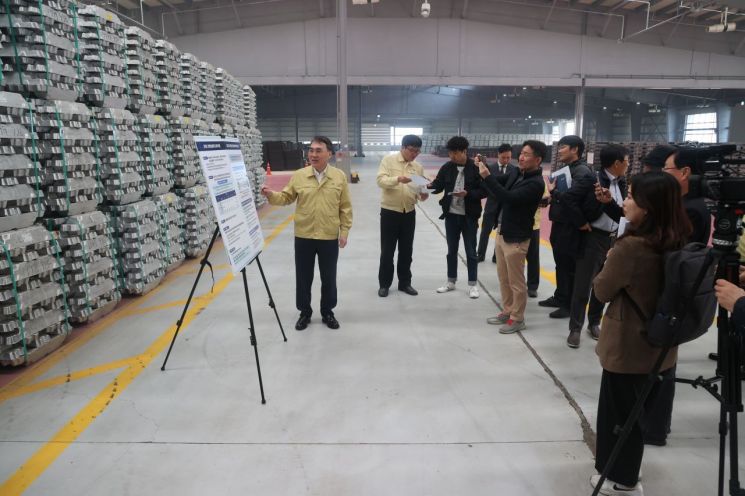 On the 6th, Lee Jong-wook, Administrator of the Public Procurement Service, explained the stock status of raw materials and economic security items, as well as future plans for utilizing the stockpile base at the Gunsan stockpile base. Photo by Public Procurement Service
Meanwhile, on this day, the Public Procurement Service held an on-site briefing at the Gunsan stockpile base. The briefing was organized to introduce the government’s stockpile project promotion direction in response to recent raw material supply and demand imbalances and consequent raw material price surges and supply chain crises.
At the event, Lee Jong-wook, Administrator of the Public Procurement Service, said, “With the ongoing global supply chain issues becoming a constant, securing a stable raw material supply chain is emerging as an important topic for our economy these days. The Public Procurement Service, as a government agency responsible for one axis of the domestic supply chain, will devote itself to strategic activities to enhance raw material crisis response capabilities by utilizing the Gunsan stockpile base and others.”
© The Asia Business Daily(www.asiae.co.kr). All rights reserved.



















