A research team at Ulsan National Institute of Science and Technology (UNIST) has developed a model capable of diagnosing the health status of lithium-ion batteries.
Professors Kim Dong-hyuk and Choi Yoon-seok from the Department of Energy and Chemical Engineering at UNIST, along with Professor Lim Han-kwon from the Carbon Neutrality Graduate School, conducted research on a ‘Lithium-ion Battery Health Status Diagnosis Model.’
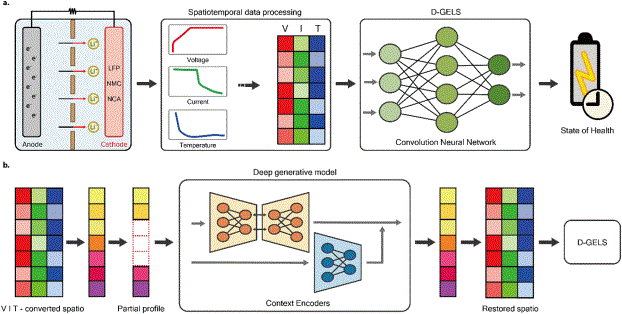
The research team developed the ‘Deep-learning-based Graphical approach to Estimation of Lithium-ion batteries SOH (D-GELS)’ model based on a deep learning model in the field of artificial intelligence.
The D-GELS model converts voltage, current, and temperature data into RGB values to generate images. This model is characterized by its applicability to LFP (Lithium Iron Phosphate), NCA (Nickel Cobalt Aluminum), and NMC (Nickel Cobalt Manganese) batteries.
The root mean square error (RMSE) value was used as an indicator to show the accuracy of the battery health status predicted by the D-GELS model. The value was confirmed to be 0.0088.
Additionally, when using three types of cathode materials, the RMSE values were 0.0081 (LFP), 0.012 (NCA), and 0.0097 (NMC). These showed higher accuracy compared to values of 0.014 and 0.022 obtained using models from previous studies.
By utilizing the D-GELS model, data lost due to partial charging and discharging can be restored to fully charged and discharged data, enabling diagnosis of the battery’s health status.
The research team restored charging and discharging data with losses of 12.5%, 25%, 50%, and 75% to the original data and diagnosed the health status. In the experiments, the RMSE values were 0.030, 0.044, 0.046, and 0.18, respectively.
Despite being the first study to diagnose battery health status using partial charging and discharging data, high accuracy was confirmed.
This study confirmed that as the size of the lost charging and discharging data increases, the diagnostic accuracy decreases, and there is a tendency for the RMSE value to increase when initial discharge data is lost.
This indicates that the initial discharge data has a significant impact on diagnosing the health status of lithium-ion batteries.
Park Seo-jeong, first author and integrated MS-PhD researcher in the Department of Energy and Chemical Engineering at UNIST, said, “We spatialized the time-series lithium-ion battery charging and discharging data like images and trained a deep learning model.”
She added, “This research presents a new approach to battery diagnosis and is a universal model applicable without restrictions on charging and discharging conditions.”
Co-first author Lee Hyun-joon, PhD in the Department of Energy and Chemical Engineering at UNIST, said, “If batteries can be diagnosed using partial charging and discharging data, it will save significant time and cost when diagnosing before recycling used batteries in the future,” and “This provides a foundation for expanding applications in various fields.”
This research was conducted with support from the Ministry of Trade, Industry and Energy and the Defense Acquisition Program Administration, and was published in the February issue of the international journal Materials Horizons.
© The Asia Business Daily(www.asiae.co.kr). All rights reserved.

















