'Nuclear-capable' B-52H Sortie... Joint Air Exercise
Strategic Bomber Escort Training... "Unbreakable Defense Resolve"
The U.S. 'nuclear bomber' B-52H (Stratofortress) was deployed to the Korean Peninsula again after a month, sending a strong warning message to North Korea.
On the 5th, the Ministry of National Defense announced that under the deployment of the B-52H strategic bomber to the Korean Peninsula, South Korea and the U.S. conducted joint air exercises. The exercise, conducted over the Korean Peninsula, involved South Korea's F-35A fighters and the U.S. Air Force's F-35B and F-16 fighters. This marks the first deployment of the B-52H strategic bomber to the Korean Peninsula in a month since the last deployment on the 6th of last month.
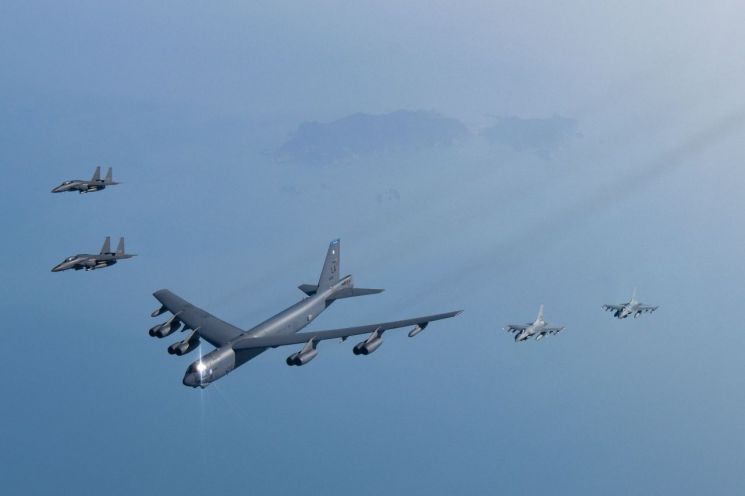 On March 6, the South Korean F-15K and KF-16 fighter jets and the U.S. B-52H strategic bomber participated in a joint air training exercise conducted by the South Korean and U.S. Air Forces over the West Sea airspace of the Korean Peninsula.
 [Photo by Ministry of National Defense]
The B-52H strategic bomber, which visited the Korean Peninsula last week along with a U.S. aircraft carrier, is considered a representative strategic asset and is often referred to as one of the "three major strategic bombers" along with the B-1B and B-2. Notably, it is capable of carrying nuclear weapons and can carry up to 31 tons of bombs, including air-to-ground nuclear missiles with a range of 200 km, flying over 6,400 km to bomb targets.
The continuous deployment of major strategic assets to the Korean Peninsula is evaluated as a demonstration of the U.S.'s resolve to defend the Republic of Korea and to enhance the credibility of extended deterrence. According to military officials, this exercise focused on protecting the strategic bomber from enemy air threats and strengthening interoperability and joint operational capabilities between the South Korean and U.S. air forces.
Scott Pleus, Commander of the U.S. 7th Air Force (Lieutenant General), emphasized, "The teamwork between the South Korean and U.S. air forces is stronger than ever," adding, "We have the capability and readiness to accomplish any mission assigned." Park Ha-sik, Commander of the Air Operations Command (Lieutenant General), evaluated, "Through joint air exercises linked with the increased frequency and intensity of U.S. strategic asset deployments, we have demonstrated a perfect readiness posture to overwhelmingly respond to North Korean provocations."
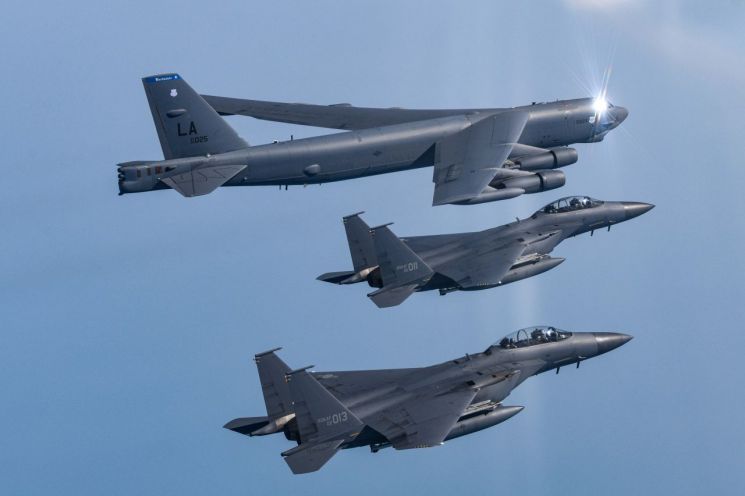 On March 6, the South Korean F-15K and KF-16 fighter jets and the U.S. B-52H strategic bomber participated in a joint air training exercise conducted by the South Korean and U.S. Air Forces over the West Sea airspace of the Korean Peninsula.
 [Photo by Ministry of National Defense]
Earlier, the U.S. Pacific Air Forces announced on the 30th of last month that four B-52Hs from the 96th Expeditionary Bomb Squadron based in Barksdale, Louisiana, were deployed to Andersen Air Force Base in Guam to carry out Bomber Task Force (BTF) missions. Since this was a direct announcement rather than a flight path exposure, it was analyzed as a strong warning signal against North Korea's successive provocations. It was also evaluated as a move to strengthen containment against China.
A military official stated, "Going forward, South Korea and the U.S. will deepen the level of joint exercises under the timely and coordinated deployment of U.S. strategic assets through close cooperation," adding, "We will realize 'peace through strength' by enhancing joint operational capabilities."
© The Asia Business Daily(www.asiae.co.kr). All rights reserved.


















