Opposition Awaits Legislative Push on Nursing and Broadcasting Laws
Presidential Office States "Will Follow Principles, No Change," Hints at Veto
President Yoon Suk-yeol has exercised his first veto power on the amendment to the Grain Management Act, while the Democratic Party of Korea plans to hold a plenary session of the National Assembly on the 13th of this month to demand a re-vote on the amendment. The Democratic Party also intends to push through contentious bills such as the Nursing Act and the Broadcasting Act, which have been directly referred to the plenary session. However, there are concerns that President Yoon's consecutive vetoes, which emphasize 'law and principle,' may be perceived as ignoring the National Assembly and a lack of communication.
A senior official from the Presidential Office said on the 5th, "This decision by the President is the result of a comprehensive judgment after listening to experts, stakeholders, and parties, and there is no change in the commitment to follow principles going forward." This implies that veto power may be exercised on bills passed by the National Assembly without bipartisan agreement, similar to the Grain Management Act amendment.
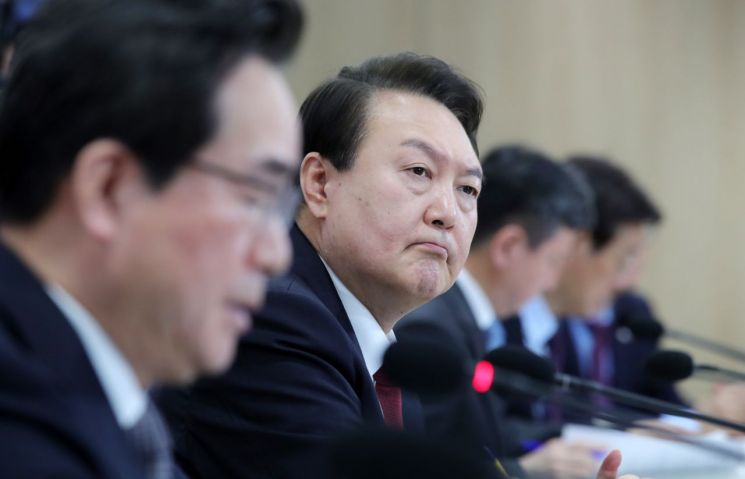
Currently, the Democratic Party of Korea is pushing for the direct referral of bills to the plenary session, including the Nursing Act, which stipulates improvements in nurses' working conditions, the Broadcasting Act amendment that changes the governance structure of public broadcasting, and the amendment to the Labor Union and Labor-Management Relations Adjustment Act (the Yellow Envelope Act). These are all contentious bills expected to be vetoed by President Yoon, and the government and ruling party have repeatedly expressed opposition. These bills differ from the Yoon administration's national agenda and governance policies, and the political sphere views the President's vetoes as an expected step.
However, there is also a sensed concern about the consecutive use of veto power. While some analyze this as an opposition party strategy to frame the President as uncooperative and lacking communication, it could ultimately be seen as an attitude that disregards the legislative authority of the National Assembly. There are voices warning that this could lead to a loss of momentum for national governance. One of the main reasons President Yoon's approval rating fell to the 20% range was due to perceived 'lack of communication,' so if the President continues to exercise vetoes in succession, the same situation could recur.
At the government level, it is expected that detailed implementation plans will be carried out in line with President Yoon's recent emphasis on party-government consultations and strengthened policy promotion. Since public support is necessary for exercising veto power on each bill, the government and ruling party plan to quickly present alternatives to gain an advantage in the public opinion battle.
President Yoon's instruction to Agriculture, Food and Rural Affairs Minister Jeong Hwang-geun the day before, saying, "The government and the party should sufficiently consult and prepare measures to carefully support agriculture and rural areas," is for this reason. Accordingly, the Ministry of Agriculture, Food and Rural Affairs plans to announce related measures through party-government consultations and has internally confirmed that it has immediately started establishing plans to foster the rice processing industry to cope with the decline in rice demand.
A Presidential Office official said, "This is not a unilateral exercise of veto power, but a comprehensive process where the President personally explains the reasons to the public and the government and ruling party promptly prepare alternatives to resolve concerns," adding, "The main purpose is to make the policies promoted by the government easy for the public to understand and to feel their impact significantly." President Yoon's chairing of the Cabinet meeting for the third consecutive week is in the same context, interpreted as his determination to personally handle issues related to people's livelihoods or deliver key messages when necessary.
© The Asia Business Daily(www.asiae.co.kr). All rights reserved.

















