Total Private Education Expenses for Elementary, Middle, and High School Students Reached 26 Trillion Won Last Year
Ministry of Education to Announce Measures to Reduce Private Education Costs in the First Half of the Year

Last year, the total fertility rate was 0.78. South Korea, which sets a new record low for total fertility rate every year, is one of the countries where low birthrate and aging population are progressing the fastest. There are concerns that as the economically active population decreases, the driving force for economic growth will be lost, causing South Korea's economic growth to come to a halt.
Experts have pointed to the burden of private education expenses as one of the causes of the low birthrate phenomenon. As competition intensifies to get into good universities and secure good jobs, the participation rate and expenditure on private education are steadily increasing. Consequently, as the burden of childcare, including private education costs, grows heavier, young people are increasingly placing marriage and having children lower on their priority list.
Foreign media have also identified the childcare burden caused by private education expenses as a cause of the low birthrate. In September last year, Bloomberg published an article titled "Childcare Burden Driving South Korea's Birthrate to the World's Lowest," stating that although the South Korean government is implementing cash subsidy policies to address the low birthrate phenomenon, such incentives alone are unlikely to solve the problem.
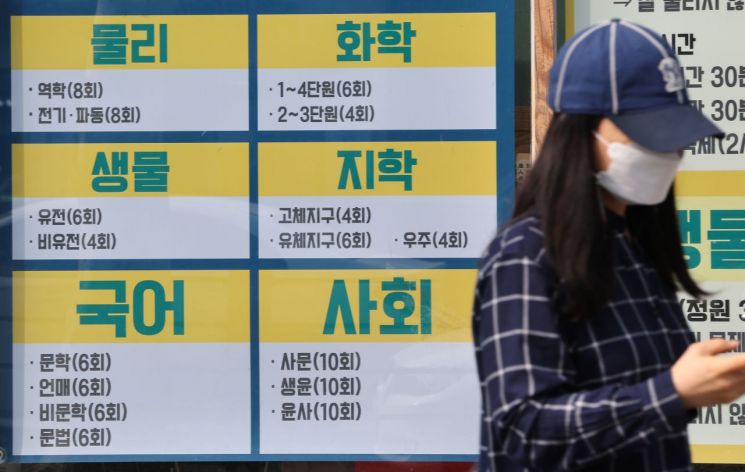 The photo was taken on the afternoon of the 7th of last month in the academy district of Daechi-dong, Gangnam-gu, Seoul. [Image source=Yonhap News]
Bloomberg emphasized, "Temporary subsidies for women considering childbirth may not help alleviate the financial worries for the coming years," and added, "While raising children is expensive in any advanced country, there is evidence that parents in South Korea are spending even more money on their children's futures."
In particular, the media pointed to "hagwons" (private academies). At the root of the ultra-low birthrate is the childcare burden, including middle and high school students' hagwon fees reaching 8.3 million won per year, which is among the highest levels even compared to advanced countries. Bloomberg noted that South Korean households spent about $6,000 (approximately 8.3 million won) per middle and high school student on education last year, with most of this money going to hagwons, which are institutions for exam preparation.
As the burden of private education expenses grew, the government established a dedicated team to reduce household burdens. The private education countermeasure team disappeared after a reorganization during the Park Geun-hye administration in 2013, but with private education expenses for elementary, middle, and high school students recently reaching record highs, the Ministry of Education appears to be responding. The Ministry plans to announce measures to reduce private education expenses within the first half of this year, including ways to absorb private education demand into public education.
According to the 2022 private education expense survey recently released by the Ministry of Education and Statistics Korea, the total private education expenses for elementary, middle, and high school students last year reached 26 trillion won, a 10.8% increase from the previous year. This increase is more than double last year's inflation rate (5.1%). The participation rate in private education also rose by 2.8 percentage points to 78.3%. In a high inflation environment, the increase in private education expenses is causing household burdens to grow heavier.
© The Asia Business Daily(www.asiae.co.kr). All rights reserved.
![Clutching a Stolen Dior Bag, Saying "I Hate Being Poor but Real"... The Grotesque Con of a "Human Knockoff" [Slate]](https://cwcontent.asiae.co.kr/asiaresize/183/2026021902243444107_1771435474.jpg)

















