This year, the '2023 Samsung Ho-Am Prize Winners' announced by the Ho-Am Foundation drew attention for selecting two young female scientists (Professor Choi Kyung-shin and Professor Marsha Haigis) and the youngest winner ever (pianist Cho Seong-jin).
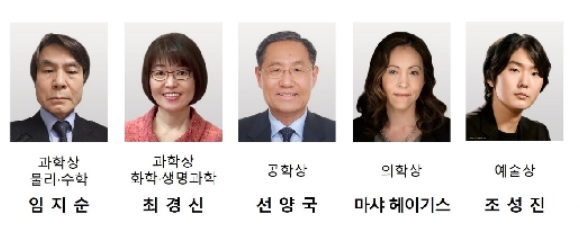
On the 5th, the Ho-Am Foundation announced the '2023 Samsung Ho-Am Prize Winners' as follows: ▲Im Ji-soon (72), Adjunct Professor at POSTECH, for the Science Prize in the Physics and Mathematics category ▲Choi Kyung-shin (54), Professor at the University of Wisconsin, USA, for the Science Prize in the Chemistry and Life Sciences category ▲Seon Yang-guk (62), Chair Professor at Hanyang University, for the Engineering Prize ▲Marsha Haigis (49), Professor at Harvard Medical School, USA, for the Medicine Prize ▲Cho Seong-jin (29), pianist, for the Arts Prize ▲and the nonprofit organization Global Care for the Social Service Prize. Five individuals and one organization were selected. Each winner in their respective category receives a certificate, a medal, and a prize money of 300 million KRW. The award ceremony is scheduled to be held on June 1.
Professor Im, the winner of the Science Prize in the Physics and Mathematics category, is a world-renowned theoretical physicist who pioneered and advanced the field of 'computational materials physics' by devising an innovative method to accurately calculate the total energy required for solid material formation, revealing the structure and properties of solids without actual experiments. Dr. Im's computational method has been integrated into supercomputers and has become an essential element in the design and synthesis process of new materials. Professor Choi, the winner of the Science Prize in the Chemistry and Life Sciences category, is a global leader in energy science who has brought groundbreaking advancements in eco-friendly hydrogen production through research that enhances the efficiency of photoelectrode materials and catalysts essential for photoelectrochemical reactions that use light to split water. The various electrode materials developed by Dr. Choi are expected to contribute to solving energy and environmental issues by converting organic waste resources such as tree bark and plant stems into eco-friendly energy and being utilized for seawater and wastewater purification.
Professor Seon, the winner of the Engineering Prize, is the hero of the K-battery myth who first applied a concentration gradient structure to nickel-cobalt-manganese compounds mainly used as cathode materials in lithium-ion batteries, dramatically improving battery stability and lifespan. Professor Seon successfully industrialized the cathode material manufacturing technology he developed by transferring it to domestic and international secondary battery-related companies, significantly impacting all advanced industries such as electric vehicles, ESS (energy storage systems), robots, and drones.
Professor Haigis (whose mother is of Korean descent), the winner of the Medicine Prize, is a world-renowned expert in cancer occurrence and cancer metabolism who first discovered that ammonia, known as a waste product of cellular metabolic activity, is recycled by cancer cells as a nutrient, accelerating cancer cell proliferation. His discovery is evaluated as opening new research directions on cancer occurrence and proliferation and enabling the development of new cancer treatments by inhibiting intracellular ammonia recycling.
Pianist Cho Seong-jin, the winner of the Arts Prize, is a young master of the contemporary international classical music scene who has continuously performed with world-class ensembles such as the Berlin Philharmonic and the London Symphony Orchestra and held top solo concerts since becoming the first Korean to win the Chopin International Piano Competition in 2015. He has elevated the status of K-classical music by signing an exclusive contract with Deutsche Grammophon, the world's leading classical record label, and being selected as the world premiere performer of Mozart's unpublished works in 2021, winning the hearts of music lovers worldwide.
The Social Service Prize goes to the nonprofit organization Global Care. Established in 1997 as Korea's first international health NGO, it has dispatched emergency medical teams to disaster sites in 18 countries, including the war-affected areas in Ukraine over the past 26 years, and conducted activities such as epidemic eradication and medical care for the poor in 15 countries. Notably, during the COVID-19 outbreak crisis in Daegu in 2020, it recruited and dispatched medical personnel and established intensive care units, playing a leading role in helping Korean society overcome the national infectious disease crisis through prompt and effective support.
© The Asia Business Daily(www.asiae.co.kr). All rights reserved.
![Clutching a Stolen Dior Bag, Saying "I Hate Being Poor but Real"... The Grotesque Con of a "Human Knockoff" [Slate]](https://cwcontent.asiae.co.kr/asiaresize/183/2026021902243444107_1771435474.jpg)











