Controversy Grows Over Full Resumption of Short Selling
Goldman Sachs, Morgan Stanley, JP Morgan, Merrill Lynch Actively Engage in Short Selling
Amid consecutive remarks on short selling by the Financial Services Commission Chairman and the Financial Supervisory Service Governor, controversy is intensifying over whether to fully resume short selling. Meanwhile, most of the top short selling balance stocks in the domestic stock market have been found to be preyed upon by foreign investment firms.

According to the Korea Exchange on the 4th, the top 10 stocks by short selling balance (as of the most recent available date, March 30) were Lotte Tour Development, OCI, IS Dongseo, HMM, Amorepacific, HUSCO, Hotel Shilla, Doosan Fuel Cell, SK Bioscience, and Kakao Bank. Notably, all 10 stocks listed only foreign investment firms as major holders of short selling balances. A major holder of short selling balance refers to those who have short sold 0.5% or more of the listed shares. No domestic securities firms appeared on the list.
For the top-ranked Lotte Tour Development, four firms?Goldman Sachs International, Morgan Stanley International PLC, Barclays Capital Securities, and UBS AG?were major holders. OCI, ranked second, also had Goldman Sachs International, Merrill Lynch International, and UBS AG as major holders. IS Dongseo, ranked third, had Goldman Sachs International, Merrill Lynch International, Morgan Stanley International PLC, and JP Morgan Securities holding large short selling volumes. HMM, ranked fourth, saw concentrated short selling from Goldman Sachs International, Morgan Stanley International PLC, UBS AG, and JP Morgan Securities.
Analysis of the top 50 stocks by short selling balance showed the same pattern. Only foreign investment firms appeared, with no domestic securities firms. This inevitably fuels criticism that the domestic short selling market remains a playground for foreign investors.
Short selling literally means borrowing stocks that one does not own and selling them. When the stock price falls, the stocks are repurchased and returned, generating a profit. Currently, short selling has been partially resumed. In March 2020, when the KOSPI fell below 2000 due to the COVID-19 pandemic, short selling was banned. It was partially resumed in May 2021, targeting only 350 large-cap stocks among the KOSPI 200 and KOSDAQ 150.
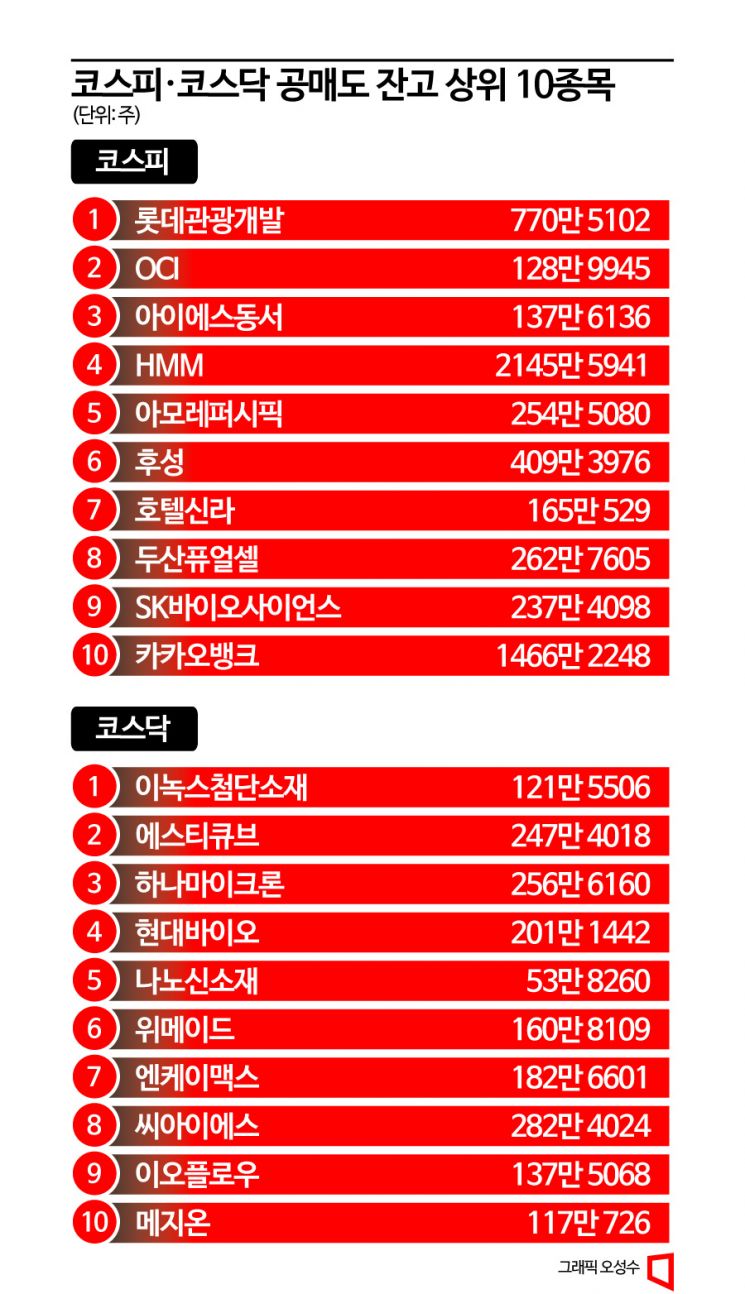
The KOSDAQ market shows a similar trend. The top 10 stocks by short selling balance (as of March 30) were Inox Advanced Materials, ST Cube, Hana Micro, Hyundai Bio, Nano New Materials, Wemade, NKMAX, CIS, Eoflow, and Mezzion. All major holders of short selling balances were foreign investment firms. Expanding the range to the top 50, except for EcoPro BM (ranked 23, held by Korea Investment & Securities), Wysiwyg Studios (ranked 30, held by Asset Plus Asset Management), and Enchem (ranked 33, held by Meritz Comprehensive Financial Securities), the stage was dominated solely by foreign investment firms.
Among both KOSPI and KOSDAQ, the most active foreign investment firms in short selling were Goldman Sachs, Morgan Stanley, JP Morgan, and Merrill Lynch. Considering that there is no reporting obligation if the short selling balance is less than 0.5% of the listed shares, the actual volume of short selling is estimated to be much higher. Given this situation, concerns have been raised that if short selling is fully resumed, the short selling offensive by foreign securities firms will intensify.
The argument for fully resuming short selling can be broadly summarized as follows: ▲ To be included in the Morgan Stanley Capital International (MSCI) Developed Markets Index, our stock market must ease short selling regulations as required by MSCI ▲ Inclusion in the MSCI Developed Markets Index will attract more foreign investor funds.
However, currently, short selling in our stock market is a system disadvantageous only to individual investors. For example, individual investors find it difficult to borrow stocks and face discrimination in the repayment period. Foreigners and institutions have unlimited short selling repayment periods, whereas individuals are limited to 90 days. In this 'tilted playing field,' foreign securities firms actively engage in short selling.
Foreign Securities Firms Active in Short Selling Show Good Performance
Short selling appears to have influenced the operating profits of foreign securities firms. According to the Korea Financial Investment Association, many foreign securities firms turned to operating losses last year. Standard Chartered Securities and ING Securities each shifted to losses compared to the previous year, and BNP Paribas Securities saw an expanded deficit. Other securities firms recorded poor results, with operating profits decreasing by 50-90%. Foreign securities firms that increased operating profits compared to the previous year included Goldman Sachs, Merrill Lynch, and Deutsche Bank. Coincidentally, those actively engaged in short selling received relatively better results.
When the stock market plunged due to the COVID-19 pandemic in March 2020, short selling was banned for all stocks. Although short selling was partially resumed in May 2021 for KOSPI 200 and KOSDAQ 150 stocks, more than 2,000 stocks remain banned from short selling. Foreign investment firms have consistently demanded a full resumption of short selling.
Recently, Financial Supervisory Service Governor Lee Bok-hyun attracted attention with remarks on the full resumption of short selling. In an interview with Bloomberg on the 29th of last month, Governor Lee said, "If certain conditions are met, there is a possibility of lifting the short selling ban," and added, "I hope short selling regulations will be lifted within this year." However, as investor backlash intensified, he called for a slowdown just one week later. On the 3rd, after a briefing following a 'Mutual Growth Finance Expansion Meeting' held at the DGB Daegu Bank headquarters, Governor Lee took a step back, stating, "Without easing financial market instability, it is difficult even to consider resuming short selling."
Following the rapid deterioration of public opinion after Governor Lee's remarks on short selling, the Financial Services Commission also moved to appease investors. Chairman Kim Ju-hyun said on the 31st of last month, "It is correct to normalize short selling, but there are many uncertainties regarding timing and methods, so we are continuing to observe." He added, "At this point, it is actually difficult to specify the timing of resumption," expressing a cautious stance.
© The Asia Business Daily(www.asiae.co.kr). All rights reserved.


















