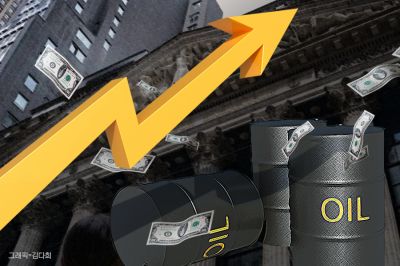
The sudden production cut measures by oil-producing countries have caused international oil prices to surge, increasing uncertainty in the future monetary policy path of the Bank of Korea. Since the domestic consumer price inflation rate slowed to the low 4% range last month, there is still a high possibility that the base interest rate will be kept unchanged at the Monetary Policy Committee meeting on April 11. However, if global inflation, which had been easing due to the rise in international oil prices, worsens again, the hawkish stance (preference for monetary tightening) of the U.S. Federal Reserve (Fed) and the Bank of Korea could be reinforced.
Inflation Rate at 4.2%... Bank of Korea Says "In Line with Forecast"
On the morning of the 4th, the Bank of Korea held a 'Price Situation Review Meeting' chaired by Deputy Governor Kim Woong to assess recent price trends and future outlooks. Deputy Governor Kim said, "The March consumer price inflation rate significantly decreased as expected in the February forecast due to the base effect caused by last year's sharp rise in international oil prices," but added, "There remains high uncertainty regarding the future inflation path related to international oil price trends, domestic and foreign economic conditions, and the magnitude and timing of public utility fee hikes."
The slowdown in consumer price inflation reduces the pressure on the Bank of Korea to raise the base interest rate. According to Statistics Korea on the same day, the consumer price index last month rose 4.2% year-on-year, marking the smallest increase in the past year. Earlier, Bank of Korea Governor Lee Chang-yong stated at a press conference on the 7th of last month, "I expect the consumer price inflation rate to fall below 4.5% after March and drop to the low 3% range by the end of the year," which is still consistent with the current figures.
If inflation proceeds as the Bank of Korea expects, it is highly likely that the Bank will keep the base interest rate unchanged, considering financial stability. Given the increased concerns about a global financial crisis following the collapse of Silicon Valley Bank (SVB) in the U.S. last month, further rate hikes could trigger liquidity shortages starting from weaker sectors such as savings banks or securities firms, shaking the market. Among market experts, the prevailing view is that the Bank of Korea will halt its rate hike trajectory at the current level of around 3.5% per annum.
 Deputy Prime Minister for Economy Choo Kyung-ho, Bank of Korea Governor Lee Chang-yong, Financial Services Commission Chairman Kim Ju-hyun, and Financial Supervisory Service Governor Lee Bok-hyun attended the "Emergency Macroeconomic and Financial Meeting" held on the 23rd of last month at the Bankers' Hall in Jung-gu, Seoul, and were talking before the meeting started. Photo by Yoon Dong-joo doso7@
Price Instability Due to Oil-Producing Countries' Production Cuts... Will the Bank of Korea Become 'Hawkish' Again?
However, this outlook assumes that international oil prices stabilize at around $70 to $80 per barrel. Since OPEC+?a coalition of the Organization of the Petroleum Exporting Countries (OPEC), Russia, and other oil-producing countries?announced an additional production cut of 1.16 million barrels per day on the 2nd (local time), oil prices have turned upward, which may lead to revisions in the Bank of Korea's previously forecasted inflation path and monetary policy direction.
West Texas Intermediate (WTI) and Brent crude prices have already surged more than 6% intraday, surpassing $80 per barrel. Park Sang-hyun, a researcher at Hi Investment & Securities, said, "If oil prices exceed around $90 per barrel, it will stimulate inflation expectations and negatively affect consumption. Above all, the inflationary pressure, which had been easing due to energy price stabilization, may expand again."
In fact, the recent drop in domestic consumer price inflation to the low 4% range was significantly influenced by the decline in international oil prices. If the forecast that inflation will fall to the 3% range by the end of the year is revised, the Bank of Korea may resume raising interest rates. The core inflation rate, excluding food and energy, was high at 4.8% in both February and March, and the rise in international oil prices has also expanded expectations for Fed rate hikes, which supports the Bank of Korea's potential rate increases.
However, some analysts predict that the recent production cuts by oil-producing countries will not significantly impact international oil prices or the monetary policy path. Im Hwan-yeol, a researcher at Shinhan Investment Corp., said, "Global oil demand and growth rate are highly correlated, and considering that the global growth rate is expected to slow to 1.7% this year, oil demand is projected to increase by only 1.5%. Oil prices in the second quarter are expected to fluctuate between $80 and $90, averaging around $85."
Exchange rates, one of the key indicators in deciding the base interest rate, remain highly uncertain. The won-dollar exchange rate surged past 1,320 won intraday following the news of production cuts by oil-producing countries but fell back below 1,310 won the next day. Kim Seung-hyuk, a researcher at NH Futures, said, "OPEC+'s production cuts have led to the strengthening of commodity currencies such as the Australian dollar, which is a downward factor for the dollar. Accordingly, the won-dollar exchange rate is expected to show a downward trend."
© The Asia Business Daily(www.asiae.co.kr). All rights reserved.


















