Impact of 14.2% Decline in Petroleum Product Prices
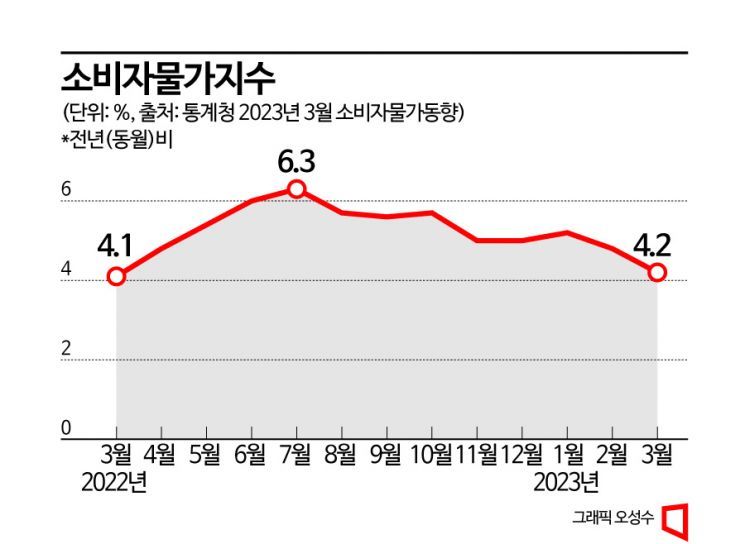
Last month, the consumer price inflation rate recorded 4.2%, marking the smallest increase in a year. This was influenced by a decline in petroleum prices due to falling international oil prices.
According to the 'March Consumer Price Trends' released by Statistics Korea on the 4th, last month's consumer price inflation rate rose 4.2% compared to the same month last year. This is 0.6 percentage points lower than the 4.8% increase recorded last month. The inflation rate is the lowest in 12 months since March last year (4.1%). The high inflation levels that surged to 5.4% in May, 6.0% in June, and 6.3% in July last year have gradually eased since the second half of the year.
The significant drop in petroleum prices helped maintain the inflation rate in the 4% range last month. Petroleum prices fell by 14.2 percentage points compared to the same month last year. This is the largest decline since November 2020, when prices dropped by 14.9 percentage points. Kim Bo-kyung, Economic Trend Statistics Officer at Statistics Korea, analyzed, "The decline in petroleum prices due to falling international oil prices had a major impact."
The core inflation rate (excluding agricultural products and petroleum) that shows the underlying trend of prices recorded a 4.8% increase, the same as the previous month (4.8%). The index excluding food and energy rose by 4.0%. The living cost index, which is composed mainly of frequently purchased items and closely reflects perceived inflation, rose by 4.4 percentage points compared to the same month last year, showing a slower increase than last month (5.5%). The living cost index consists of 144 items out of a total of 458 items, selected for their high purchase frequency and expenditure share, making price changes more sensitive. The fresh food index rose by 7.3 percentage points compared to the same month last year.
Kim Bo-kyung, Economic Statistics Officer at Statistics Korea, said, "While the outlook for inflation rate is cautious, the consumer price inflation trend is slowing down since the second half of the year, and considering the base effect from the significant rise in the first half of last year, stability is expected from the second half. However, uncertain factors such as public utility fee increases, international raw material prices including petroleum, and the service sector still remain at high levels." Last month, electricity, gas, and water prices rose by 28.4 percentage points compared to the same month last year, following February. Specifically, electricity rates increased by 29.5%, city gas by 36.2%, and district heating by 34.0%.
However, the decision by the major oil-producing countries' coalition OPEC+ to cut production is one of the risk factors. On the 2nd, they announced a daily crude oil production cut of 1.16 million barrels starting next month. This follows the large-scale production cut policy announced in October last year and the decision to implement additional cuts. Officer Kim explained, "If the production cuts cause international oil prices to rise, it is expected to be gradually reflected in domestic prices as well."
© The Asia Business Daily(www.asiae.co.kr). All rights reserved.

















