Won Hee-ryong "Reviewed as an Example of a Single Policy"
The government considered allowing non-stop passage during severe subway congestion but withdrew the related measures after receiving public complaints.
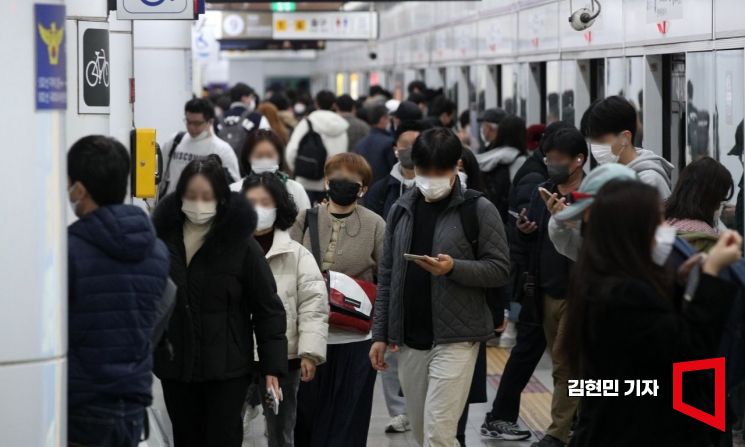 On the 15th, when the government announced the additional lifting of the mask-wearing mandate in most public places, including public transportation such as buses and subways, starting from the 20th, citizens wearing masks were walking on the platform of Yeouido Station in the Seoul subway. Photo by Kim Hyun-min kimhyun81@
On the previous day, Won Hee-ryong, Minister of Land, Infrastructure and Transport, ordered a "complete cancellation" of the non-stop passage plan related to urban railway congestion and instructed the preparation of fundamental improvement measures such as increasing train formations and expanding the number of operations.
Earlier, the Metropolitan Area Wide-area Transportation Committee under the Ministry of Land, Infrastructure and Transport announced on the 28th of last month that the manual would be revised to require railway operators to mandatorily review non-stop passage when congestion reaches a "severe" level. This raised concerns that trains might not stop at transfer stations even during peak commuting hours with heavy passenger flow.
In response, Minister Won explained, "The non-stop passage measure was reviewed internally only as one policy example. It was ordered to be scrapped because it is not acceptable to the public and cannot be a fundamental solution."
He added, "Even if it takes a little more time, we need to increase transport capacity by expanding train formations, increasing the number of train operations, and extending platforms. Fundamental measures that can directly resolve urban railway congestion are necessary."
He also said, "In exceptional cases such as large-scale events or festivals where non-stop passage is necessary, relevant agencies are currently cooperating to respond. However, disaster management measures related to congestion risk are being misunderstood as applying to daily life such as commuting, causing unnecessary anxiety among the public."
The Ministry of Land, Infrastructure and Transport explained that it initially considered applying non-stop passage due to subway congestion not during commuting hours but only in special cases such as festivals.
© The Asia Business Daily(www.asiae.co.kr). All rights reserved.
![Clutching a Stolen Dior Bag, Saying "I Hate Being Poor but Real"... The Grotesque Con of a "Human Knockoff" [Slate]](https://cwcontent.asiae.co.kr/asiaresize/183/2026021902243444107_1771435474.jpg)
















