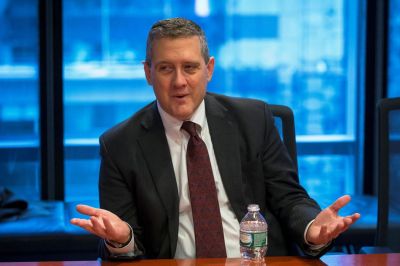
James Bullard, president of the Federal Reserve Bank of St. Louis and a prominent 'hawk' within the U.S. Federal Reserve (Fed), stated that the Fed's mission to lower inflation could become more difficult due to the unexpected production cut decision by the Organization of the Petroleum Exporting Countries Plus (OPEC+).
In an interview with Bloomberg TV on the 3rd (local time), President Bullard said, "(OPEC+’s production cut decision) was surprising," adding, "Whether it will have lasting effects is an open question that needs further observation." He pointed out, "Oil prices are highly volatile and hard to track precisely," and noted, "Some of this could lead to inflation, making the Fed’s job of lowering inflation a bit more difficult."
Following OPEC+’s announcement of production cuts the previous day, market speculation has emerged that Brent crude prices could soar to as high as $100 per barrel by the end of the year. Goldman Sachs has raised its Brent crude price forecasts by $5 each to $95 per barrel at the end of this year and $100 per barrel by the end of next year, reflecting the recent production cut decision. On the same day, West Texas Intermediate (WTI) crude for May delivery on the New York Mercantile Exchange (NYMEX) surged more than 8% intraday. As of the afternoon, it was trading above $80 per barrel, up more than 6%.
As a result, there is growing assessment that the Fed’s interest rate calculations, which have prioritized the fight against inflation, have become more complicated. There are concerns that the sharp rise in international oil prices could fuel inflation and trigger a hawkish interest rate hike stance among central banks, including the Fed. President Bullard, known as a representative hawk, also acknowledged this aspect.
However, President Bullard also mentioned that this year’s rise in oil prices aligns with his previous expectations. He explained, "In the first half of 2023, China reopened faster than expected, and Europe is avoiding a recession, so I anticipated high oil prices regardless," adding, "Strong U.S. economic indicators are also a bullish factor in the oil market."
Earlier, President Bullard stated that the U.S. terminal interest rate should rise to 5.625% this year. The Fed raised its benchmark interest rate by 0.25 percentage points to a range of 4.75?5.0% at the March Federal Open Market Committee (FOMC) meeting. The next meeting is scheduled for May 2?3.
Market expectations for a 0.25 percentage point rate hike at the May FOMC meeting, known as a baby step, have strengthened. According to the Chicago Mercantile Exchange (CME) FedWatch tool, as of the afternoon, federal funds futures markets are pricing in more than a 56% probability of a baby step, up from the previous day’s 48% range.
However, since the Fed primarily monitors core inflation, which excludes volatile oil and food prices, there is also a judgment that a more cautious watch is necessary. The probability of a rate hold is 43.6%.
This week, key indicators that could impact the Fed’s monetary policy decisions are scheduled to be released, including U.S. March employment data, PMI reports, and the ADP payroll report. Wall Street estimates that the March nonfarm payrolls report, scheduled for the 7th, will show about 240,000 new jobs, reflecting a potential further decline from the previous month’s 311,000. The unemployment rate is expected to remain steady at 3.6%.
© The Asia Business Daily(www.asiae.co.kr). All rights reserved.
!["The Woman Who Threw Herself into the Water Clutching a Stolen Dior Bag"...A Grotesque Success Story That Shakes the Korean Psyche [Slate]](https://cwcontent.asiae.co.kr/asiaresize/183/2026021902243444107_1771435474.jpg)
















