Simultaneous Wildfires in Seoul, Daejeon, and Chungnam
Impact of Climate Change... Increasing and Enlarging Wildfires
Spring wildfires across the country have subsided thanks to timely rainfall, but the fundamental cause?climate change?remains. The number of wildfires is increasing, and the scale of damage is growing as they become larger.
According to the fire authorities and the Korea Forest Service on the 2nd, wildfires broke out simultaneously in 35 locations nationwide, including Seoul, Daejeon, and Chungnam. Strong winds exceeding 10 meters per second amid dry weather caused the fires to spread.
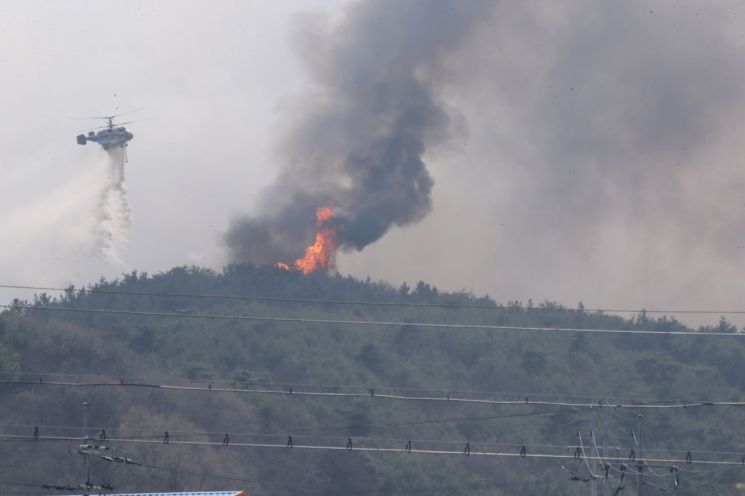 On the afternoon of the 3rd, the second day of the Hongseong wildfire, the flames, which had calmed down, intensified again due to strong winds, and wildfire helicopters are continuously engaged in firefighting efforts. Photo by Yonhap News
The wildfire that occurred on Inwangsan Mountain in Jongno-gu, Seoul, has been fully extinguished. Approximately 15 hectares of forest, equivalent to the area of 21 soccer fields (7,140㎡ each), were destroyed by this fire.
In Hongseong, Chungnam, where a 'Level 3 wildfire alert' was issued, the fire continued for two days. The wildfire that started on the 2nd in the hills of Jung-ri, Seobu-myeon, Hongseong-gun, seemed to be under control by the morning of the 3rd, but strong winds reaching up to 10 meters per second caused it to spread again. The affected area is estimated to be 984 hectares. Additionally, on the same day, wildfires broke out simultaneously in other regions such as Seo-gu in Daejeon, Geumsan in Chungnam, Dangjin in Chungnam, Okcheon in Chungbuk, and Goheung in Jeonnam.
According to wildfire statistics from the National Institute of Forest Science under the Korea Forest Service over the past 10 years, 57% of wildfires occur between March and May. This is because people's outdoor activities increase in spring and the farming season begins. The 10-year average number of wildfires during March to May is 303.4 cases, with damage covering approximately 3,233 hectares.
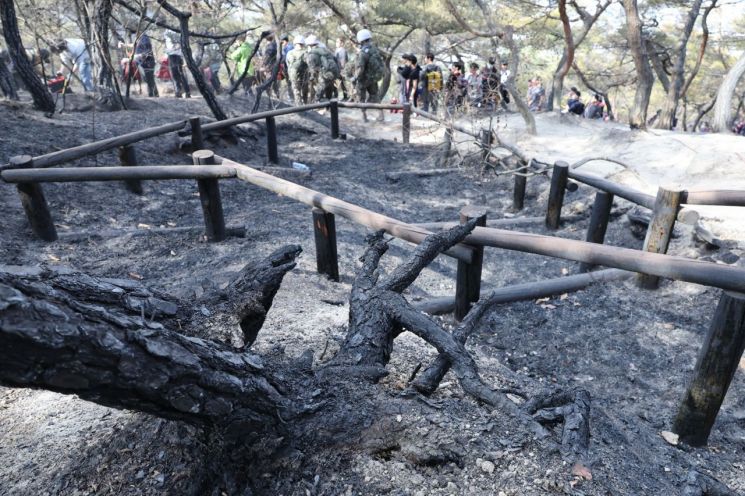 The hiking trail in the area of the wildfire that occurred on the 3rd at Inwangsan Mountain, Jongno-gu, Seoul, is burned. Photo by Yonhap News
Most wildfires are caused by human factors. According to the Korea Forest Service's "Wildfire Occurrence by Cause over 10 Years (2013?2022)," the leading causes are unauthorized fires by visitors (177.4 cases), garbage burning (68.2 cases), cigarette-related fires (30.4 cases), and residential fire spread (30.2 cases), in that order.
The problem is that due to the impact of climate change, spring wildfires are becoming more frequent and larger in scale. Reduced rainfall and increased dry days have created conditions conducive to wildfires. According to the National Institute of Forest Science, the number and area of wildfires during the spring period (February to May) were 238 cases and 707.3 hectares in 2021, and 508 cases and approximately 24,704 hectares in 2022. Compared to 2021, the number of cases doubled and the damaged area increased 34 times in 2022.
In fact, as spring began this year, dry weather continued nationwide. According to the Korea Meteorological Administration's analysis of monthly nationwide precipitation days, March 2023 (3.6 days of precipitation, total 28.7 mm) had significantly less rainfall compared to March 2021 (8.1 days, 110.7 mm) and March 2022 (9.0 days, 89.4 mm).
 On the afternoon of the 2nd, a firefighting helicopter is conducting extinguishing operations at Inwangsan Mountain in Jongno-gu, Seoul, where a wildfire occurred. Photo by Yonhap News
The decrease in fuel moisture content within forests during spring also contributed to the spread of wildfires. Fuel moisture content is an important factor affecting wildfire occurrence, intensity, and spread; generally, lower moisture content increases the likelihood of wildfires.
According to research by the National Institute of Forest Science, applying forest fuel moisture distribution data to days with simultaneous wildfires from 2013 to 2018 showed that the fuel moisture content at 453 wildfire sites ranged from 7.2% to 17.2%. Notably, 315 of these wildfire occurrences happened under conditions where fuel moisture content was 10.5% or lower.
On the 2nd, when simultaneous wildfires occurred, the fuel moisture content within forests was very low: 4.7% in Jongno-gu, Seoul (Inwangsan), 5.6% in Hongseong, 6.1% in Seo-gu, Daejeon, and 6.6% in Geumsan, Chungnam.
Im I-ja, a member of the People Power Party, stated at the party's strategy meeting on the 21st of last month, "The mountains of South Korea are groaning under large-scale wildfires breaking out simultaneously," and pointed out, "The increasing frequency and scale of wildfires cannot be separated from climate change."
She added, "Recognizing that Korea's climate is vulnerable to wildfires, I hope the government, local governments, and related agencies review overall wildfire prevention and suppression measures and prepare more thorough countermeasures. I will do my best to support the necessary budgets and legislation for manpower and facilities in the National Assembly."
© The Asia Business Daily(www.asiae.co.kr). All rights reserved.
![Clutching a Stolen Dior Bag, Saying "I Hate Being Poor but Real"... The Grotesque Con of a "Human Knockoff" [Slate]](https://cwcontent.asiae.co.kr/asiaresize/183/2026021902243444107_1771435474.jpg)


















