SK Hynix's Female Employees Have Longer Tenure Than Males
Effect of Reducing Pay Gap and Increasing Welfare Benefits
"Carefully Designed Childcare Support System Prevents Career Breaks"
The average employee tenure at the top 10 companies has increased by 1.7 years over the past decade. The gap in tenure between men and women has narrowed by 2.2 years. This is the result of companies expanding welfare benefits such as average female wages and parental leave to prevent career interruptions.

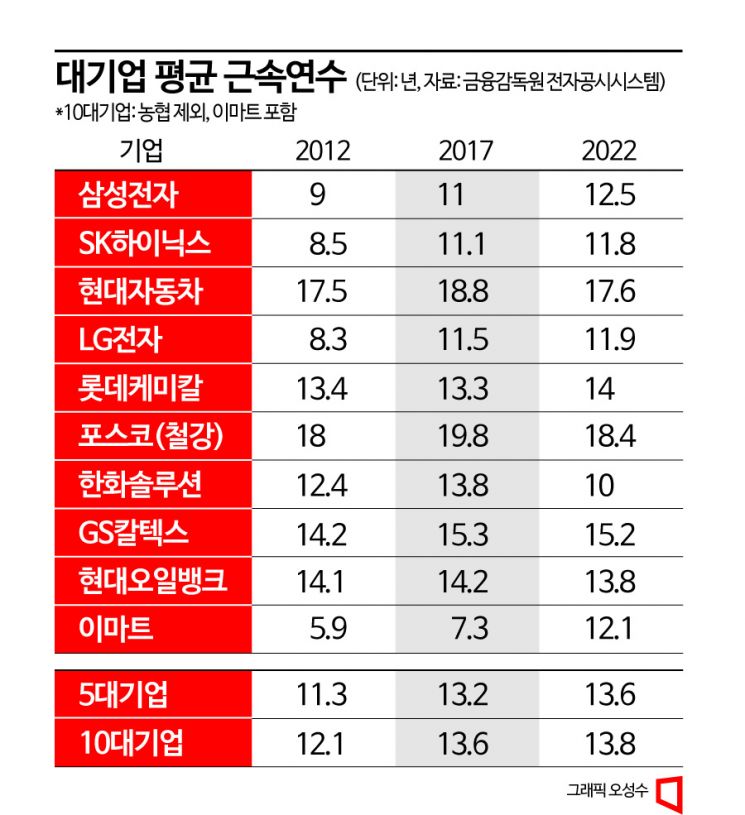
A comprehensive survey of business reports from major affiliates of the top 10 companies shows that last year, the average employee tenure was 13.8 years. This is an increase from 12.1 years in 2012 and 13.6 years in 2017. The calculation replaced the 10th-ranked cooperative NongHyup with 11th-ranked Emart.
Narrowing down to the top 5 companies, last year's average tenure was 13.6 years, up from 11.3 years in 2012 and 13.2 years in 2017.
Companies with the largest increases in tenure over the past 10 years include Emart with 6.2 years (5.9 → 12.1 years), LG Electronics with 3.6 years (8.3 → 11.9 years), and SK Hynix with 3.3 years (8.5 → 11.8 years).
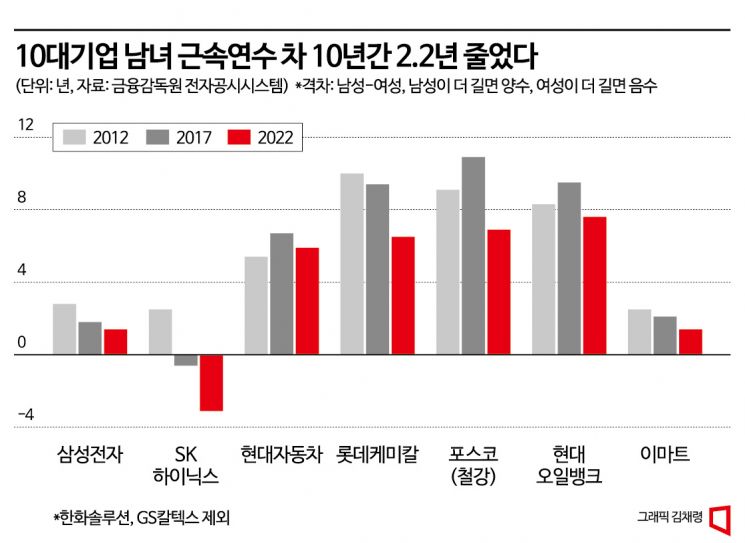
Notably, the gap in tenure between men and women has decreased. It shrank by 2.2 years from 6 years in 2012 (men 13.2 years - women 7.2 years) to 3.8 years last year (14.7 - 10.9 years).
Companies with smaller differences include Samsung Electronics at 1.4 years (men 12.9 years - women 11.5 years) and Emart at 1.4 years (men 12.9 years - women 11.5 years).
There are also companies where women’s tenure exceeds men’s, such as SK Hynix. In 2012, men (9.7 years) had longer tenure than women (7.2 years). However, last year, women’s tenure (13.9 years) was 3.1 years longer than men’s (10.8 years).
The narrowing gap in tenure between men and women is related to the reduction in wage differences. Among the top 10 companies, looking at six companies where data over 10 years can be directly compared, the ratio of women’s average annual salary to men’s (excluding those on leave) increased from 59.8% in 2012 to 65.6% in 2017, and 71.6% last year. This represents an 11.8% increase over 10 years.
Over the past decade, the female wage ratio increased most at Samsung Electronics by 21.9% (55% → 76.9%), followed by Lotte Chemical at 15.7% (50% → 65.7%), and Emart at 15.4% (42% → 57.4%).
Long employee tenure alone is not necessarily a positive sign, as it can indicate severe personnel stagnation. Since the end of last year, companies such as Lotte Duty Free, Lotte Himart, Hi Plaza (operator of LG Electronics Best Shop), and Hite Jinro have been accepting voluntary retirements from employees with 10 to 15 years or more of tenure or those aged 50 and above to resolve personnel bottlenecks. They are persuading employees by offering tuition support, consolation money, and lump-sum payments.
However, the fact that the tenure and wage gaps between men and women are narrowing while tenure is lengthening is positive. It means that conditions for women’s career management are improving. The simultaneous increase in women’s tenure and wages is evidence that the number of promotions to managerial and deputy managerial positions has increased.

Companies providing various welfare benefits have played an important role in reducing the tenure and wage gaps between men and women. Companies are offering not only maternity and parental leave but also pregnancy and childbirth allowances and flexible work arrangements.
SK Hynix introduced a 'family-friendly program' at the end of last year. It provides 500,000 KRW per treatment without limit on the number of infertility treatments (in vitro fertilization/artificial insemination). It offers five days of paid infertility leave, reduced working hours throughout pregnancy, and childbirth support payments of 300,000 KRW for the first child, 500,000 KRW for the second, and 1,000,000 KRW for the third and subsequent children. HD Hyundai operates a daycare center until 10 p.m. to care for children of employees working late shifts.
An SK Hynix official said, "To prevent talented employees from experiencing career interruptions due to childbirth and childcare, it is necessary to carefully design and operate parental leave and infertility support systems."
© The Asia Business Daily(www.asiae.co.kr). All rights reserved.


















