Hyundai Motor Company and Kia continued their record monthly sales in the United States last month.
Hyundai Motor America announced on the 1st (local time) that it sold 75,404 units last month. This represents a 27% increase compared to the same month last year and is the highest March sales volume in history. It marked the fifth consecutive month of sales growth on a monthly basis.
The compact sport utility vehicle (SUV) Venue saw a 74% increase during the same period, and most of the main models showed steady sales growth, including the Elantra (Avante) Hybrid (37%), Tucson Hybrid (52%), Santa Cruz (30%), and Santa Fe Hybrid (123%).
Sales in the first quarter of this year reached 184,449 units, a 16% increase compared to the same period last year. This is also the highest first-quarter sales volume in Hyundai's history.
Kia Motors America also set a new record for the highest sales in March. It sold 71,294 units last month, a 19.8% increase compared to the same period. First-quarter sales totaled 184,146 units, marking a new record for the first quarter, just like Hyundai.
This is a 19.8% increase compared to the first quarter of last year and a 15% increase compared to the previous first-quarter record set in 2021. Multiple models saw sales growth, including the multipurpose vehicle (MPV) Carnival, which increased by 81%.
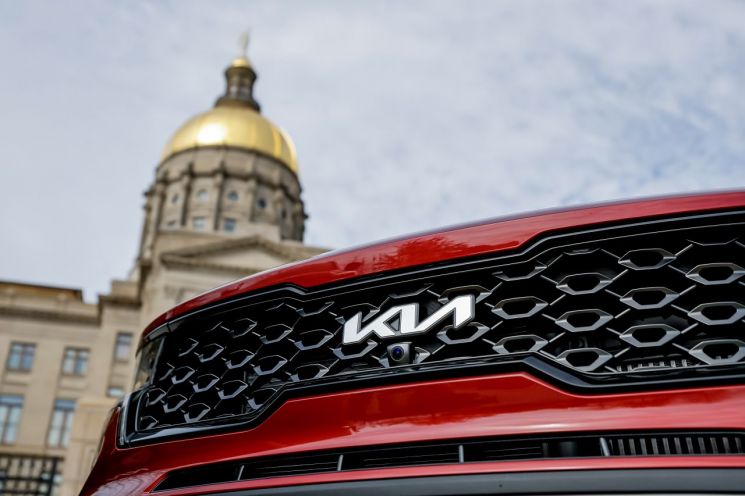 A Kia Sorento vehicle is displayed at the state capitol in Atlanta, Georgia, USA. Georgia is the only state with a Kia factory, and the state government has designated a Kia Day.
 The combined sales of Hyundai and Kia continued to increase year-over-year for eight consecutive months. This is the longest streak among mass-market brands sold locally. The premium brand Genesis sold 5,656 units last month, a 23% increase compared to the same period last year.
However, electric vehicle sales declined. Hyundai’s dedicated electric vehicle Ioniq 5 sold 2,114 units, down 22% compared to the same period. The hydrogen vehicle Nexo sold only 21 units, down 81%. Kia’s EV6 sold 988 units, a sharp 69% decrease.
The decline in electric vehicle sales is due to the U.S. Inflation Reduction Act (IRA), which does not provide tax credit benefits for fully assembled vehicles not assembled locally. Commercial vehicles purchased by rental car companies and others are exempt from this regulation, but Hyundai and Kia have primarily targeted individual customers in their promotional activities so far.
© The Asia Business Daily(www.asiae.co.kr). All rights reserved.
![Clutching a Stolen Dior Bag, Saying "I Hate Being Poor but Real"... The Grotesque Con of a "Human Knockoff" [Slate]](https://cwcontent.asiae.co.kr/asiaresize/183/2026021902243444107_1771435474.jpg)

















