The government has analyzed that if the increase in electricity and gas prices is delayed, Korea Electric Power Corporation (KEPCO) will exceed its bond issuance limit, endangering the power supply network, and Korea Gas Corporation (KOGAS) will see its outstanding receivables swell to 13 trillion won by the end of this year.
According to the energy industry on the 2nd, KEPCO's cost recovery rate through electricity charges is only about 70%, so it raises the power purchase payments to power producers by issuing bonds four times a month (at an average interval of 9 days).
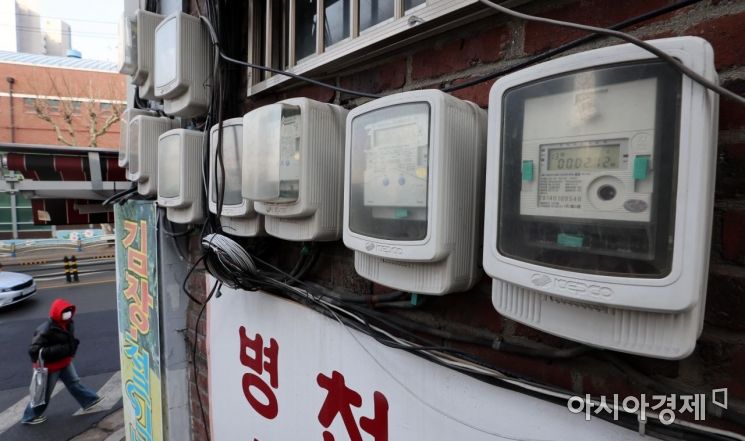 On the 30th, an electric meter at a multi-family house in Seoul city, where the government is scheduled to announce the electricity and gas rate adjustment plan to be applied in the first quarter of next year. The Ministry of Trade, Industry and Energy will announce the electricity and gas rate adjustment plan for the first quarter of next year on this day. Photo by Kim Hyun-min kimhyun81@
The problem is that if a deficit of more than 5 trillion won occurs again this year, it is expected that next year KEPCO will exceed the bond issuance limit stipulated by the KEPCO Act (five times the sum of capital and reserves). KEPCO stated that if there is a disruption in bond issuance, it will be difficult to pay for power purchase and equipment/construction costs, which could jeopardize the entire power industry ecosystem. If investment in transmission and distribution networks, which is at the level of 6 to 7 trillion won annually, shrinks and power generated by power plants cannot be delivered to demand sites, output restrictions at power plants will expand and the stability of the power system may be compromised.
KEPCO emphasized that if the electricity price increase is delayed, it will have no choice but to increase the scale of KEPCO bond issuance, which could cause market disruption due to the concentration of KEPCO bonds. KEPCO bonds accounted for 4.8% (37.2 trillion won) of total bond issuance last year and already 2.6% (5.3 trillion won) this year. The KEPCO bond interest rate rose from 1.6% in June 2021 to 5.8% in October last year and maintained a high level at 4.3% last month, so if the issuance scale expands, the concentration phenomenon is likely to worsen.
KOGAS projected that if gas prices are not raised, the accumulated raw material cost receivables of 8.6 trillion won by the end of last year will increase to 12.9 trillion won by the end of this year. The annual interest cost on these receivables is expected to reach about 470 billion won (13 billion won per day). Currently, the cost recovery rate through gas charges is only 62.4%, so KOGAS's receivables are inevitably increasing. KOGAS expressed concern, saying, "Since the COVID-19 pandemic, uncertainties continue due to increased liquefied natural gas (LNG) demand following China's reopening, competition with European countries for stockpiling LNG, and investment contraction in major LNG production projects," adding, "The financial deterioration of KOGAS could negatively affect negotiations to secure LNG volumes."
The Ministry of Trade, Industry and Energy plans to review the financial conditions of KEPCO and KOGAS, inflation, and international energy price trends and announce adjustment measures for electricity and gas prices as soon as possible. On the 3rd, an 'Emergency Meeting of Private Members of the Energy Committee' attended by Minister Lee Chang-yang will be held to discuss the necessity of energy price adjustments.
© The Asia Business Daily(www.asiae.co.kr). All rights reserved.

















