Opposition to Flexible Working Hours Rises... Party-Government-Assembly Prepare Countermeasures
Legislation to Address Long Vacations and Abuse of Comprehensive Wages Planned
Feasibility in Question... Existing Laws Also Poorly Enforced
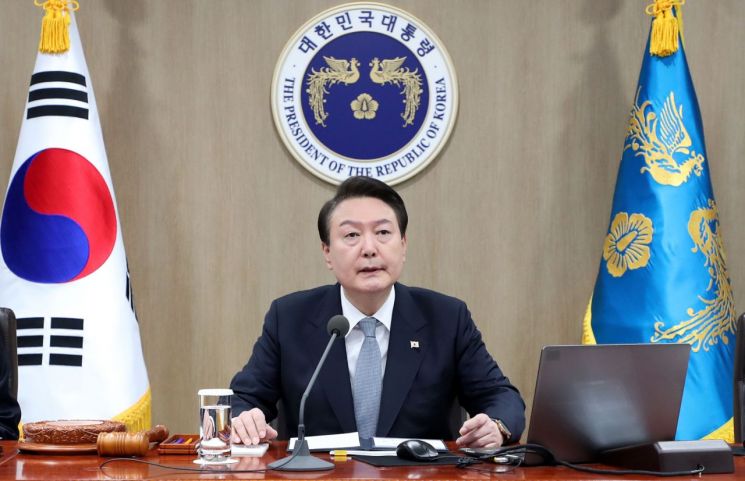 President Yoon Suk-yeol is speaking at the Cabinet meeting held on the 28th of last month at the Yongsan Presidential Office building in Seoul. [Image source=Yonhap News]
The ruling party and the government have decided to push for legislation to resolve the issues of long-term leave usage and the abuse of comprehensive wage systems, which are considered the biggest obstacles in the process of reforming the working hours system. With strong public opposition to the government's plan to increase the maximum weekly working hours, attention is focused on whether such measures can persuade workers, including the MZ (Millennial + Generation Z) generation.
According to the government and ruling party on the 1st, the tripartite meeting (ruling party, government, presidential office) reaffirmed the principle of diversifying the management units of extended weekly working hours to monthly, quarterly, semi-annual, and annual units. However, due to significant public anxiety over the increase of maximum weekly working hours to 69 hours, they plan to gather public opinion from 6,000 citizens and supplement anticipated issues such as guaranteeing long-term leave.
Park Dae-chul, the Policy Committee Chair of the People Power Party, held a breakfast meeting with Im E-ja, the ruling party's senior member of the Environment and Labor Committee, Lee Kwan-seop, the Chief of National Planning at the Presidential Office, and Lee Jeong-sik, Minister of Employment and Labor, to discuss the reform plan for the working hours system. Chair Park emphasized, "We must establish a working hours system that does not make workers anxious," adding, "No matter how good the content is, if workers doubt and feel uneasy, it is not a good system."
A key point discussed by the ruling party and government that day was legislating to allow workers to freely take long-term leave. The government initially promoted the 'Working Hours Savings Account System,' which allows workers to accumulate and use extended, night, and holiday working hours in exchange for flexible working hours, enabling long-term leave. However, the labor sector strongly opposed this, arguing that "in reality, work is concentrated and leave cannot be taken," resulting in backlash.
In fact, a survey conducted last year by the Korea Institute for Health and Social Affairs on 22,000 adults (17,510 employed) showed that the average annual leave entitlement was 17.03 days, but the actual used leave was only 11.63 days. The labor sector criticized that due to various factors such as 'lack of replacement personnel,' 'excessive workload,' 'supervisor's scrutiny,' and 'organizational atmosphere,' workers cannot fully use their entitled leave, making long-term leave an unrealistic policy.
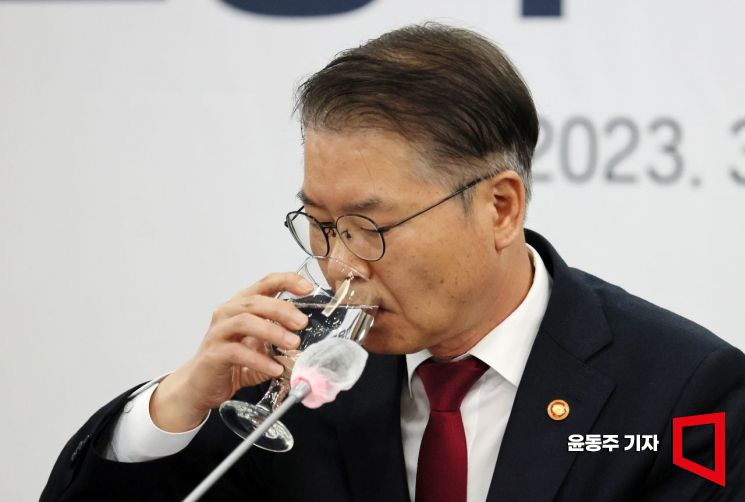 Lee Jeong-sik, Minister of Employment and Labor, is attending a meeting with five major economic organizations held at the Press Center in Jung-gu, Seoul, on the 28th of last month. During the meeting, he appears to be drinking water as if feeling thirsty. Photo by Yoon Dong-joo doso7@
The ruling party and government also began legislative work to eradicate the abuse of the comprehensive wage system, which is considered the biggest cause of 'free labor.' The comprehensive wage system pays a fixed monthly wage regardless of actual working hours. Therefore, there are serious concerns that overlapping the comprehensive wage system with flexible working hours will lead to widespread 'unpaid overtime.'
The government views thorough working hours calculation as essential to resolving the abuse of the comprehensive wage system and is considering measures such as having workers record their working hours through an application. Chair Park said yesterday, "We discussed legislating measures to eradicate the abuse of the comprehensive wage system and to supplement the worker representative system to prevent potential misuse in the field."
The government's move to prepare supplementary measures, including legislation, appears to be based on the judgment that while it is necessary to push forward with easing the 52-hour workweek?a campaign pledge of President Yoon Seok-yeol?there is unexpectedly strong opposition from workers, so incentives must also be provided. President Yoon's approval rating recently dropped to its lowest level in four months amid controversies over working hours reform and diplomatic issues with Japan.
However, despite the ruling party and government's push for legislation, concerns remain in the labor sector. Considering that even already legislated systems such as annual leave are not well observed, they argue that guaranteeing long-term leave through legislation is difficult. Especially with many small and medium-sized enterprises suffering from manpower shortages, some believe legislating long-term leave is impossible. A labor sector official said, "It will be difficult to even push for legislation, and even if it passes, it is questionable whether it can be realistically applied."
© The Asia Business Daily(www.asiae.co.kr). All rights reserved.


















