Ministry of Unification Publishes First Public North Korean Human Rights Report
Surveyed 3,412 on Human Rights Conditions... Only 508 Testimonies Used
Lacks Objectivity and Representativeness... "Predictable Inadequate Report"
The government invested billions of won to build a database (DB) for investigating human rights in North Korea, but it has been revealed that the first North Korean Human Rights Report recently released did not properly utilize it. Although President Yoon Suk-yeol urged the disclosure of North Korean human rights conditions, stating that "the horrific human rights violations of North Korean residents must be fully exposed to the international community," the report merely listed testimonies without even basic data analysis, leading to criticism that the report is unlikely to gain trust internationally.
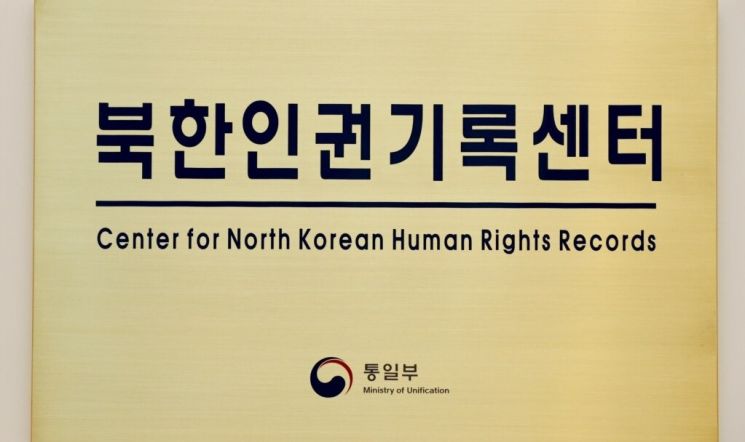
According to the revenue and expenditure data of the North Korean Human Rights Records Center reported to the National Assembly on the 2nd, the center has spent at least 7.98 billion won in budget since its launch in September 2016 until the end of July last year. Among this, it was identified that more than 3.33 billion won was invested solely in building and operating the human rights investigation database called the 'North Korean Human Rights Information System.'
Despite creating a multi-billion won DB... Human rights analysis less thorough than private sector
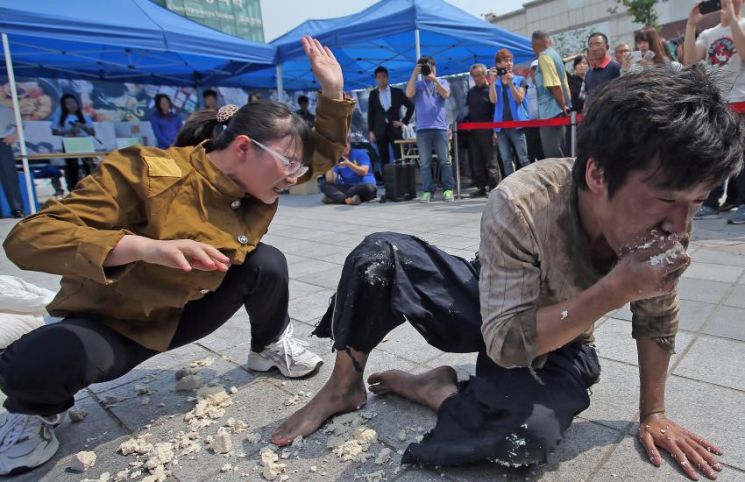 A play depicting the flower children days of North Korean defector adolescents
 [Photo by Yonhap News]
Earlier, the Ministry of Unification published the 'North Korean Human Rights Report' for the first time on the 31st of last month, seven years after the enactment of the North Korean Human Rights Act. This report was based on testimonies from 508 defectors and over 1,600 cases, containing harrowing realities experienced by North Korean residents, such as testimonies of public executions of residents who sold Korean products like high heels or cosmetics.
The DB built by the North Korean Human Rights Records Center contains records of a total of 3,412 defectors surveyed since 2017. This number represents those who responded to the 'basic survey' dealing with human rights conditions. However, this report only utilized testimonies from 508 individuals whose human rights violation experiences occurred after 2017. Although 2,075 defectors completed 'interrogation records,' which are legal documents containing detailed damage statements, the report failed to present even basic frequency values of human rights violations by time, region, or type for each testimony.
The report only analyzed defectors' gender and region of origin in a single table. This is a less thorough level compared to the North Korean Human Rights White Paper published by the Korea Institute for National Unification in December last year, which detailed the status and conditions by issue.
In particular, while the report presented horrific human rights violation cases such as experiments on disabled persons and executions of pregnant women, it failed to specify comparable status or evidence. The UN Commission of Inquiry (COI) report on North Korean human rights indicated testimonies of defectors as anonymous footnotes for each human rights violation case to secure minimum credibility, but the center concealed all information about the testimony subjects citing 'personal information protection.'
Listing testimonies of 508 victims... "No trend presentation or analysis"
The representativeness of the investigation was also lacking. Among the 508 subjects, 300 (59.1%) were from Yanggang Province and 88 (17.3%) from North Hamgyong Province, showing a bias toward border regions. It has been pointed out that if the DB had been properly utilized, it would have been possible to assign 'a kind of weighting' by region to mitigate the skewed responses. For example, in election polls, if respondents from provinces are fewer than those from metropolitan areas, adjustments are made accordingly.
Notably, among defectors whose victim testimonies were cited, 55 (10.8%) were from Pyongyang, a relatively high proportion. The report explains this as due to the increased proportion of defectors among overseas dispatched workers following North Korea's border closure. However, the actual conditions of 'overseas dispatched workers' were only briefly addressed under the labor rights section. This accounted for only 25 pages out of the entire 450-page report.
Even this was at the level of re-explaining previously known conditions, with only 9 cases presented out of over 1,600. This is why there is criticism that it falls short of the level of existing North Korean human rights reports that separately address overseas defectors and workers.
Lee Young-hwan, former head of the Transitional Justice Working Group (TJWG), pointed out, "To utilize the report in line with the purpose of the North Korean Human Rights Act, it is necessary to analyze and present trends such as whether certain problems are concentrated in specific periods, whether they are ongoing issues, or whether they pertain to some regions or the entire North Korea, but none of this is present." He added, "The North Korean Human Rights Records Center has not shown what issues it has tracked over seven years or which human rights violations it considers important."
Reasons for not utilizing the DB... Was the human rights investigation inadequate?
There are also criticisms that the failure to utilize the vast DB stems from the survey questions themselves being inadequate. The Ministry of Unification has kept the human rights investigation questions confidential and has not submitted the contents despite requests from the National Assembly.
In particular, during the process of composing the survey questions, there was opposition from the advisory group regarding the setting of some questions, but it is known that the previous government pushed them through. An expert who was a former advisory committee member involved in publishing the report said, "The Blue House (Moon Jae-in administration) instructed to include 'social rights' items in the survey for use in North Korea policy," adding, "We opposed it because social rights surveys require long and meticulous review, but it was ultimately reflected."
Unlike clear types of human rights violations such as violence, detention, and public executions, 'social rights,' which deal with livelihood issues, are considered the most challenging in human rights investigations. This is because it is difficult to quantify the perpetrators, responsibility, and degree of harm. For example, regarding the statement "I ate only one meal a day," it is difficult to objectively measure who caused the harm and to what extent.
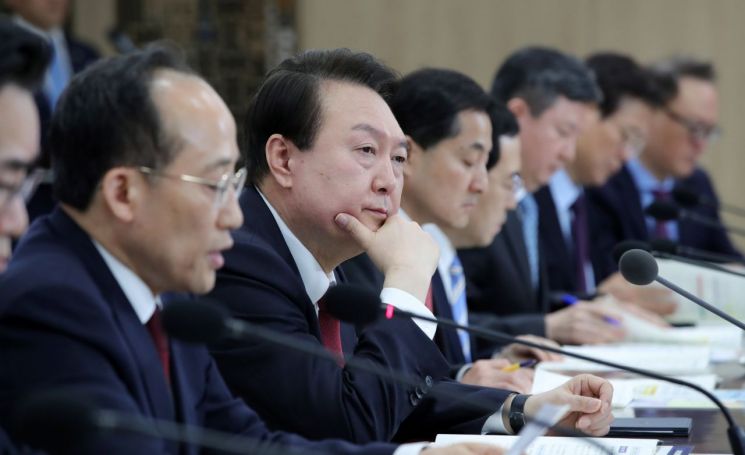
Earlier, on the 28th of last month, President Yoon Suk-yeol emphasized at a Cabinet meeting, "The horrific human rights violations of North Korean residents must be fully exposed to the international community," and stated, "(Taking the occasion of the report's publication) the North Korean Human Rights Act must now be practically implemented." A government official said that the presidential office instructed the Ministry of Unification to include the term 'annual' in the report, emphasizing that the North Korean Human Rights Report should be published every year.
However, the Ministry of Unification removed the term 'annual,' which had been used provisionally, when releasing this report. Like the previous administration, which delayed the report's release throughout its term, the publication cycle has again become unclear. A center official said, "If the number of survey participants is extremely low, there may be no changes in next year's report, so we are concerned," adding, "If we feel the need to publish, we will release it next year as well, but there is no fixed publication cycle."
An expert in human rights investigations who requested anonymity evaluated, "The level is too low to be called a government-issued report," and added, "Even reports published by civil organizations do not just list testimonies for hundreds of pages." The expert continued, "If the DB had been properly built, at least the experience and witness ratios by type of human rights violation could have been presented," and said, "If they wanted to show recent situations, they should have compared past data to indicate which human rights violations have increased or decreased."
© The Asia Business Daily(www.asiae.co.kr). All rights reserved.



















