On the 31st, the Space Development Promotion Working Committee Plans to Handle 10 Agenda Items
The government will significantly expand investment to foster the space economy, including increasing the space development budget by about 20% compared to the previous year. It will also finalize other project plans such as the schedule for the third launch of the Korean Launch Vehicle (Nuriho).
On the morning of the 31st, the government held the 46th Space Development Promotion Working Committee meeting at the National Science and Technology Advisory Council's main conference room in Gwanghwamun, Seoul, chaired by Oh Tae-seok, First Vice Minister of the Ministry of Science and ICT, to handle 10 agenda items including the '2023 Space Development Promotion Implementation Plan.'
First, the '2023 Space Development Promotion Implementation Plan,' which significantly increases the budget compared to the previous year, was approved. To accelerate the realization of the space economy, 874.2 billion KRW will be invested in space development this year, an increase of 19.5% from 731.6 billion KRW in the previous year. With the expanded resources, focused investment will be made to achieve the five major missions presented in the 4th Basic Plan for Space Development Promotion (2023?2027), including space exploration, space transportation, space industry, space security, and space science.
The 'Third Launch Permit Review Results (Draft)' for conducting the third launch of the Korean Launch Vehicle (Nuriho) between mid-May and late June will also be approved. The detailed date and time will be decided in April through the Launch Management Committee, considering the satellite preparation status and launch conditions.
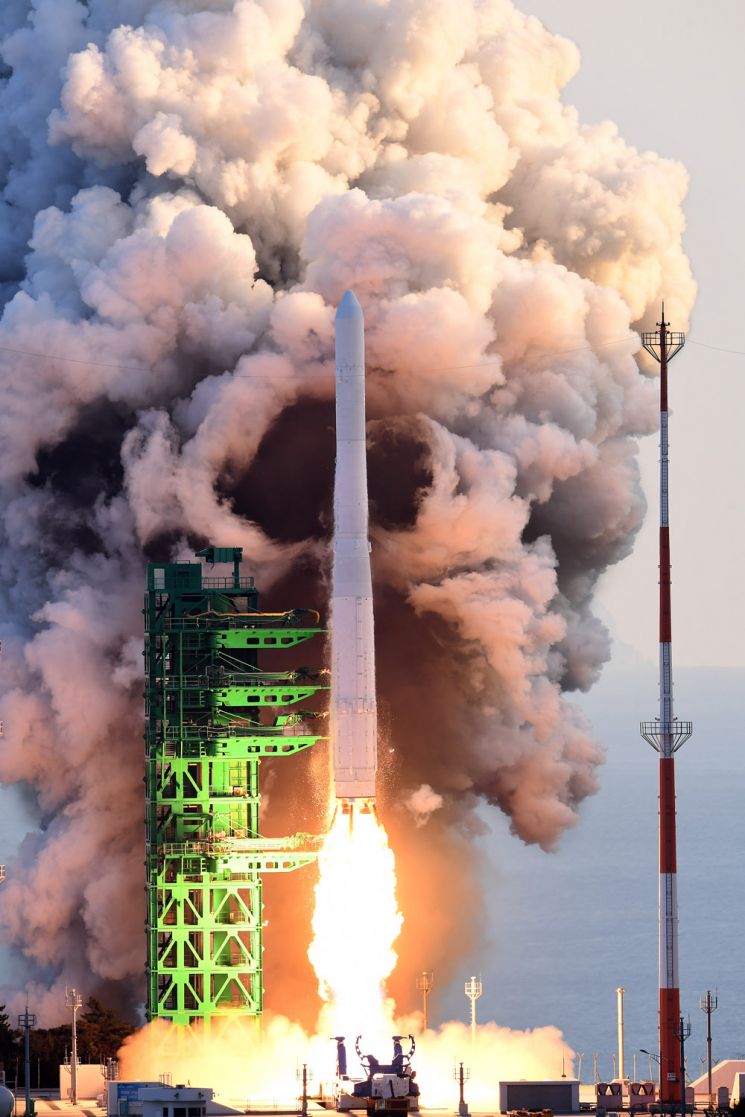
Regarding recent confusion over space launch vehicle permit procedures related to the Ministry of National Defense's test launch and private startup Innospace's test launch, the government will organize the launch permit process. Anticipating a sharp increase in private sector demand for space launch vehicle launches, the government will establish a 'Standard Procedure for Space Launch Vehicle Launch Permits' to support the commercialization of private space launch services. Currently, there are no permit procedures or standards for companies or public institutions other than the Korea Aerospace Research Institute (KARI) to conduct launches.
The next-generation launch vehicle development plan will also be finalized on this day. It will be developed as a two-stage configuration with more than three times the performance of Nuriho for large satellite launches and space exploration. The next-generation launch vehicle is planned to be launched twice in 2030 and 2031, followed by a launch carrying a lunar lander in 2032. To enhance private sector launch vehicle technology and industrial capabilities, a system integrator company will participate in the entire process of next-generation launch vehicle development (design to launch operation) at KARI, and the system integrator company will be publicly recruited and selected within this year.
The response system for the fall of large space objects will also be organized. The government plans to improve the points identified through an evaluation of inter-agency response measures during the crash of a large satellite owned by NASA in January. At that time, notification was received only 20 hours before the crash, creating an urgent situation. Comprehensive responses such as inter-agency meetings were not properly conducted during holidays and nighttime. Only two text messages were sent. The satellite later passed over the Korean Peninsula and crashed in Alaska. The government will establish an emergency meeting system and supplement the lack of independent monitoring capabilities. Along with expanding monitoring infrastructure such as radar construction, the response manual will also be revised and supplemented.
The 'Development Plan for Active Control Preceding Technologies for Space Objects' contains a comprehensive strategy for technology development to extend the lifespan of space assets (on-orbit services) by approaching space objects with rendezvous and docking, robotic arms, changing position and orbit, refueling, repair, and orbit towing. As the number of artificial satellites and other space objects is expected to increase rapidly, securing related technologies is expected to help lead new space industries such as on-orbit services.
A 'Space Exploration Specialized Subcommittee' will be newly established under the National Space Committee. Composed of relevant experts, the subcommittee will continuously identify space exploration-related demands from research and industry fields and domestic capabilities, concretize long-term visions for space exploration such as lunar and Mars exploration, and discover and prepare implementation plans for space exploration missions suitable for Korea.
Additionally, the '2023 Key Promotion Plan for the Korean Positioning System (KPS) Development Project,' '2023 Satellite Information Utilization Implementation Plan,' and '2023 Space Risk Preparedness Implementation Plan' will also be reviewed and approved.
Vice Minister Oh stated, "Recent domestic and international space development is characterized by significant changes summarized as 'speed' and 'innovation.' How Korea responds this year is very important for its leap to a strong space economy nation." He added, "We will successfully complete the reorganization of space governance, including the establishment of the Space Aviation Agency this year, and vigorously and swiftly implement policies to achieve the five major space missions: space industry, space security, space science, space exploration, and space transportation."
© The Asia Business Daily(www.asiae.co.kr). All rights reserved.
![Clutching a Stolen Dior Bag, Saying "I Hate Being Poor but Real"... The Grotesque Con of a "Human Knockoff" [Slate]](https://cwcontent.asiae.co.kr/asiaresize/183/2026021902243444107_1771435474.jpg)
















