Goldman Sachs Report
One-Quarter of Jobs in US and Eurozone Automated
7% Annual Global GDP Growth Over 10 Years
Musk: "AI Poses Major Risk to Civilization"
Global investment bank (IB) Goldman Sachs has projected that 300 million jobs in major economic regions such as the United States and Europe are at risk of disappearing due to the development of generative artificial intelligence (AI) like 'ChatGPT.' There is also an optimistic forecast that if large-scale investment in AI continues, the global gross domestic product (GDP) will grow at an average annual rate of 7% over the next decade. Amid this, attention has been drawn as celebrities including Elon Musk, CEO of Tesla, have argued that advanced AI could pose significant risks to humanity and called for a six-month halt to AI development.

'White-collar' sectors at risk... Significant impact on office, administrative, and legal jobs
According to major foreign media on the 27th (local time), global investment bank Goldman Sachs released a report containing these findings.
The report predicted that with the recent development of generative AI, one-quarter of jobs in the U.S. and Eurozone will be automated. By industry, it forecasted that 46% of office and administrative support workers would be automated. This was followed by legal (44%), architecture and engineering (37%), life and social sciences (36%), management and finance (35%), social services (33%), administration (32%), and sales (31%). Most of the top ranks were occupied by 'white-collar' sectors, suggesting that office workers are expected to follow in the footsteps of manufacturing workers who lost jobs due to automation in the 1980s.
In contrast, blue-collar sectors involving outdoor work or physical labor such as construction and mining (6%), installation and maintenance (4%), and building cleaning (1%) are estimated to have single-digit automation rates due to AI substitution.
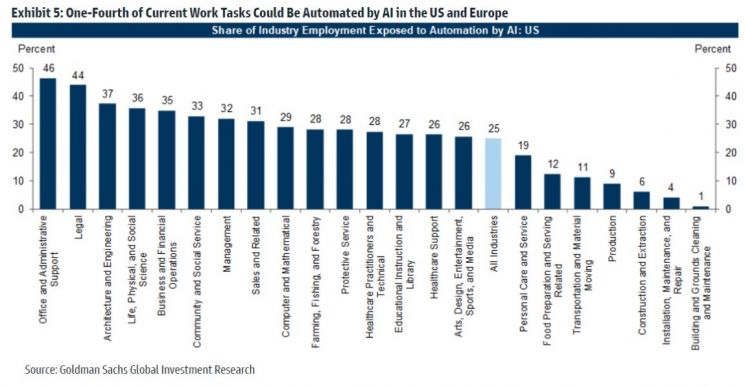
Looking at occupations, two-thirds of thousands of jobs in the U.S. and Eurozone are expected to be exposed to automation risk from AI. The amount of work that AI can replace is expected to range from at least 25% to more than half. In the U.S., it is estimated that 7% of the total workforce could have more than half of their tasks replaced by generative AI.
However, the report also suggested the possibility that since AI’s productivity is about half that of humans, workers might maintain their jobs by using the time saved from automation for other productive activities.
Goldman Sachs’ projections are conservative. OpenAI, the developer of ChatGPT, stated in a report released last week that 80% of the U.S. workforce could be replaced by AI. They predicted that the amount of work AI can perform will exceed at least 10% of human labor.
"Global GDP grows 7% annually" vs "AI poses great risk to civilization... Development must stop"
The report forecasted that alongside job restructuring caused by the advancement of generative AI, global GDP could grow at an average annual rate of 7% (approximately 7 trillion dollars per year) over the next decade.
In particular, if investment in AI increases at the same pace as software (SW) investment in the 1990s, it is expected to approach 1% of U.S. GDP by 2030. According to the U.S. Congressional Budget Office, the projected real potential growth rate of the U.S. is 1.8% for 2022?2032 and 1.6% for 2033?2042. If Goldman Sachs’ prediction is correct, the development of generative AI could raise the U.S. growth rate by nearly 3%.
In fact, AI investment is rapidly increasing. As of 2021, AI investments in the U.S. and worldwide were 53 billion dollars and 94 billion dollars respectively, about five times higher than five years earlier.
Goldman Sachs stated, "If this technology meets expectations (for growth rate increase), it will cause significant disruption in the labor market," adding, "It will expose 300 million full-time workers in major economic zones to automation risk, with lawyers and administrative and office workers particularly at high risk of layoffs."
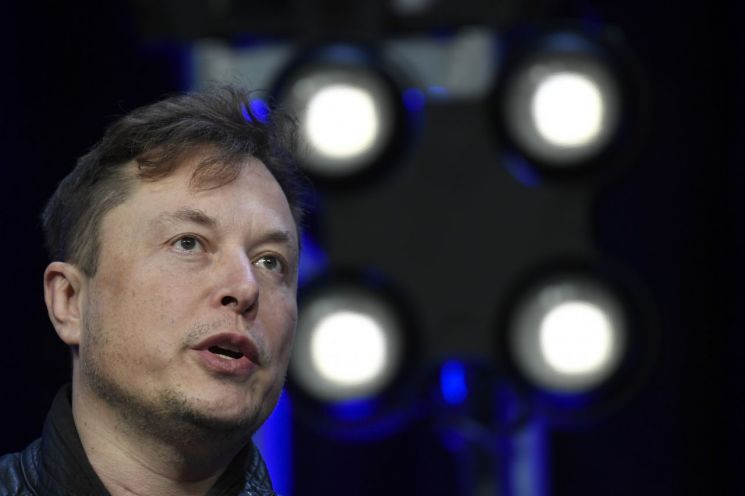
As AI advances, voices opposing technological development are also growing louder. Elon Musk, along with Apple co-founder Steve Wozniak and Yuval Harari, author of the global bestseller 'Sapiens,' joined a public petition campaign led by the U.S. nonprofit 'Future of Life Institute (FLI)' calling for a temporary halt to the development of cutting-edge AI systems. Musk, who co-founded OpenAI, has previously warned that "one of the great risks to the future of civilization is AI" and has urged regulation of AI.
© The Asia Business Daily(www.asiae.co.kr). All rights reserved.
!["The Woman Who Threw Herself into the Water Clutching a Stolen Dior Bag"...A Grotesque Success Story That Shakes the Korean Psyche [Slate]](https://cwcontent.asiae.co.kr/asiaresize/183/2026021902243444107_1771435474.jpg)


















