Detailed Plan for Space Development Promotion Working Committee to Be Finalized on the 31st
South Korea will invest 872.4 billion KRW in space development this year, marking a significant increase of 19.5% compared to the previous year.
On the morning of the 31st, the Ministry of Science and ICT held the 46th Space Development Promotion Working Committee meeting at the National Science and Technology Advisory Council conference room in Gwanghwamun, Seoul, where it finalized the 2023 Space Development Promotion Implementation Plan.
The government first confirmed the space development budget at 874.2 billion KRW, up 19.5% from last year's 731.6 billion KRW. By sector, space industry promotion, including the development of the Korean Positioning System (KPS) satellites, increased the most, rising by 192.9 billion KRW (49.1%) to 586.2 billion KRW. Space security and space science budgets also increased by 51.5% and 4.9% respectively, reaching 95.4 billion KRW and 34.4 billion KRW. However, due to the completion of the Nuri rocket launches and the Danuri lunar exploration project, budgets for space transportation (148.2 billion KRW) and space exploration (10 billion KRW) significantly decreased compared to the previous year.
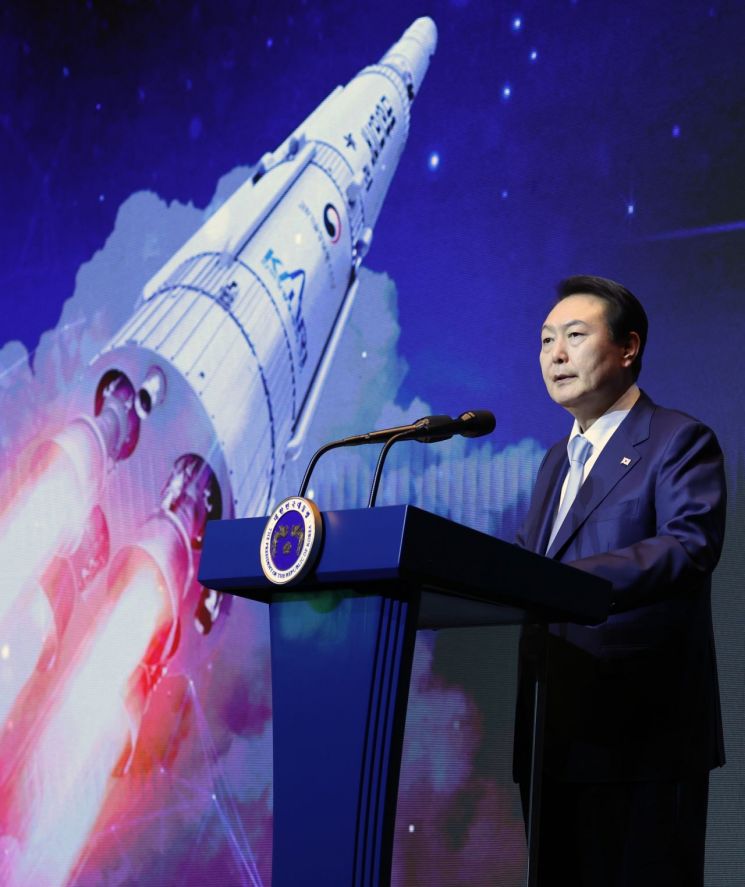
Specifically, in the space exploration sector, the lunar orbiter Danuri will carry out lunar exploration missions, and a preliminary feasibility study will be conducted for the development of a 1.8-ton class lunar lander aimed for a 2032 moon landing. Additionally, South Korea will strengthen cooperation with the United States by advancing the existing CLPS collaboration and expanding participation in international joint space exploration projects. The CLPS collaboration is a project jointly pursued by South Korea and the U.S. company Intuitive Machines. Equipment for monitoring the lunar space environment (LUSEM) is being developed for the lunar lander scheduled to launch in 2024, with production expected to be completed and shipped to the U.S. within this year. To develop future exploration technologies, preliminary research on lunar resource survey and extraction (2023?2027, 12.5 billion KRW) and future manned space base construction (2023?2025, 4.6 billion KRW) will be conducted. A specialized subcommittee for space exploration will be established under the National Space Committee to formulate strategies for the full-scale advancement of South Korea’s space exploration.
In the space transportation sector, the third launch of the Nuri rocket will mark the beginning of full-scale technology transfer to the private sector. Through public-private cooperation, a next-generation launch vehicle development project will be pursued over nine years starting this year with a budget of 2 trillion KRW to enter the global space launch market, alongside strengthened support for small launch vehicle development. Infrastructure improvements such as performance upgrades for the Naro Space Center (2023?2025, 47.6 billion KRW) and the construction of private small launch pads will also commence.
In the space industry sector, the plan is to actively create an initial market by expanding the development of public satellites such as microsatellites, geostationary public multi-purpose communication satellites, next-generation medium-sized satellites, and KPS. Furthermore, technology development and infrastructure will be established to improve the quality of satellite information utilization services in areas such as land, ocean, environment, weather, and agriculture and forestry. A total of 48.7 billion KRW will be invested in the national satellite integrated operation and calibration infrastructure advancement project (2023?2026). Support infrastructure for the space industry will be expanded through projects such as the space industry cluster support project (currently under preliminary feasibility study) and the establishment of a space-exclusive fund (5 billion KRW this year). To achieve component self-reliance, development of domestically produced device and component verification satellites (12 billion KRW by 2028) and expanded support for component testing and verification will be promoted.
In the space security sector, 1.4223 trillion KRW will be invested from November last year through 2030 in military reconnaissance satellites and microsatellite systems. The development of space assets for precise and continuous surveillance of the Korean Peninsula will be accelerated. Additionally, 1.5 billion KRW will be spent this year to develop technologies for monitoring and responding to space hazards such as solar activity and space debris. A total of 26 billion KRW will be invested by 2027 to establish a space hazard response system. Furthermore, 2.5 billion KRW will be allocated by 2027 for the construction and operation of space weather forecasting and warning systems. A project to provide proactive satellite information on heavy rain and typhoons using artificial intelligence technology will also begin.
Investment to revitalize space science will continue. South Korea will jointly develop a solar coronagraph (CODEX) for the International Space Station with NASA and will continue participating in the international joint construction project of the Giant Magellan Telescope (GMT), the next-generation extremely large optical observatory. As of the end of last year, the GMT construction progress rate was about 35%, with the Korea Astronomy and Space Science Institute holding a 12.9% stake. Planning research for the internationally led 'L4 satellite development' project, led by South Korea, will also commence. Additionally, multidisciplinary convergence research will be strengthened to solve challenging problems in space science, such as the origin of the universe and the search for extraterrestrial life phenomena.
By the end of this year, governance reforms for space development will be promoted, including the opening of the Space Aviation Agency, elevating the chairperson of the National Space Committee to presidential level, establishing subcommittees under the National Space Committee, and initiating the enactment of the 'Basic Space Act' considering increased space activities. To support the industry, efforts will be intensified to create a space industry ecosystem through the establishment of a 'roadmap for localization of space components and technologies,' planning projects exclusively for startup companies, and proactive regulatory responses.
© The Asia Business Daily(www.asiae.co.kr). All rights reserved.

















