Gangnam Severance Professor Lee Yong-je Team
Confirms Correlation Between Smoking and Metabolic Syndrome
A study has found that smoking is a major cause of increased risk for metabolic syndrome.

Yonsei University Gangnam Severance Hospital announced on the 30th that Professor Lee Yong-je and Lecturer Kim Ae-hee from the Department of Family Medicine conducted research on "The Impact of Smoking on the Development of Metabolic Syndrome."
The research team explained that compared to non-smokers, smokers have a higher risk of developing metabolic syndrome, and the risk progressively increases with the number of cigarettes smoked per day and the total lifetime smoking amount. Metabolic syndrome, characterized by the simultaneous presence of abdominal obesity, hypertension, hyperglycemia, and dyslipidemia, is a "latent disease" that increases the risk of cardiovascular disease and diabetes.
To understand the association and degree of risk between smoking and the development of metabolic syndrome, the research team conducted a long-term follow-up study over 12 years. Specifically, from 2001 to 2014, they investigated the risk of metabolic syndrome in 3,151 Korean men aged 40 to 69, subdividing them by daily smoking amount and lifetime smoking amount. Daily smoking amount was measured by the number of cigarettes smoked per day, and lifetime smoking amount was calculated in pack-years by multiplying the number of cigarettes smoked per day by the total years of smoking.
The study results showed that based on the number of cigarettes smoked per day, the risk of metabolic syndrome increased by 1.50 times for those smoking 0?9 cigarettes, 1.66 times for those smoking 10?19 cigarettes, and 1.75 times for those smoking 20 or more cigarettes. The risk for former smokers was similar to that of non-smokers.
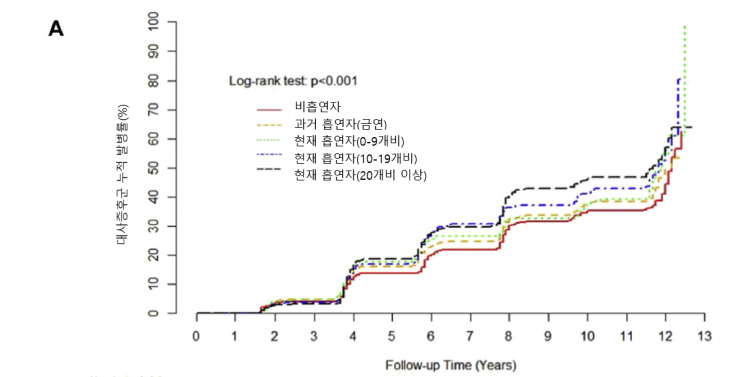 Difference in cumulative incidence of metabolic syndrome according to daily smoking amount.
 [Image provided by Gangnam Severance Hospital]
When considering lifetime smoking amount in pack-years, the risk ratio for former smokers did not differ significantly from that of smokers regardless of cumulative lifetime smoking. However, smokers with less than 20 pack-years had a 1.63 times higher risk, and those with 20 or more pack-years had a 1.67 times higher risk of metabolic syndrome. Smoking one pack daily for 20 years increases the risk of developing metabolic syndrome by about 1.7 times compared to non-smokers.
Professor Lee stated, "This study confirms that smoking, known as a risk factor for lung disease, cardiovascular disease, and various cancers, also increases the risk of developing metabolic syndrome." He explained, "Smoking can induce insulin resistance and chronic inflammation through direct and indirect pathways." He added, "Even if someone has a history of smoking, quitting smoking significantly reduces the risk to a level similar to that of non-smokers, so we strongly recommend smoking cessation."
This study was published under the title "The Impact of Smoking on the Development of Metabolic Syndrome" in the journal Endocrine Practice of the American Association of Clinical Endocrinologists.
 Professor Lee Yong-je (left) of the Department of Family Medicine at Gangnam Severance Hospital and Lecturer Kim Ae-hee.
 [Photo by Gangnam Severance Hospital]
© The Asia Business Daily(www.asiae.co.kr). All rights reserved.



















