Central America Tour... Via US
Friendly Stance for US Semiconductor Cooperation
Strong China Backlash Expected if Agreement Reached
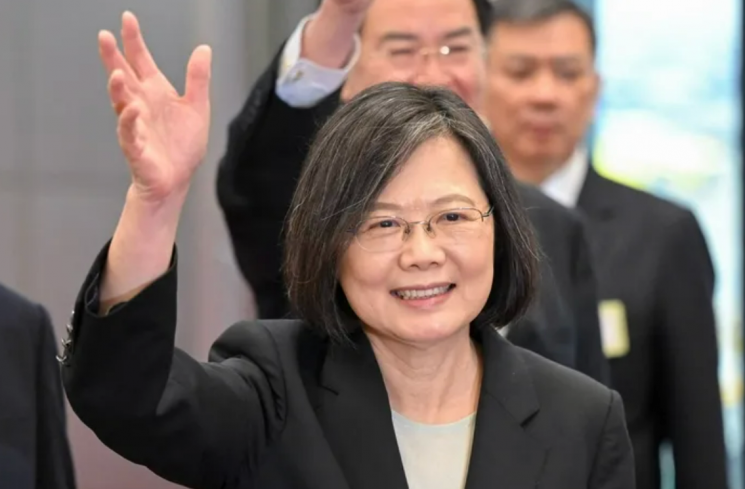 Taiwan President Tsai Ing-wen arrived at the boarding gate of Taoyuan International Airport on the 29th to visit Guatemala and Belize, Central American diplomatic allies, waving her hand.
 [Image source=AFP Yonhap News]
Taiwan President Tsai Ing-wen has embarked on a tour of two Central American countries via the United States, and during this U.S. visit, she is expected to demand negotiations on double taxation for Taiwan's semiconductor companies. The U.S. has not recognized Taiwan as a sovereign state capable of signing treaties, having agreed to the 'One China' principle with China. If a double taxation agreement is concluded between the two countries, a strong backlash from China is anticipated.
On the 29th (local time), Bloomberg reported that President Tsai Ing-wen will visit the U.S. during this trip to engage in double taxation negotiations between the two countries. President Tsai will visit Guatemala and Belize, both of which have diplomatic relations with Taiwan, over a 9-night, 10-day trip, and will stop by Los Angeles (LA) on her way home. In LA, she is expected to meet with U.S. House Speaker Kevin McCarthy.
Recently, Taiwan has been urging the U.S. government to provide tax benefits for its companies, as the U.S. is strengthening its semiconductor alliance with Taiwan to counter China. Currently, Taiwanese companies face an effective tax rate of 51% on profits earned in the U.S. In contrast, South Korean and Australian companies are subject to an effective tax rate of 40.5%, which is 10 percentage points lower than Taiwan's rate. Taiwan argues that the high effective tax rate due to double taxation issues hampers the expansion of corporate investment and potential growth.
The U.S. also desires cooperation from Taiwan in the semiconductor industry and is taking a favorable stance toward a double taxation agreement. U.S. Treasury Secretary Janet Yellen, attending a House Appropriations Subcommittee hearing that day, stated, "We recognize that the absence of a double taxation agreement with Taiwan is a significant issue," and added, "The Treasury and State Departments will find ways to resolve this."
China is viewing this situation with concern. Since the normalization of diplomatic relations with China, the U.S. cannot recognize Taiwan's sovereignty under the 'One China' principle. The 'One China' principle means that mainland China, Hong Kong, Macau, and Taiwan are inseparable, and there is only one legitimate government of China. Therefore, Taiwan, which does not possess sovereignty, cannot sign treaties with the U.S. Signing agreements between the two countries would mean the U.S. does not accept the 'One China' principle.
The U.S. is reportedly exploring various methods to pursue a tax agreement with Taiwan. Bloomberg explained, "When the U.S. and Taiwan enter into economic agreements, they avoid the appearance of diplomatic relations by using intermediary organizations that are somewhat detached from the government, such as Taiwan's American Institute in Taiwan and the American Institute in Taiwan's Taipei Economic and Cultural Representative Office (TECRO)."
A TECRO official told Bloomberg, "Taiwan hopes to start negotiations as soon as possible this week," adding, "This agreement will expand business opportunities for Taiwanese companies in the U.S. and benefit both countries."
© The Asia Business Daily(www.asiae.co.kr). All rights reserved.
![User Who Sold Erroneously Deposited Bitcoins to Repay Debt and Fund Entertainment... What Did the Supreme Court Decide in 2021? [Legal Issue Check]](https://cwcontent.asiae.co.kr/asiaresize/183/2026020910431234020_1770601391.png)















