Major Steel Companies Turn Profitable in Q4 Last Year
Global Steel Market Reacts to China's Economic Reopening
Favorable Global Exports and Product Prices
Passenger Numbers on Korea-China Routes Increase 36 Times Compared to Last Year
Shipping Freight Index Also Rises Significantly... 'Recession' Seems Unfounded
As Chinese construction workers who had been resting resumed work, South Korean steelmakers saw a significant increase in operating profits in the first quarter of this year. The company with the largest increase recorded nearly KRW 1.2 trillion in profit growth compared to the previous quarter. The Korean economy began to stir as China, which had been dormant due to the COVID-19 pandemic, stretched and started moving again.
Major domestic steelmakers, which posted losses of several hundred billion won in the fourth quarter of last year due to the global economic downturn and typhoon Hinnamnor's flood damage, are expected to turn to profits simultaneously in the first quarter of this year. POSCO Holdings, which recorded an operating loss of KRW 425.4 billion in Q4 last year, is looking at an operating profit of KRW 753.4 billion (according to FnGuide estimates) in Q1 this year. Hyundai Steel is also expected to recover from the previous quarter's operating loss of KRW 276 billion and record an operating profit of KRW 252.7 billion. Dongkuk Steel is also expected to post an operating profit of KRW 111.6 billion. The steel industry, which was shivering in the cold just three months ago, is heating up. In the case of POSCO, profits have increased by nearly KRW 1.2 trillion compared to Q4 last year.
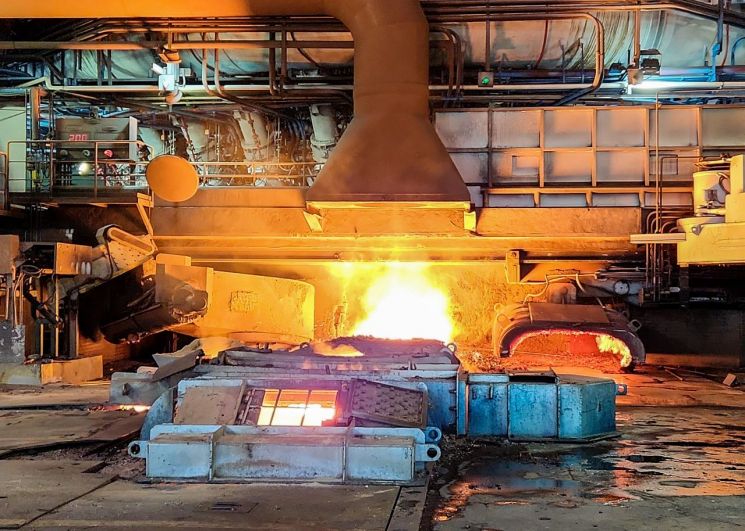 Molten iron is pouring out from the No. 2 blast furnace at Pohang Steelworks. The photo is not directly related to the article. Photo by POSCO
An executive at Hyundai Steel said, “We thought this year would be difficult due to the global economic recession, but the company normalized faster than expected thanks to the China reopening effect.” What boosted the performance of Korean steelmakers was China's government infrastructure investment. Chinese local governments plan to invest about CNY 2.8 trillion (approximately KRW 527.996 trillion) in major infrastructure projects this year. All across China is turning into a construction site. Construction sites are where steel products are most heavily used. For example, the skeleton of high-rise buildings consists of steel columns called H-beams. Simply put, Chinese construction sites are swallowing an enormous amount of steel blocks.
Interestingly, the improved performance of steelmakers is not because domestic steel was sold to China. Chinese steelmakers have drastically reduced exports as they are busy supplying domestic demand. Thanks to this, South Korean steel exports have increased. Additionally, prices have risen. In other words, Korean steelmakers' performance is soaring without directly supplying the Chinese infrastructure construction sites. Furthermore, Turkey, which suffered massive earthquake damage, and Ukraine, affected by war, are also likely to purchase steel materials on a large scale from this year for reconstruction work. As of last year, the export share of domestic steelmakers' sales was ▲POSCO 48.2%, ▲Hyundai Steel 13.4%, and ▲Dongkuk Steel 26.8%.
As China consumes a large amount of steel, prices of steelmaking raw materials such as scrap metal and coking coal are also fluctuating. Scrap metal prices rose from KRW 450,000 per ton in December last year to KRW 520,000 this month, and coking coal for steelmaking jumped from USD 245.25 per ton (approximately KRW 318,334) in November to USD 320 (approximately KRW 415,360). Although rising raw material prices might seem to hurt steelmakers, profits actually increase because raw material price hikes lead to steel product price increases. Industry insiders expect the steel industry to enjoy an 'unexpected boom' amid the overall recession this year.
Moreover, this boom is expected to exceed forecasts in scale. For example, securities firms have begun to predict that POSCO's performance will improve as the year progresses, setting a record high in sales this year. POSCO's expected sales this year are KRW 85.9777 trillion, with operating profit reaching KRW 5.1216 trillion. Hyundai Steel's estimated sales for this year are KRW 27.1624 trillion, with an expected operating profit of KRW 1.389 trillion.
For a while, there were talks that the China reopening effect would not be significant. The basis was that China's economic growth rate is not as strong as before. However, China accounted for 22.8% of South Korea's exports (as of last year). The import share from China is also in the 20% range. China's share in the Korean economy is substantial. The China reopening effect is bound to be significant.
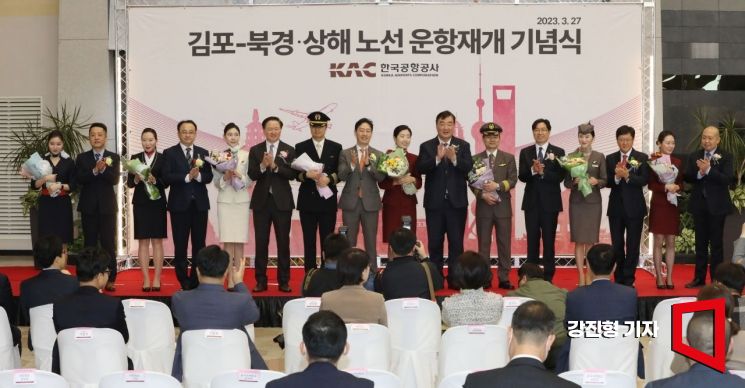 The Gimpo-Beijing and Gimpo-Shanghai flight routes, which had been suspended due to COVID-19, have fully resumed operations after three years. On the afternoon of the 27th, at a ceremony held at Seoul Gimpo Airport attended by Yoon Hyung-jung, President of Korea Airports Corporation, Xing Haiming, Chinese Ambassador to Korea, and others, bouquets were presented to the airline captains and crew members, followed by a commemorative photo. Photo by Kang Jin-hyung aymsdream@
For example, from the 26th to the 28th, when the number of air route users between Korea and China began to increase in earnest, a total of 23,713 travelers traveled between Korea and China. This is a 3,622.6% increase compared to 637 travelers from March 27 to 29 last year. Although it seems to be increasing exponentially, this number will continue to rise. During the same period in 2019, before COVID-19, the number of travelers was 101,393. The Korean and Chinese economies grew even during the COVID-19 period.
The Baltic Dry Index (BDI), a leading indicator of the global economy, is also affected by the reopening. The BDI, announced by the Baltic Exchange, fell to 538 on the 17th of last month but rose to 1,587 on the 14th of this month, the highest this year. Although the index recently dropped to 1,402 on the 28th, it still remains above the 1,400 level. The BDI indicates the market conditions of bulk carriers that transport raw materials such as steel, coal, and grains. Since it mainly carries raw materials, it is used as a leading indicator to gauge economic trends. Won Chae-woon, a researcher at Korea Investment & Securities, said, “The China reopening effect is just beginning,” adding, “The BDI will trend upward until the peak season in autumn this year.”
© The Asia Business Daily(www.asiae.co.kr). All rights reserved.


















