10 Days After Apple Pay Launch, Few Usage Locations and Persistent Errors
15% Market Share in Next Year's Mobile Payment Market Seems Difficult
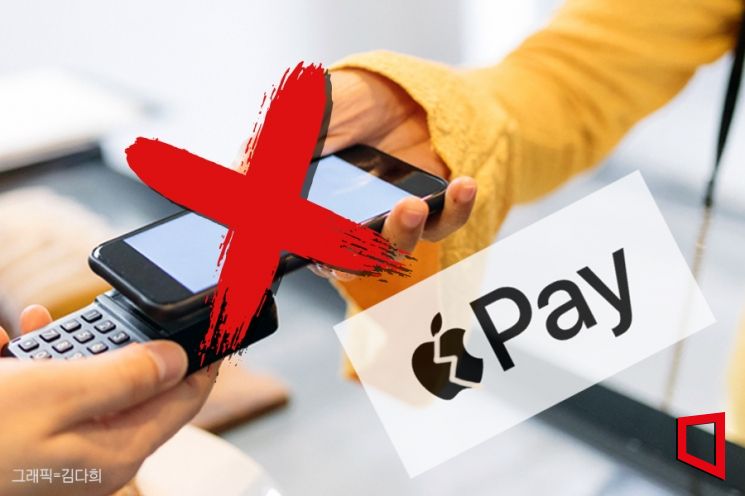
"Where exactly can Apple Pay be used?"
It has been 10 days since Apple Pay landed in Korea. Although it attracted attention by surpassing 1 million card registrations on the first day of launch, it appears that Apple Pay is still insufficient to penetrate the daily lives of Koreans. The number of near-field communication (NFC) terminals is minimal, resulting in few stores where payments are possible, and even in places where it can be used, payment errors occur. It seems unlikely that Apple Pay will easily surpass the dominance of Samsung Pay, which has captured the domestic simple payment market.
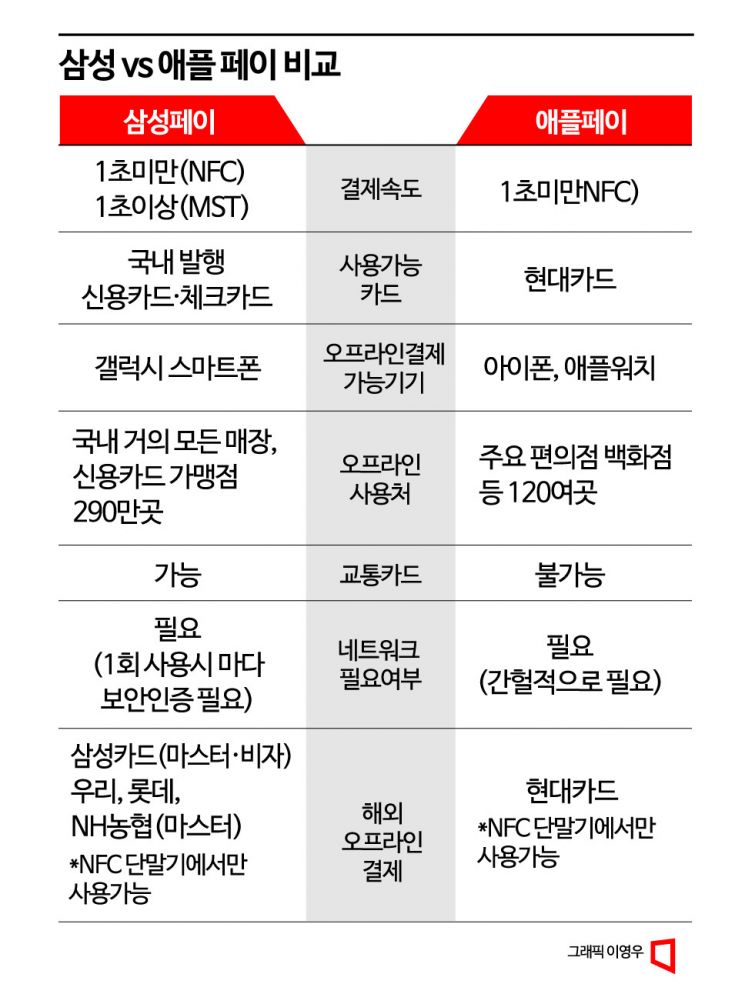
Samsung Pay VS Apple Pay Comparison
Let's compare the functions of Samsung Pay and Apple Pay. As of the 30th, places where Apple Pay can be used are limited to about 120 locations including Lotte Group's retail and food & beverage brands, Hyundai Department Store Group's retail brands, SPC brands, convenience stores, GS Caltex (fuel), Kyobo, Youngpoong Bookstore, etc. Most small restaurants and general merchants that are not large corporations cannot use Apple Pay. Shinsegae Group's retail and food & beverage brands such as Starbucks and E-Mart also do not support Apple Pay services. There is no transportation card function either. This is why it is called a 'half-pay.' On the other hand, Samsung Pay is available at most of the 2.9 million domestic credit card merchant locations. Samsung Pay users can also make simple payments at 550,000 online stores such as Naver. It also has a transportation card function.
Apple Pay payments are made through EMV contactless (NFC) terminals. EMV is a near-field communication (NFC) payment method created by card companies such as Visa, Mastercard, and EuroPay, mainly used overseas. Samsung Pay supports both NFC methods including EMV contactless and Magnetic Secure Transmission (MST) payment methods. The payment speed is less than one second for NFC methods. MST speed is about 1 to 2 seconds. Regarding usable cards, Samsung Pay can use most domestic issued credit and debit cards, whereas Apple Pay only supports Hyundai Card. Samsung Pay also includes mobile student ID, mobile driver's license verification service, mobile OTP (one-time password) authentication service, and UWB (ultra-wideband)-based 'digital home key' service.
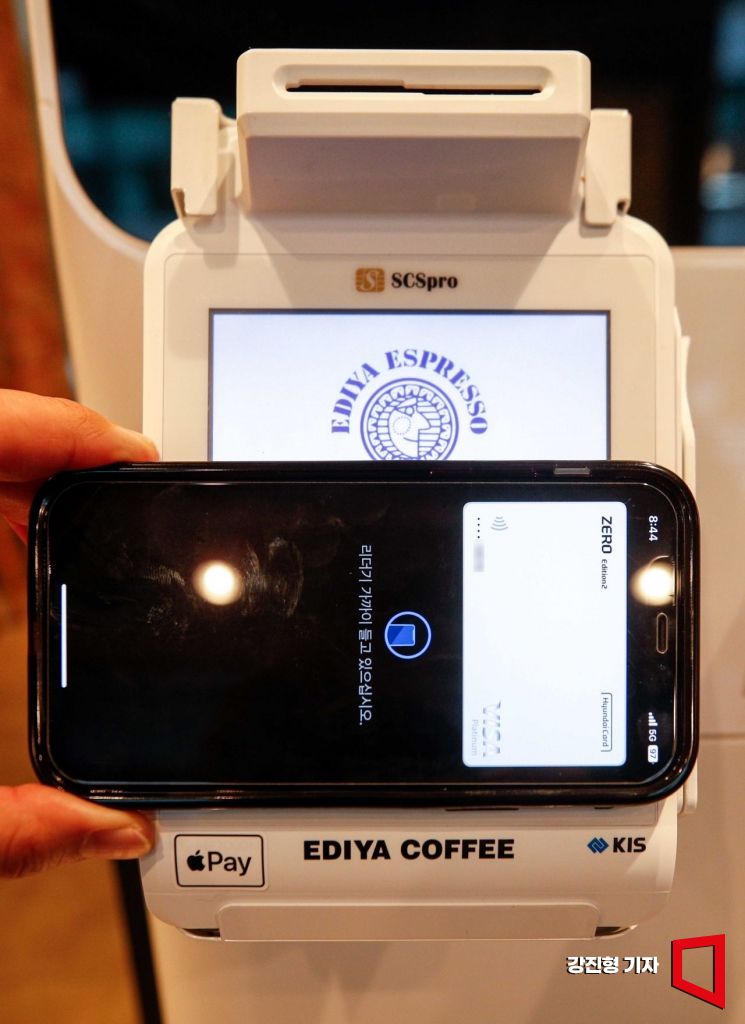 On the 23rd, a customer is making a payment using Apple Pay at a coffee shop in Seoul. Photo by Jinhyung Kang aymsdream@
Growing Simple Payment Market, Apple Pay's Presence
According to the status of simple payment and simple remittance service usage announced by the Bank of Korea, the daily average amount used for simple payment services last year was 732.6 billion KRW, an increase of 20.8% compared to the previous year. Compared to 2019 before the COVID-19 outbreak, it has more than doubled in three years. Among providers, the fastest-growing sector is mobile phone manufacturers. The usage performance of mobile phone manufacturers increased by 34.7% to 185.3 billion KRW, accounting for 25% of the total. Mobile phone manufacturers include Samsung Pay and LG Pay. Samsung Pay, first introduced in 2015, surpassed a cumulative payment amount of 2 trillion KRW within one year of launch and has grown 1.5 times annually since. The cumulative amount of Samsung Pay usage reached 219 trillion KRW as of the end of February this year. Electronic financial companies such as Naver and Kakao Pay increased usage by 16.5%, and financial companies by 17.1% compared to the previous year.
Market research firm Counterpoint Research predicted that Apple Pay will secure a 15% market share in the simple payment market next year. However, the industry expects Apple Pay's market share in Korea to grow slowly. As of the fourth quarter of last year, Samsung Electronics' domestic smartphone market share reached 63%, and due to installation cost issues, the spread of NFC terminals is expected to be difficult in the short term. Hana Financial Research Institute forecasted, "Although the number of partner card companies is expected to expand after the exclusive partnership with Hyundai Card ends, the profitability of card companies will not be significant due to Apple's additional fee demands."
Excessive Fee Rates Ultimately Passed to Consumers
Concerns have also been raised that Apple Pay's excessive fee business will ultimately lead to consumer burdens. The Apple Pay fee Hyundai Card pays to Apple is 0.15% per transaction, the highest among countries that have introduced Apple Pay. The fee rate Korean card companies must bear is five times that of China. If Apple Pay captures 15% of the simple payment market as market research institutions predict, card companies will have to pay Apple more than 10 billion KRW in fees daily. In the U.S., more than 4,000 partner banks using Apple Pay pay at least 1 billion USD (about 1.3 trillion KRW) annually in fees, causing controversy. Meanwhile, Samsung Pay, with over 16 million active users domestically, does not charge fees for offline merchant simple payments.
From a long-term perspective, fee burdens may be passed on to consumers. Card companies are already running deficits in credit sales due to excessive competition such as lowering merchant fees. If other simple payment service providers also start demanding fees, card companies are likely to reduce consumer benefits to maintain profitability. The Financial Services Commission also urged credit card companies related to Apple Pay, "Costs such as fees related to Apple Pay should not be borne by customers or merchants." Some argue that Apple is free-riding on a market that domestic companies have cultivated for 10 years without any investment for the Korean market.
© The Asia Business Daily(www.asiae.co.kr). All rights reserved.



















