"New Drug Sales to Account for 40% by 2030"
"Merger of 3 Companies to Complete Within 4 Months if Financial Market Stabilizes"
Active Consideration of Mergers and Acquisitions... "Funds of 4-5 Trillion Available"
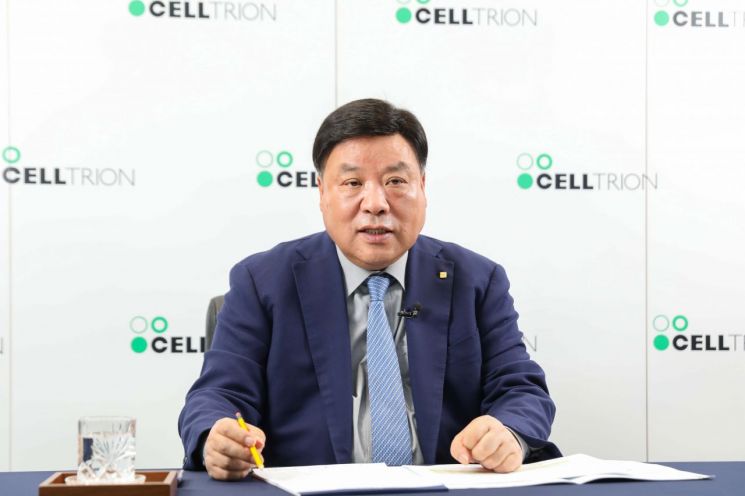 Seo Jung-jin, Chairman of Celltrion Group, is speaking at an online press conference held on the morning of the 29th. [Photo by Celltrion]
"By 2030, we aim to increase the sales proportion of original new drugs to 40%, becoming a leader in biosimilars while also competing shoulder to shoulder with multinational companies as a new drug developer."
Seo Jung-jin, Chairman of the Celltrion Group, who has returned to the front lines of management, presented his future plans including this statement during an online press conference on the morning of the 29th. Seo emphasized that now that he has returned, he will firmly establish the foundations in key areas such as ▲new drug development ▲merger of the group's three companies ▲digital healthcare ▲direct sales network establishment ▲mergers and acquisitions (M&A), before returning to a private life.
He said, "I will change the company's scale to become a ship that does not shake even in rough waves and then leave," adding, "While I am here, I will set the big picture of product strategy. Sales will probably grow by 25% this year, but next year will see an innovative and significant increase. The telemedicine platform will be nearly completed, the direct sales network will be solidified, the merger of the three companies will be finalized, and M&A will be activated to produce results." Through this, he expressed his ambition to "focus on our company and do our best to become a global pharmaceutical healthcare company."
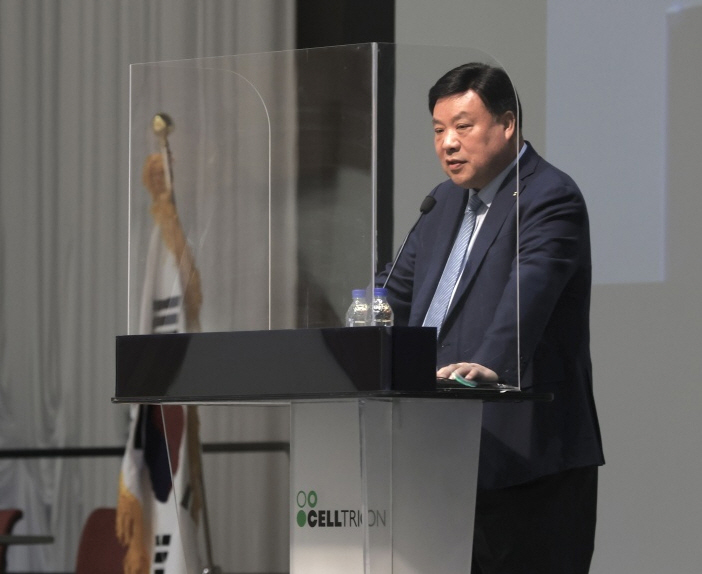 Seo Jung-jin, Chairman of the Celltrion Group, is speaking at the Celltrion shareholders' meeting held on the 28th.
 [Photo by Celltrion]
Seo, who stepped down from the front lines of management in March 2021 to become honorary chairman, returned to the chairman position after being unanimously appointed as an inside director at the shareholders' meetings of the three Celltrion Group companies?Celltrion, Celltrion Healthcare, and Celltrion Pharm?held the day before. At the subsequent board meeting, Seo Jin-seok, his eldest son, was appointed chairman of Celltrion and Celltrion Pharm, and Seo Jun-seok, his second son, was appointed co-chairman of Celltrion Healthcare.
Seo, whose voice was hoarse after a long Q&A session with shareholders protesting the stock price decline at the previous day's shareholders' meeting, explained the reason for his return: "The global economy is uncertain, and I believe this uncertainty will not end this year but will continue into next year." Since he had promised to return as a 'firefighter' if there were rapid changes in the environment surrounding the group when he stepped down, concerns about worsening management due to the recent global economic downturn increased, leading to strong demands for his return. However, regarding measures to raise the stock price demanded by shareholders, he drew a line, saying, "Stock prices are driven by performance and cannot be artificially raised," and added, "We will become a company that builds trust with shareholders by explaining in detail what the company is doing and working together toward common goals."
Regarding new drug development, he said, "We will primarily strengthen the pipeline to balance biosimilars and original new drugs and adapt to changes," explaining that next year they will initiate clinical trials for six bispecific antibody new drugs and ten anticancer new drugs. About 'Remsima SC,' the most advanced new drug currently under development, he said, "It will be approved as a new drug in the U.S. by October," and "We expect to complete the pricing registration process within the year."
He also emphasized building a platform to advance as a full-fledged new drug development company. Seo said, "We will secure a messenger RNA (mRNA) platform by June this year," and additionally acquire platforms for antibody-drug conjugates (ADC), bispecific antibodies, and oral antibody drugs, aiming to launch six products through these platforms starting next year.
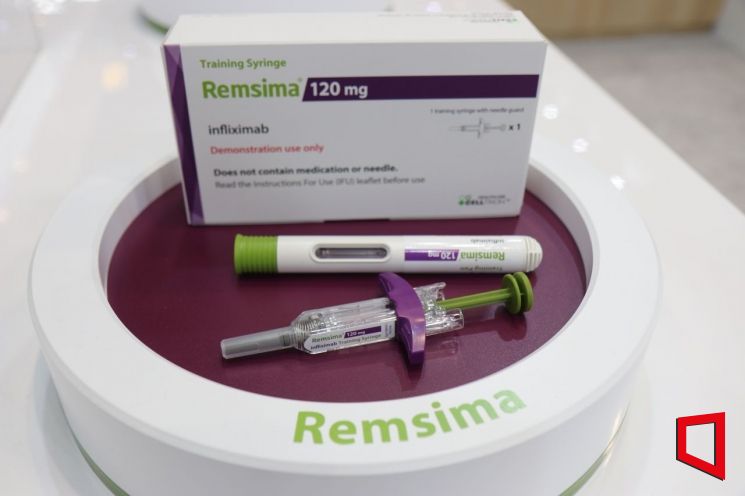
He also stated that biosimilars will continue to be developed and approved. By 2030, they plan to build 21 pipelines and expect to receive approval or start sales for about six new products within the year. In particular, regarding 'CT-P42,' a biosimilar of Aflibercept (marketed as Eylea) under development, Seo mentioned the possibility of R&D comparable to a new drug that surpasses the original, similar to Remsima SC. He said, "We are currently negotiating to resolve patent issues," and added, "Since the drug is injected directly into the eye, many patients find it difficult and painful, so we plan to develop it as a biobetter like Remsima SC."
As he had personally instructed European medical staff to develop Remsima SC from an intravenous (IV) formulation to a subcutaneous (SC) formulation, Seo also emphasized the importance of on-site management. He explained, "The most important thing is on-site management, and management is not about control. Management involves setting strategies, making decisions, designing, and integrating them on-site. Therefore, when there is uncertainty, it is important for the head of the group to be on-site."
Regarding the highly anticipated merger of the three companies, he said, "Preparations are almost complete," adding, "The key is financial market stability." He stated, "If the financial market stabilizes and it is deemed appropriate to proceed with the merger, we will present milestones and complete the merger within four months."
On digital healthcare, Seo explained that the ultimate goal is 'telemedicine,' and that Chairman Seo Jin-seok has completed basic research based on artificial intelligence (AI). "We will expand personnel and establish a separate research institute within the merged company," he said. Seo identified the three pillars of digital healthcare as data integration, diagnostic equipment capable of home testing, and AI-based healthcare. He acknowledged that "there are many legal amendments required, so it will take time," but added, "We will continue to invest actively and keep pace without falling behind."
Regarding the establishment of a direct sales network, he said, "We have built direct sales networks worldwide, including in the U.S. and Canada," and explained, "We are preparing for Celltrion's direct sales corporation in the U.S. to achieve sales exceeding 3 trillion won within two years to maximize effectiveness." He also revealed plans to extend development and sales to quasi-drugs based on this sales network.
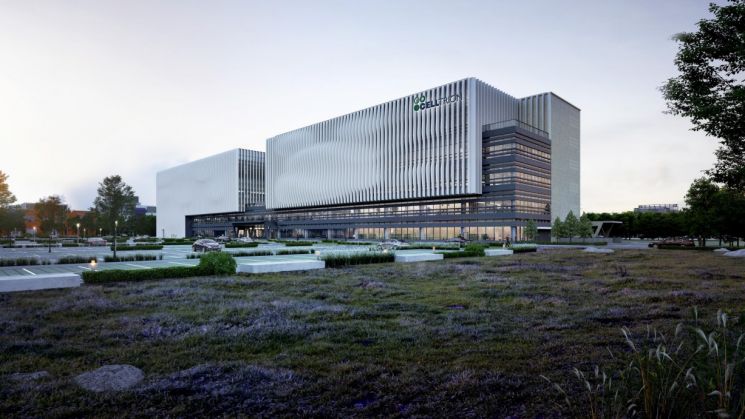
Regarding the recent introduction of protectionist measures on biopharmaceuticals by the U.S. administration following semiconductors, Seo mentioned that they could actively utilize this to build a fourth plant in the U.S. He said, "Originally, we planned to build the fourth plant in China, but if necessary, half could be built in the U.S. and half in Korea," adding, "The U.S. government will provide specific directions within this year, and once details such as the best location and incentives are announced, we will finalize plans." On the China market, which has been dormant due to the COVID-19 pandemic, he added, "We will first complete the U.S. business and then enter China step by step."
Seo, who repeatedly emphasized that "a crisis situation is also an opportunity," expressed his determination to actively pursue mergers and acquisitions (M&A) with 4 to 5 trillion won in funds raised through surplus cash and personal contributions. He said, "We are observing several companies mainly in upstream and downstream businesses that have synergy with our existing business, and after the first half of this year, the list will be narrowed down to about ten companies," adding, "We expect to start deploying funds from the third quarter." However, he also stressed that these efforts will not lead to overexpansion of management.
© The Asia Business Daily(www.asiae.co.kr). All rights reserved.



















