Japan Strengthens Historical Distortion in Elementary Textbooks
"Dokdo Is Japan's Inherent Territory" Unfounded Claim
Korean Government: "Proper Historical Awareness Must Be Established"
The South Korean government expressed deep regret over Japan's approval of an elementary school textbook containing claims such as "Dokdo is Japan's inherent territory." In response, Japanese netizens reacted by accusing South Korea of "interfering in domestic affairs."
Government expresses "deep regret" over Japan's textbook approval
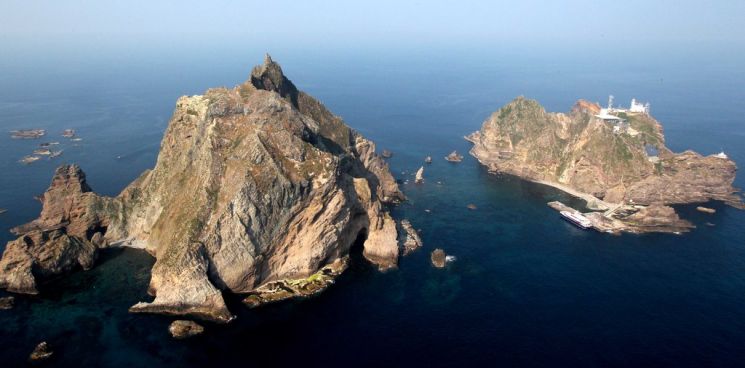
On the 28th, the government issued a statement through the Ministry of Foreign Affairs spokesperson, saying, "We express deep regret over Japan's approval of an elementary school textbook that follows the unreasonable claims that have continued for decades."
It added, "For the constructive and future-oriented relationship between South Korea and Japan, a correct historical awareness among the generation that will carry the future must be the foundation."
Earlier, Japan's Ministry of Education, Culture, Sports, Science and Technology held a textbook screening committee meeting and announced that 149 types of textbooks to be used in elementary schools from 2024 had passed the review.
Among these, a total of 11 textbooks, including 9 social studies textbooks for grades 4 to 6 and 2 geography textbooks, contained descriptions referring to Dokdo as Japan's territory "Takeshima (竹島)." Previously, some elementary school textbooks mixed the terms "Japanese territory" and "Japan's inherent territory" for Dokdo, but this time the description was unified as "Japan's inherent territory."
Regarding Japan's forced labor, the textbook expressions also changed. In 12 social studies textbooks for grades 3 to 6 and 2 geography textbooks used by grades 3 to 6, the term "voluntary" was added to the conscription-related content, weakening the sense of coercion. This could instill the perception that many Koreans voluntarily joined the Japanese military during the Japanese colonial period.
Japanese netizens: "Isn't this interference in domestic affairs?"
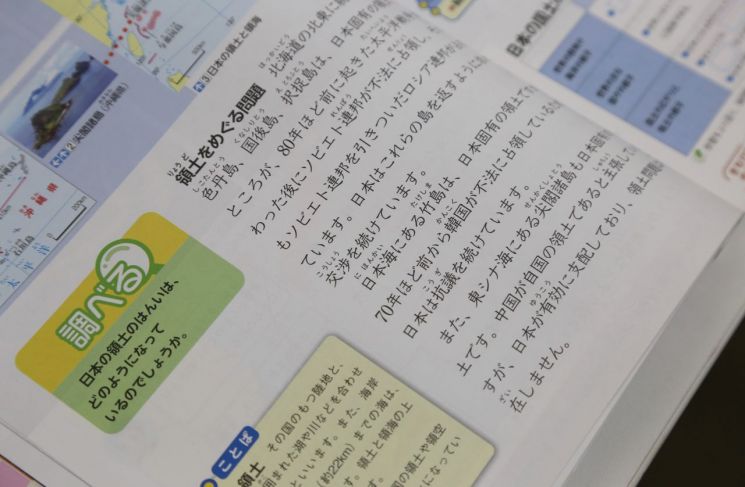 The photo shows a 5th-grade social studies textbook from Tokyo Shoseki that includes the phrase "for about 70 years" in the content stating that Korea has illegally occupied Dokdo.
 [Image source=Yonhap News]
As news spread that the South Korean government protested Japan's historical distortion in textbooks, Japanese netizens showed cynical reactions.
A Jiji Press article posted on Japan's largest portal site Yahoo Japan received over 1,000 comments.
One Japanese netizen commented, "While I understand the protest, it is interference in domestic affairs. What content to include in textbooks is the sovereign right of that country," adding, "It would be best to express the intention not to accept interference and leave (South Korea's backlash) alone." This comment received over 9,000 'likes,' gaining the most sympathy.
Another netizen said, "Is reconciliation with this country (South Korea) impossible after all? There is no country that denies Japan as much as this one," and argued, "Japan should deepen relations with countries that want to maintain friendly ties with us."
Other reactions included, "Japan should properly protest as well," "We should not ignore or overlook the South Korean government's claims," and "Takeshima is Japan's inherent territory."
Marine policy expert Professor Yoshihiko Yamada of Tokai University in Japan commented in the thread, "The Japanese government needs to continue informing its people that Takeshima is Japanese territory and that this territory is being invaded," adding, "South Korea thoroughly educates its people as if Dokdo is its own territory, so Japan must strongly protest such actions. Even if it is a small island issue, the surrounding sea is vast and can bring many benefits."
Meanwhile, although the leaders of South Korea and Japan recently declared the resumption of shuttle diplomacy (alternating visits) after 12 years, the overt historical distortion issue is expected to negatively affect future improvements in South Korea-Japan relations.
© The Asia Business Daily(www.asiae.co.kr). All rights reserved.


















