Measures to Revitalize Domestic Demand 'Plans to Reduce Housing Burden'
Resolve DSR Regulation Issues for Residential Officetels
Financial Support for Jeonse Fraud Victims in Auction and Public Sale
Indicate Registration Status in Real Transaction Price Disclosure System
The government has decided to improve the calculation method of the total debt service ratio (DSR) for residential officetels, which is currently less favorable compared to general housing, in early May. This improvement will reflect the actual agreed loan maturity when calculating the DSR for secured loans. Along with this, support for victims of jeonse fraud tied to auction and public sale will proceed as planned from April.
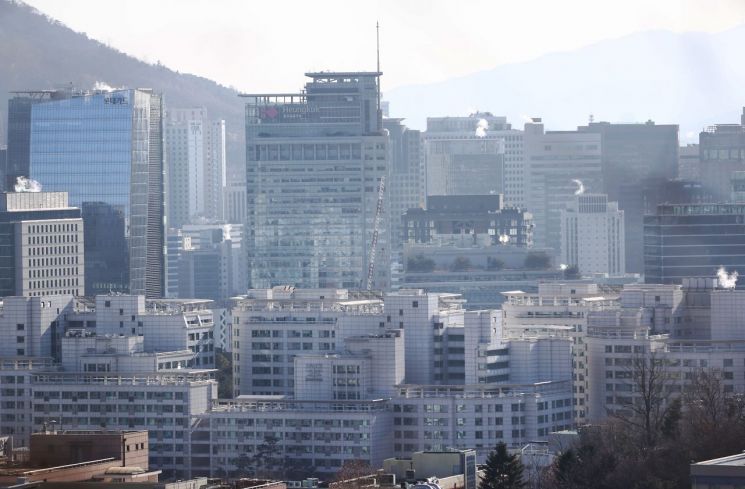
On the 29th, at the Emergency Economic and Livelihood Meeting presided over by President Yoon Seok-yeol, the government announced these measures as part of its domestic demand revitalization plan to reduce housing burdens.
Currently, residential officetels are classified as non-residential under the Housing Act. As a result, the loan maturity is uniformly fixed at 8 years, making the DSR calculation less favorable compared to apartments of the same price. For example, if a person with an annual income of 50 million KRW borrows 100 million KRW at an annual interest rate of 5% to purchase a 200 million KRW officetel, the DSR applied is 30.4%. In contrast, under the same conditions, an apartment loan maturity is 30 years, resulting in a DSR of 12.8%.
Therefore, the government plans to improve the DSR calculation for residential officetels by applying an 8-year maturity for lump-sum repayment loans but reflecting the actual agreed maturity for installment loans. Additionally, the government intends to structurally block the tax burden issue arising from counting officetels confirmed for residential use as part of the housing count by reforming the heavy taxation system. Capital gains tax will fundamentally change the heavy taxation on multiple homeowners in regulated areas, which is currently temporarily deferred, and acquisition tax will be promptly revised through legislation on the heavy taxation reform plan.
Regarding support for victims of jeonse fraud, from April, for tenants affected by ongoing auction and public sales, the government will prioritize protecting the deposit over the current year's taxes that occurred after the deposit. The current year's taxes refer to taxes (such as comprehensive real estate tax) imposed on real estate under forced execution related to property.
For victims who inevitably have to move after the start of auction or public sale, they will be able to receive new emergency low-interest jeonse loans. Even before the auction or public sale ends, if the deposit damage becomes apparent, it is possible to receive a 'Conditional Confirmation of Jeonse Damage' in advance. The previously announced refinancing loans will be launched starting with Woori Bank, centered on guarantees from the Korea Housing Finance Corporation (HF).
Victims who face credit crises due to incomplete recovery of jeonse deposits and unpaid jeonse loans will also be assisted. When residual debt occurs, jeonse loan guarantee institutions such as the Housing and Urban Guarantee Corporation (HUG) will make subrogation payments to financial institutions and then collect repayments in installments. If repayment is delayed, the government will promote a grace period for registering delinquency information on unpaid jeonse-related loans.
Loan requirements for guaranteed monthly rent loans (such as area criteria) will also be relaxed for vulnerable groups including low-income households, youth, and newlyweds. Furthermore, for 1,065,000 rental housing units of the Korea Land and Housing Corporation (LH) that are renewed from January this year to December next year, rent will be frozen.
The government will also strengthen efforts to prevent market disruption and expand public rental housing. To prevent false reports aimed at manipulating market prices, the government plans to include registration status confirming the completion of sales in the real transaction price disclosure system in the future. To prevent the spread of damage to actual buyers, a focused investigation on abnormal high and low direct apartment transactions nationwide will be conducted, with interim results announced in June. In the first half of the year, 23,000 public rental housing units of the Korea Land and Housing Corporation (LH), both construction and acquisition types, will recruit tenants.
© The Asia Business Daily(www.asiae.co.kr). All rights reserved.
![Clutching a Stolen Dior Bag, Saying "I Hate Being Poor but Real"... The Grotesque Con of a "Human Knockoff" [Slate]](https://cwcontent.asiae.co.kr/asiaresize/183/2026021902243444107_1771435474.jpg)
















