"Should Have Urged Japan's Sovereignty Claim on Dokdo"
Textbook Describing Dokdo as "Japanese Territory" Passed
Recently, some right-wing media outlets have pointed out that Japanese Prime Minister Fumio Kishida did not mention the Takeshima (Dokdo) issue to President Yoon Suk-yeol during the recent Korea-Japan summit. Criticism has arisen that he did not take a more assertive stance on territorial claims, leading to an expanding controversy both inside and outside Japan.
In this context, the Japanese Ministry of Education, Culture, Sports, Science and Technology (MEXT) approved content in textbooks to be used by students starting April next year that describes Dokdo as Japan's inherent territory. This has led to interpretations that the Japanese government is conscious of the territorial claim controversies raised by right-wing media ahead of elections.
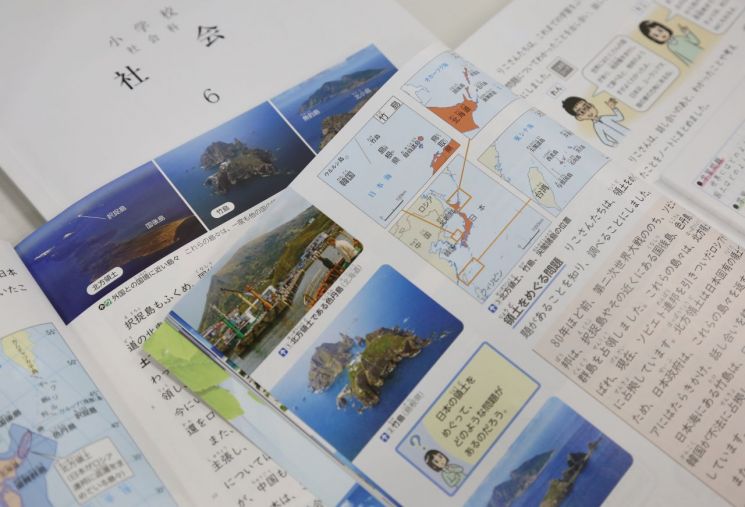
On the 29th, the Sankei Shimbun published an editorial titled "The Dokdo Issue Was Overlooked (Without Mention) at the Korea-Japan Summit." The editorial stated, "The Korea-Japan summit has spread a thawing atmosphere between the two countries, which was called the worst since the postwar period. However, Prime Minister Kishida did not individually mention the Dokdo issue, where Korea's illegal occupation continues," and added, "If he cannot reach an agreement even with President Yoon, who is eager to improve relations with Japan, the prime minister's sincerity is also in doubt."
It continued, "Prime Minister Kishida individually mentioned issues such as the implementation of the 2015 comfort women agreement and the lifting of import restrictions on Fukushima seafood during the summit," and criticized, "Compared to the Dokdo issue, which was lumped together with various other issues, isn't there a difference in treatment?"
The editorial also expressed that the Japanese government has continuously postponed resolving the territorial issue and described Korea as "occupying" Dokdo. Sankei claimed, "Because the Korea-Japan Fisheries Agreement signed in 1998 deferred the issue of Korea's (Dokdo) occupation, the Japanese side has been unable to crack down on illegal fishing by Korean vessels, causing significant damage to Japanese fishermen."
Sankei quoted a senior official from the Cabinet Office, saying, "If Korea's control over Dokdo is taken as a fait accompli, this issue cannot be ignored in building a genuine trust relationship," and raised its voice, "After the forced labor issue, the next is the Dokdo issue. We must strongly appeal (our territorial claims) within the progressive Yoon administration aiming to improve Korea-Japan relations."
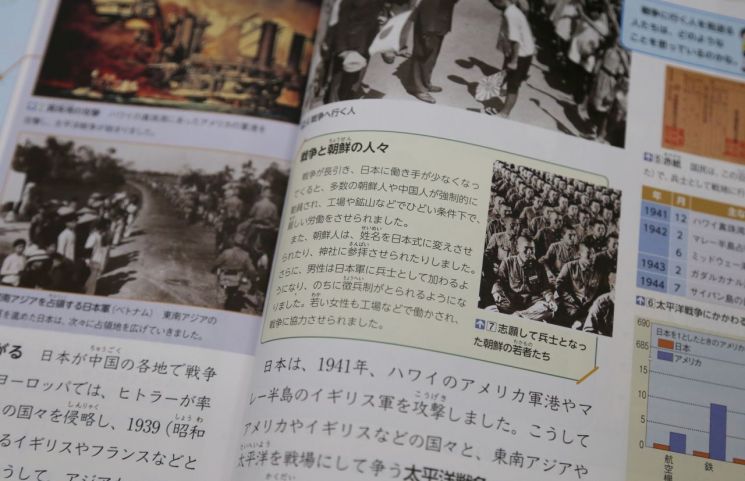
The Japanese government is also reportedly highly aware of these criticisms from right-wing media ahead of the April local elections and by-elections. Recently, during textbook screening by MEXT, the number of textbooks describing Dokdo as Japan's inherent territory has significantly increased.
The Sankei Shimbun emphasized, "The proportion of textbooks reflecting the government's views has noticeably increased," and stated, "MEXT has explicitly instructed in this elementary school textbook guidance policy for the first time in five years to mention that the Senkaku Islands (Chinese name Diaoyu Islands) and Dokdo are Japan's inherent territories." According to MEXT, inherent territory means "territory that has never been part of another country."
Additionally, among sixth-grade social studies textbooks, one initially described the Northern Territories and Takeshima as "Japanese territory" during the application stage. However, the textbook review committee attached a review comment stating "there is a possibility of misunderstanding by children," and subsequently, that part was revised to "Japan's inherent territory," passing MEXT's final screening. An anonymous textbook editor said, "Since the government view has been decided (that way), we have no choice but to write accordingly."
© The Asia Business Daily(www.asiae.co.kr). All rights reserved.


















